
Vyberte si konkrétne v ktorom jazyku si chcete prečítať novinku : ENG,DE,FR,RU,ES,SK
Выберите, на каком языке вы хотите прочитать новость:ENG,DE,FR,RU,ES,SK
Select the specific language in which you would like to read the news: ENG,DE,FR,RU,ES,SK
Wählen Sie die konkrete Sprache, in der Sie die Neuigkeit lesen möchten :ENG,DE,FR,RU,ES,SK
SK>
EN>
DE>
FR>
ES>
RU>
Komplexná vedecko-technická analýza satelitného distribučného reťazca pre digitálne terestriálne televízne vysielanie (DTT) v Cyperskej republike.
1. Abstrakt a úvod
2. Kontextualizácia: Digitálna televízia na Cypre – historický vývoj
3. Hellas Sat 3/4 – technická charakteristika satelitu na 39,0°E
4. Štandard DVB-T2: Architektonické a modulačné princípy
5. T2-MI (T2 Modulator Interface) – normatívna definícia a technická podstata
6. Physical Layer Pipe (PLP) – princíp a klasifikácia
7. Satelitné T2-MI vysielanie na Cypre: Parametre frekvencie f1 = 11 761 MHz H
8. Satelitné T2-MI vysielanie na Cypre: Parametre frekvencie f2 = 11 778 MHz H
9. DVB-S2 vrstva: Modulačné a kódovacie parametre prenosového reťazca
10. Multistream (MIS) a Gold/Root PLS kódy – technická analýza
11. Architektúra distribučného reťazca: Od produkčného štúdia k DVB-T2 vysielaču
12. Sieť SFN (Single Frequency Network) na Cypre – topológia a výhody
13. Obsah multiplexov: Kanálová štruktúra a kodeky
14. Cyperské DTT pokrytie, počet divákov a sociálno-technologický kontext
15. Príjem T2-MI signálu v Európe: Technické požiadavky na zariadenia
16. Porovnanie T2-MI/Satelit vs. tradičného IP/Fiber distribučného riešenia
17. Regulačný a licenčný rámec – Hellas Sat ako prevádzkovateľ DTT na Cypre
18. Záver a vedecké zhrnutie
19. Zoznam noriem, štandardov a odborných referencií
1. ABSTRAKT A ÚVOD
Predkladaný vedecko-technický dokument predstavuje komplexnú analýzu satelitného distribučného systému pre digitálne terestriálne televízne vysielanie (DTT) na Cyperskej republike, realizovaného prostredníctvom technologického štandardu T2-MI (T2 Modulator Interface) v kombinácii s Physical Layer Pipe (PLP) v súlade s normou ETSI TS 102 773. Satelitné vysielanie je uskutočňované z geostacionárnej polohy satelitu Hellassat 3/4 at 39,0° East v pásme Ku na dvoch nosných frekvenciách: f1 = 11 761 MHz, polarizácia horizontálna (H) a f2 = 11 778 MHz, polarizácia horizontálna (H).
Obidve frekvencie používajú moduláciu DVB-S2 s kódovaním 8PSK a FEC 3/4 pri symbolovej rýchlosti SR = 15 157 ksymbolov/s.
Dokument sa zaoberá technologickými, regulačnými, historickými a sociálno-mediálnymi aspektmi vybudovania modernej DTT infraštruktúry na ostrove Cyprus. Vysvetľuje príčiny prechodu na DVB-T2, podrobne opisuje architektúru T2-MI distribučného reťazca od výrobného štúdia po anténny vysielač, definuje normatívne pozadie PLP štruktúry a podáva súhrnný prehľad obsahu cyperských multiplexov vrátane HD a UHD služieb. Výsledky výskumu sú opierané o overené technické zdroje, európske normy rady ETSI/DVB a o verejne dostupné parametrické merania.
1.1 Vedecká motivácia a cieľ výskumu
Rozvoj digitálneho terestriálneho televízneho vysielania na menších európskych ostrovných štátoch predstavuje jedinečnú technologickú výzvu. Kyperský ostrov, s populáciou približne 1 380 000 obyvateľov (odhad OSN, 2026), dispo- nuje
geograficky komplikovanou morfológiou – horský masív Troodos, sezónne klimatické výchylky a politické rozdelenie ostrova – čo si vyžaduje inovatívny prístup k distribúcii televíznych programových tokov pre terestriálnu sieť DVB-T2. Práve tu nachádza uplatnenie satelitný T2-MI link ako primárny distribučný reťazec, nahrádzajúci tradičné pozemné IP-okruhy alebo optické vlákna v oblastiach s obmedzenou infraštruktúrou. Cieľom tohto výskumného dokumentu je: (1) poskytnúť technicky presný a vedecky overiteľný opis cyperského T2-MI satelitného distribučného systému; (2) analyzovať
parametre oboch nosných frekvencií v kontexte platných technických noriem; (3) vysvetliť úlohu Hellas Sat ako inte-grovaného prevádzkovateľa satelitnej distribúcie aj terestriálnej DTT siete; a (4) zasadiť toto riešenie do širšieho európskeho kontextu migrácie na DVB-T2 štandard.
2. DIGITÁLNA TELEVÍZIA NA CYPRE – HISTORICKÝ VÝVOJ
Televízne vysielanie na Cypre sa začalo v roku 1957. Cyperská vysielacia korporácia (CyBC / RIK – Radiofoniko Idryma Kyprou) bola zriadená ako prvá verejnoprávna televízna inštitúcia na ostrove. Súkromná televízia bola zavedená 26. apríla 1992 stanicou Logos TV, financovanou Cyperskou pravoslávnou cirkvou, ktorá vysielala v stereo formáte s teletextom od prvého dňa. Do polovice deväťdesiatych rokov existovalo na Cypre päť bezplatných terestriálnych televíznych kanálov, vrátane staníc ANT1 Cyprus a Sigma TV.
2.1 Prechod na digitálne terestriálne vysielanie (2011)
V súlade so záväzkami Cyperskej republiky ako členského štátu Európskej únie bol analógový vypínač (Analogue Switch-Off, ASO) uskutočnený 1. júla 2011, čím Cyprus splnil harmonogram EÚ pre digitálnu migráciu pred všeobecným európskym termínom v roku 2012. Prvotná DTT platforma bola vybudovaná na báze štandardu DVB-T s kódovaním MPEG-4 – teda nie pôvodného MPEG-2, čo Cypru umožnilo priamo nasadiť HD-ready riešenie. Toto bolo v danom čase technologicky pokrokové rozhodnutie v porovnaní s mnohými inými krajinami EÚ. Na prevádzku DTT boli udelené dve licencie: verejnoprávna platforma CyBC (RIK) a komerčná platforma Velister Ltd., združujúca súkromné stanice ANT1 Cyprus, Plus TV, Mega Channel Cyprus, Sigma a New Extra. CyBC prevádzkovala vlastný DVB-T multiplexor, Velister Ltd. zabezpečoval komerčné prenosy. Terestriálne vysielacie miesta pokrývali južnú časť ostrova na viacerých UHF frekvenciách.
2.2 Modernizácia na DVB-T2 a úloha Hellas Sat
Potreba výrazne vyššej spektrálnej účinnosti, HD a UHD kapacity a synchronizovaných jednofrekvenčných sietí (SFN) vyvolala záujem o migráciu na DVB-T2. Operátor Hellas Sat – dcérska spoločnosť Arab Satellite Communications Organization (Arabsat) – získal v roku 2025 licenciu od Ministerstva výskumu Cyperskej republiky (Oddelenie
elektronických komunikácií) na prevádzku DTT siete s platnosťou od 1. decembra 2025 do 9. novembra 2040. Nová sieť pozostáva zo štyroch sietí s jednou frekvenciou (SFN), každá vybavená dvoma prenosovými kanálmi. Jeden kanál v každej sieti pokrýva oblasť pohoria Troodos,druhý oblasť Famagusty, čo spolu tvorí osem prenosových kanálov pre celý ostrov.
Hellas Sat preto nie je len prevádzkovateľom satelitného distribučného reťazca (prostredníctvom T2-MI linku), ale zároveň prevádzkovateľom celej pozemskej DVB-T2 sieťovej infraštruktúry. Tento model – kde jeden subjekt prevádzkuje satelitný feeding aj terestriálnu sieť – je efektívny z hľadiska SFN synchronizácie, pretože T2-MI pakety zo satelitu nesú presné
časové informácie potrebné pre koherentné vyžarovanie na všetkých anténnych stožiaroch siete SFN bez externých GPS-synchronizačných protokolov.
3. HELLAS SAT 3/4 – TECHNICKÁ CHARAKTERISTIKA SATELITU NA 39,0°E
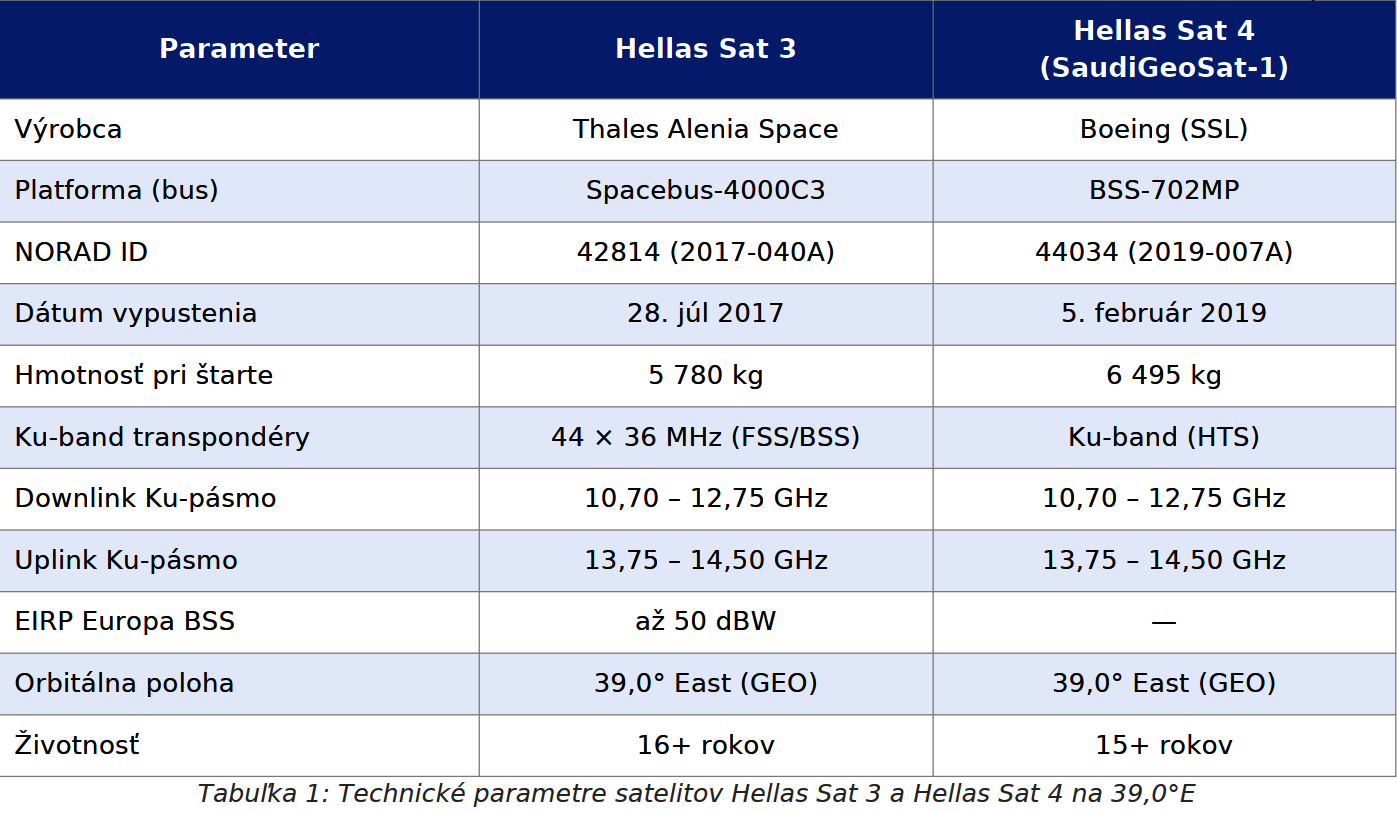
Na orbitálnej polohe 39,0° East sú ko-lokované dva satelity: Hellas Sat 3 a Hellas Sat 4 (SaudiGeoSat-1). Hellas Sat 3 bol vypustený 28. júla 2017 raketou Ariane 5 ECA z Guiany. Hellas Sat 4 bol vypustený 5. februára 2019, taktiež raketou Ariane 5 ECA. Obidva satelity spoločne pokrývajú regióny Európy, Blízkeho východu a subsaharskej Afriky. Európsky Ku-band lúč Hellas Sat 3 (FSS/BSS beam) dosahuje hodnoty EIRP až 50 dBW nad územím Grécka, Cypru a Balkánskeho polostrova. Táto vysoká úroveň EIRP umožňuje príjem aj s anténami priemeru 70–80 cm v strednej Európe a s anténami
45–60 cm na Cypre a v Grécku. Cyperský T2-MI link je preto možné monitorovať vo väčšine európskych krajín, čo má vedecký a pozorovateľský zmysel pre výskumné centrá zamerané na DTT technológie.
4. ŠTANDARD DVB-T2 – ARCHITEKTONICKÉ A MODULAČNÉ PRINCÍPY
4.1 Kľúčové technické vlastnosti DVB-T2
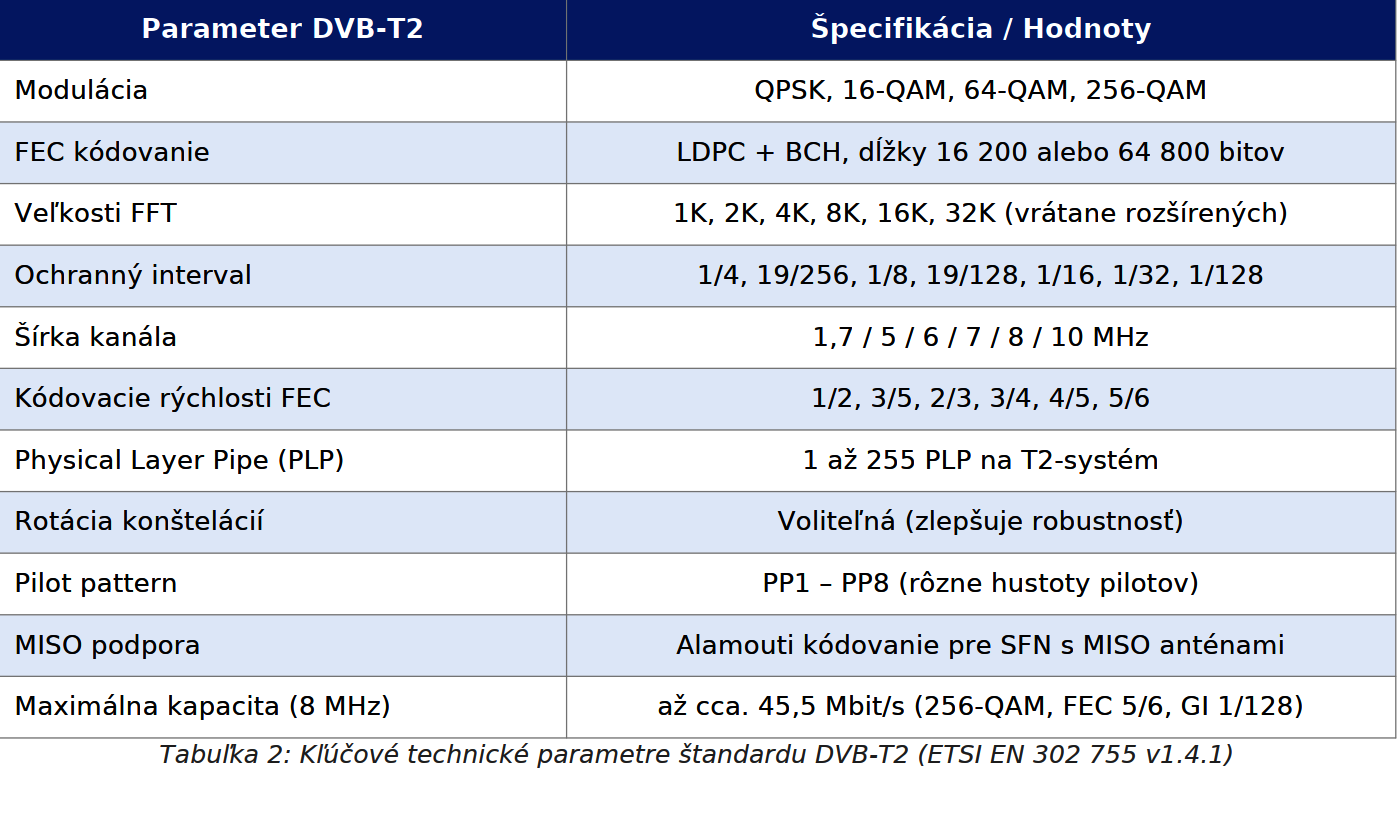
DVB-T2 (Digital Video Broadcasting – Second Generation Terrestrial) je definovaný normou ETSI EN 302 755 a predstavuje druhú generáciu európskeho štandardu pre digitálne terestriálne televízne vysielanie. Oproti DVB-T prináša 30–50 % nárast spektrálnej kapacity vďaka týmto technologickým inováciám: pokročilé kódovanie LDPC+BCH, modulácia 256-QAM, Physical Layer Pipes (PLP), rozšírené FFT veľkosti (1K, 2K, 4K, 8K, 16K, 32K), dlhšie ochranné intervaly a plná podpora SFN sietí. Norma ETSI EN 302 755 definuje dva profily: T2-Base (pôvodný profil pre stacionárne prijímače) a T2-Lite (pridaný vo verzii 1.3.1 pre mobilný príjem s nízkou kapacitou). Cyperská DTT sieť využíva profil T2-Base, ktorý plne podporuje všetky modulačné a kódovacie parametre vrátane 256-QAM a multi-PLP štruktúry.
5. T2-MI (T2 MODULATOR INTERFACE) – NORMATÍVNA DEFINÍCIA A TECHNICKÁ PODSTATA
T2-MI (T2 Modulator Interface) je rozhranie definované normou ETSI TS 102 773 (DVB Bluebook A136), ktoré slúži na transport vopred spracovaných, avšak ešte nemodulovane uložených dátových rámcov DVB-T2 od centrálneho T2-Gateway zariadenia k jednotlivým modulátorom v distribuovanej sieti. T2-MI je základným stavebným kameňom, ktorý u- možňuje prevádzku synchronizovaných sietí SFN bez potreby lokálneho multiplexora v každom vysielacom uzle.
5.1 Princíp fungovania T2-MI
V architektúre T2-MI je centrálne zariadenie označované ako T2-Gateway. Toto zariadenie prijíma vstupné transportné toky (MPEG-2 TS) alebo GSE (Generic Stream Encapsulation) dáta pre jednotlivé PLP a vykonáva nasledujúce kroky:
• Formátovanie vstupných dát do Baseband Frames (BBFRAME) pre každý PLP
• Generovanie L1-signalizácie (Layer 1 pre-/post-signalling) obsahujúcej parametre T2-rámca
• Časové plánovanie (scheduling) T2-rámcov a interleaving frames
• Vkladanie presných časových značiek TTO (Time to Output) pre SFN synchronizáciu
• Zapuzdrenie do T2-MI pakety a ich prenos smerom k modulátorom
T2-MI paket je nosnou jednotkou tohto rozhrania. Každý T2-MI paket má hlavičku identifikujúcu T2-MI_STREAM_ID, typ paketu (DATA, TIMESTAMP, GENERIC_STREAM) a dĺžku. Dáta sú zarovnané do jednotného formátu kompatibilného
s transportom cez IP siete alebo satelitné transpondéry v rámci MPEG-2 TS kontajnera na definovanom PID = 4096 (0x1000). Cyperský T2-MI link využíva práve PID 4096, čo je štandardná hodnota definovaná normou ETSI TS 102 773.
6. PHYSICAL LAYER PIPE (PLP) – PRINCÍP A KLASIFIKÁCIA
Physical Layer Pipe (PLP) je kľúčovým konceptom DVB-T2 štandardu, definovaným v norme ETSI EN 302 755. PLP predstavuje logický dátový kanál na fyzickej vrstve DVB-T2 systému. Vstup T2 systému pozostáva z jedného alebo viacerých logických dátových tokov, pričom každý logický tok je prenášaný práve jedným PLP. Identifikátor PLP je 8-bitové pole (PLP_ID), ktoré jednoznačne identifikuje PLP v rámci T2 systému označeného T2_system_id.
6.1 Typy PLP
DVB-T2 rozlišuje dva základné typy PLP:
• Data PLP: Nesie dáta jednej alebo viacerých multimediálnych služieb (TV kanálov).
Môže byť staticky alebo dynamicky alokovaný v rámci T2-rámca.
• Common PLP: Obsahuje dáta spoločné pre skupinu Data PLP (napr. spoločné SI/PSI
tabuľky). Vysiela sa raz za T2-rámec bezprostredne po L1-signalizácii.
Každý PLP prechádza cez modul adaptácie módu (mode adaptation), ktorý zahŕňa Input Stream Synchronizer (ISSY) pre zaistenie konštantného bitového toku, Null Packet Deletion pre efektívne využitie kapacity a CRC-8 encoder. Výsledkom sú BBFRAME (Baseband Frames), ktoré tvoria vstup pre LDPC+BCH FEC kódovanie.
6.2 Prepojenie PLP s T2-MI
V kontexte cyperského T2-MI linku každý vysielaný multiplexový program (kanál) zodpovedá jednému PLP identifikovanému hodnotou PLP_ID = 0. Pre oba transpondéry f1 aj f2 na Cypre je deklarované T2MI-PLP ID 0, čo znamená, že v každom z oboch T2-MI streamov sa nachádza práve jeden primárny dátový tok. Norma ETSI EN 302 755 v čl. 5 uvádza, že vstup T2 systému tvorí jeden alebo viacero logických dátových tokov, pričom každý z nich je prenášaný prostredníctvom práve jedného PLP.
Poznámka: T2MI-PLP ID 0x00 (hodnota 0) je platná a bežne používaná hodnota pre základný
(prvý) dátový PLP v jednokanálovej konfigurácii.
7. SATELITNÉ T2-MI VYSIELANIE: FREKVENCIA f1 = 11 761 MHz H
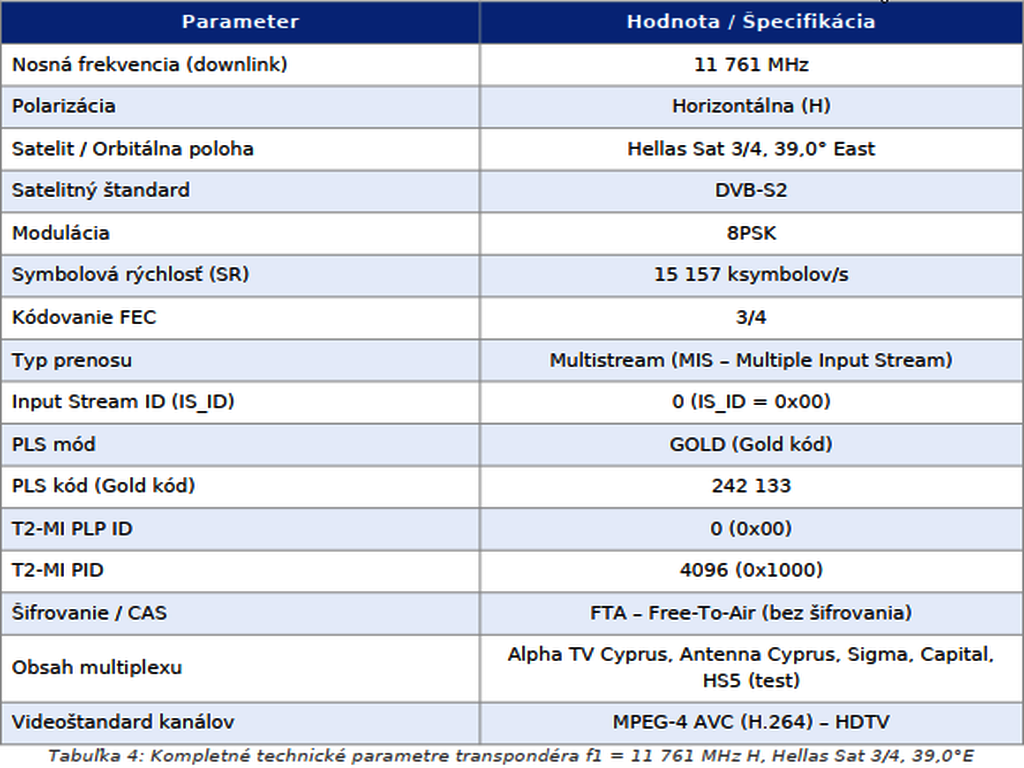
Prvý cyperský T2-MI transpondér pracuje na frekvencii f1 = 11 761 MHz, polarizácia horizontálna (H). Nasledujúca tabuľka uvádza kompletné technické parametre transpondéra:
Gold PLS kód 242 133 identifikuje fyzickú vrstvu Multistream paketu. PLS kód v Gold móde umožňuje jednoznačnú identifikáciu konkrétneho Input Streamu v rámci MIS transpondéra, čo je nevyhnutné pri prenose viacerých logicky nezávislých dátových tokov na jednom nosnom signál DVB-S2. Bez správneho PLS kódu nie je možné demodulovať T2-MI obsah ani v prípade, že hardvér podporuje MIS aj T2-MI.
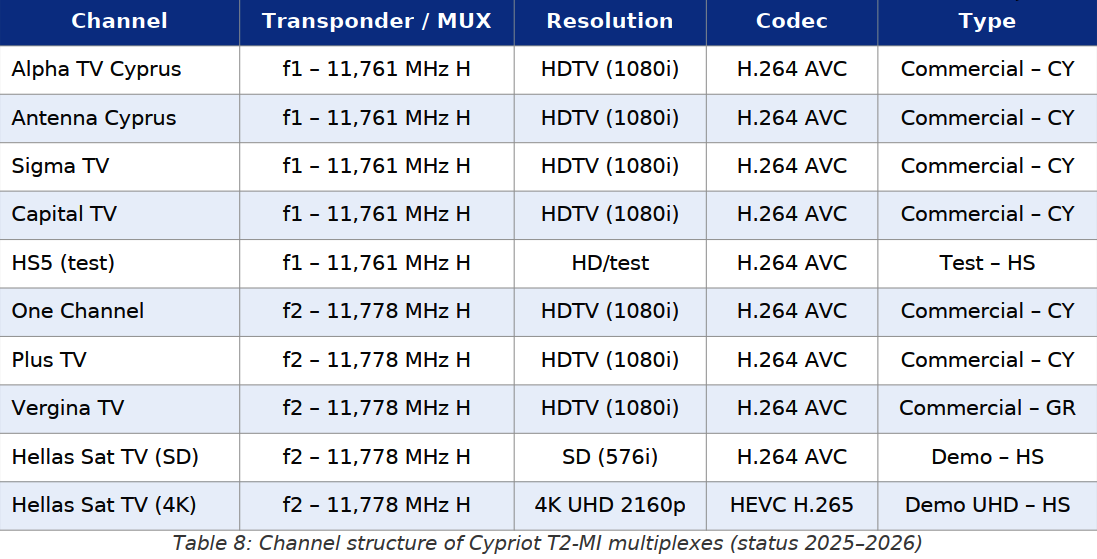
Alpha TV Cyprus je komerčnou televíziou s grécko-cyperským programovým zameraním. Antenna Cyprus (dcéra gréckeho Antenna Group) vysiela grécky obsah prispôsobený cyperskému trhu. Sigma TV je jedným z najstarších komerčných kanálov na Cypre, pôsobiaci od roku 1995. Capital TV je spravodajsko-informačný kanál. Všetky stanice sú vysielané v HD rozlíšení (HDTV) s kódovaním H.264/AVC.
8. SATELITNÉ T2-MI VYSIELANIE: FREKVENCIA f2 = 11 778 MHz H
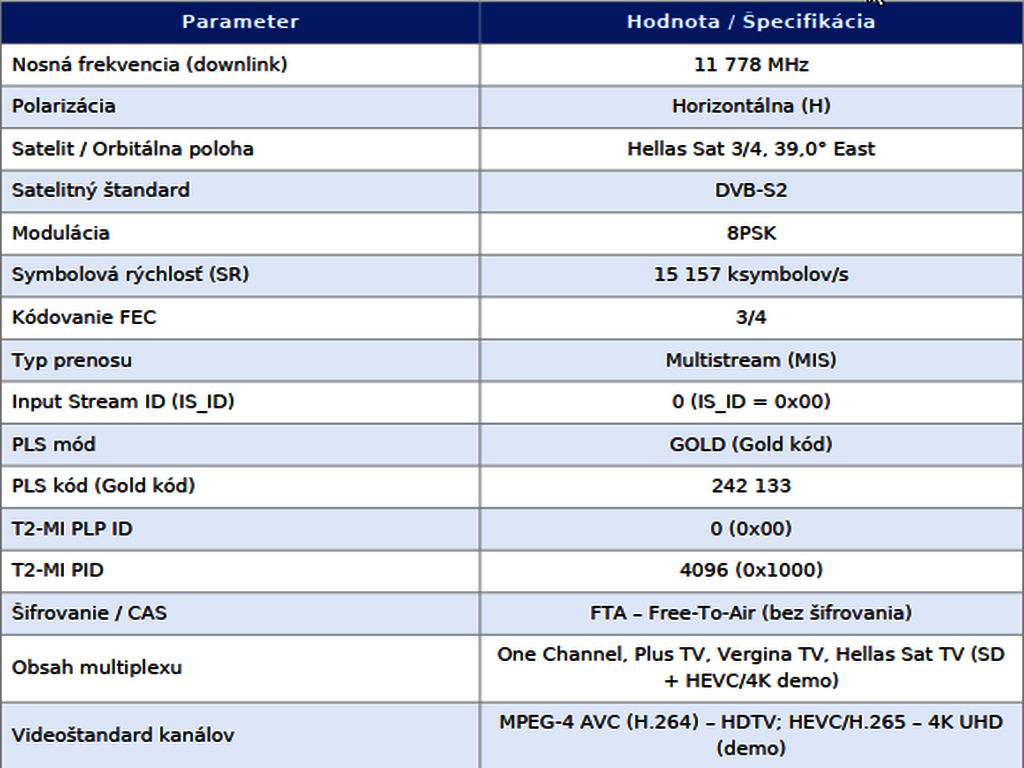
Druhý cyperský T2-MI transpondér pracuje na frekvencii f2 = 11 778 MHz, polarizácia horizontálna (H). Parametre sa vo väčšine aspektov zhodujú s f1, avšak obsah multiplexu a PLS konfigurácia sú odlišné:
Transpondér f2 je pozoruhodný prítomnosťou demonštračného kanála Hellas Sat TV v rozlíšení 4K UHD (Ultra High Definition) s kódovaním HEVC (H.265). Toto je vsúlade s licenčnými podmienkami cyperského DTT, ktoré explicitne u možňujú vysielanie v HD a UHD rozlíšení. HEVC kódovanie ponúka v porovnaní s H.264 pri rovnakej
vizuálnej kvalite až 50 % nižší bitový tok, čo je kľúčové pre efektívne využitie kapacity T2-MI linku aj terestriálneho DVB-T2 multiplexu.
Vergina TV je grécky tematický kanál (politika, dokumenty). Plus TV je cyperskýkomerčný kanál. One Channel je cyperský lifestylový a spravodajský kanál. Kombináciatýchto kanálov s demonštračnou 4K službou reflektuje technologickú snahu Hellas Sat prezentovať Cyprus ako ukážkový trh pre UHD DTT vysielanie.
9. DVB-S2 VRSTVA – MODULAČNÉ A KÓDOVACIE PARAMETRE
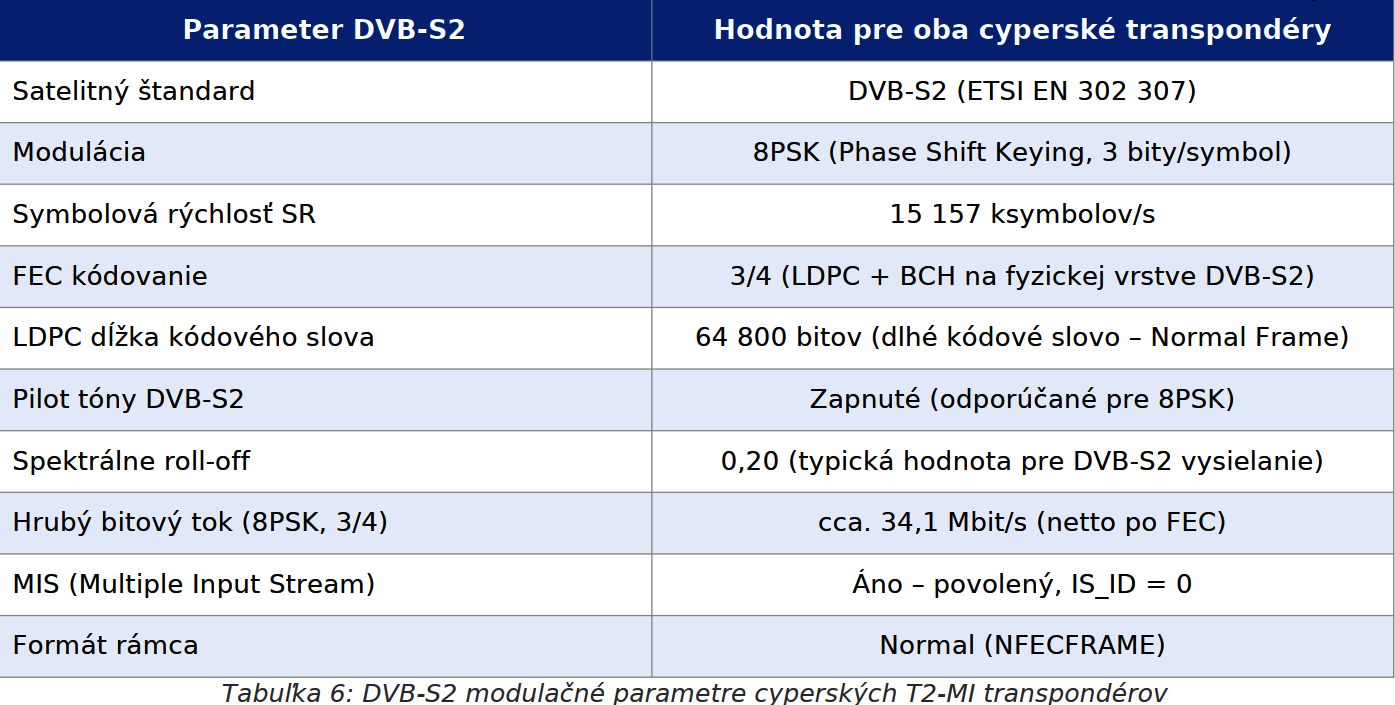
T2-MI prúd je transportovaný prostredníctvom satelitného reťazca postaveného na štandarde DVB-S2 (Digital Video Broadcasting – Satellite – Second Generation), definovanom normou ETSI EN 302 307. DVB-S2 je určený pre efektívny satelitný prenos digitálnych služieb vrátane priameho domáceho príjmu (DTH), distribúcie televízie a dátových služieb.
Modulácia 8PSK je kompromisným riešením medzi spektrálnou účinnosťou a robustnosťou prenosu. V porovnaní s QPSK (2 bity/symbol) ponúka 8PSK 3 bity/symbol, čo zvyšuje kapacitu o 50 %. Oproti 16APSK (4 bity/symbol) je 8PSK menej citlivé na nelinearitu satelitného zosilňovača (TWTA), čo umožňuje prácu bližšie k saturačnémubodu zosilňovača a tým vyšší výkon satelitného signálu. Pre T2-MI distribúciu, kde je prioritou spoľahlivosť prenosu a nie maximálna kapacita, je 8PSK s FEC 3/4 štandardnou a overenou kombináciou.
10. MULTISTREAM (MIS) A GOLD/ROOT PLS KÓDY – TECHNICKÁ ANALÝZA
DVB-S2 štandard (ETSI EN 302 307) definuje dva módy vstupného toku: SIS (Single Input Stream) a MIS (Multiple Input Stream). Cyperský T2-MI link využíva MIS mód, ktorý umožňuje prenos viacerých logicky nezávislých vstupných tokov na jednom nosnom signáli. Každý vstupný tok je identifikovaný 8-bitovým Input Stream Identifier (ISI / IS_ID). N oboch cyperských frekvenciách je IS_ID = 0, čo znamená jediný aktívny vstupný tok.
10.1 PLS (Physical Layer Scrambling) kód
Fyzické rozlišovanie MIS streamov (a zabránenie interferencii so susednými satelitnými systémami) zabezpečuje PLS (Physical Layer Scrambling) sekvencia. DVB-S2 definuje dva typy PLS kódov:
• Root kód: Generovaný M-sekvenčným polynomom stupňa 18. Každý Root kód zodpovedá unikátnemu pôvodnému kódu bez transformácie. Pre cyperský f1 transpondér bol v počiatočnej fáze identifikovaný Root PLS kód 211 867.
• Gold kód: Generovaný cyklickým posunom z Root M-sekvencie. Gold kódy umožňujú vytvorenie 262 143 unikátnych kódov. Cyperský f1 aj f2 transpondér využívajú Gold kód 242 133.
Poznámka: V rámci satelitného prijímača musí byť PLS mód (ROOT alebo GOLD) aj konkrétnyPLS kód nakonfigurovaný pred dekódovaním DVB-S2 fyzickej vrstvy. Nesprávna konfigurácia spôsobí, že tuner transpondér rozpozná, ale nebude schopný demodulovať žiadne dáta.
Technická poznámka k f1: Niektoré zdroje uvádzali pre f1 = 11 761 MHz pôvodný Root kód 211 867 a novší Gold kód 242 133 – ide o historický vývoj nastavenia transpondéra. Aktuálne (2025–2026) oba transpondéry f1 aj f2 používajú konzistentne Gold kód 242 133.
11. ARCHITEKTÚRA DISTRIBUČNÉHO REŤAZCA: OD ŠTÚDIA K DVB-T2 VYSIELAČU
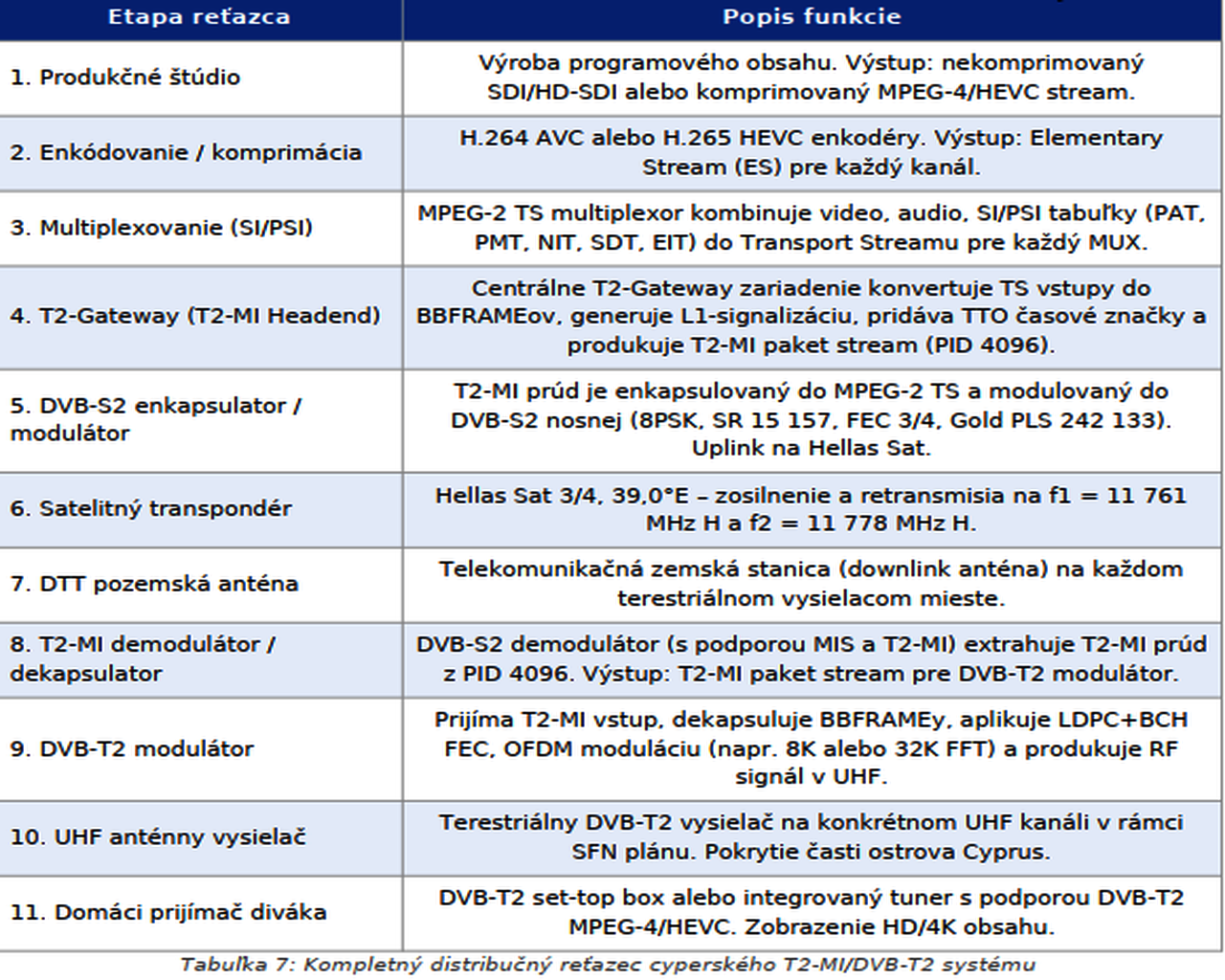
Kompletný distribučný reťazec cyperského T2-MI/DVB-T2 systému pozostáva z niekoľkých technologicky odlišných, ale funkčne prepojených vrstiev:viď. tabuľka
12. SIEŤ SFN (SINGLE FREQUENCY NETWORK) NA CYPRE –TOPOLÓGIA
Single Frequency Network (SFN) je sieť vysielačov, ktoré vysielajú rovnaký program na rovnakej frekvencii súčasne s presnou vzájomnou fázovou synchronizáciou. Z pohľadu diváka pôsobí SFN sieť ako jediný super-vysielač s rozsiahlym pokrytím. Kľúčovou podmienkou SFN prevádzky je, že ochranný interval DVB-T2 (guard interval) musí byť dlhší než maximálne oneskorenie medzi príchodmi signálov z rôznych vysielačov na
prijímací bod. Cyperský DTT systém je navrhnutý ako štyri SFN siete s celkovo ôsmimi prenosovými kanálmi: každá SFN pokrýva inú oblasť ostrova (Troodos, Famagusta a ďalšie). T2-MI distribúcia cez satelit zaručuje, že všetky DVB-T2 modulátory v danej SFN sieti dostávajú identické T2-MI pakety s rovnakými TTO hodnotami, čím je SFN synchronizácia zaistená bez potreby GPS prijímačov alebo dedikovaných IP-synchronizačných protokolov.
12.1 Výhody SFN pre Cyprus
• Efektívne využitie spektra: Rovnaký program na jednej frekvencii namiesto viacerých frekvencií pre rôzne oblasti.
• Vyššia pokrytosť: Sčítanie signálov z viacerých vysielačov zlepšuje pokrytie v tieňoch úbočí pohoria Troodos.
• Odolnosť voči interferencii: Signály zo susedných vysielačov sa navzájom sčítavajú konštruktívne (ak sú v ochrannom intervale).
• Jednoduchý zálohovací systém: Výpadok jedného vysielača nespôsobí stratu signálu v celom pokrytom území.
• Vhodnosť pre ostrovnú topografiu: Hornatý terén Cypru (Troodos max. 1 952 m n. m.) si vyžaduje viacero vysielacích miest.
13. OBSAH MULTIPLEXOV – KANÁLOVÁ ŠTRUKTÚRA A KODEKY
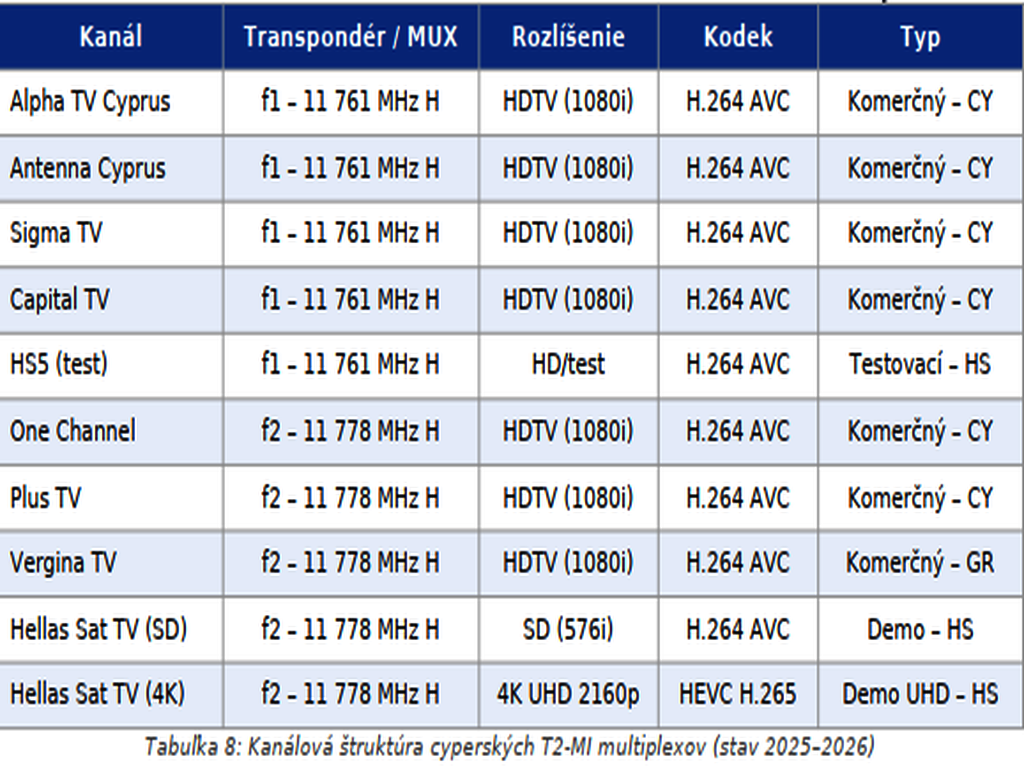
14. CYPERSKÉ DTT POKRYTIE, POČET DIVÁKOV A SOCIÁLNY KONTEXT
Cyperská republika má podľa odhadov OSN (2026) populáciu approximately 1 379 000 obyvateľov v kontrolovanej časti ostrova. Cyprus sa historicky radí medzi európske krajiny s najvyššou hustotou televíznych prijímačov na domácnosť. Celkový počet TV domácností sa odhaduje na 200 000 – 260 000, čo zodpovedá penetrácii TV prijímačov v každej domácnosti blízkej 100 %. Prevádzka DTT siete na DVB-T2 štandarde vytvára potenciál pre prístup k bezplatnému FTA (Free-To-Air) príjmu HD a UHD obsahu pre všetky domácnosti bez potreby platených predplatených satelitných alebo IPTV platforiem (napr. Nova Cyprus). Dostupnosť FTA DTT je v súlade s mediálnou politikou Cyperskej republiky, ktorá od začiatku digitalizácie (2011) uprednostňuje bezplatný pozemský príjem ako základnú službu verejnosti.
14.1 Geografické výzvy pokrytia
Cyprus má plochu 9 251 km² (kontrolovaná oblasť). Pohorie Troodos (max. 1 952 m n. m.) tvorí centrálny geografický uzol, ktorý tieni nižším oblastiam. Výrazná terénna rôznorodosť si vyžaduje väčší počet vysielacích miest oproti rovinnému terénu. Práve preto je SFN architektúra a T2-MI satelitný distribučný reťazec obzvlášť vhodným riešením – nie je nutné budovať drahé pozemné IP okruhy do každého vysielacieho miesta v horách.
14.2 DTT penetrácia a predplatitelia
FTA DTT vysielanie na Cypre nevyžaduje žiadne predplatné – príjem je bezplatný pre všetkých vlastníkov DVB-T2 kompatibilného zariadenia. Komerčné platené služby sú dostupné cez satelitnú platformu Nova (Multichoice Cyprus), nie cez pozemskú DTT. Nová DVB-T2 sieť Hellas Sat tak priamo konkuruje satelitným predplatným tým, že ponúka HD a potenciálne UHD obsah zadarmo cez DVB-T2 anténu. Odhadovaný počet DTT divákov po plnom spustení siete (2025–2026) je 150 000 – 200 000 aktívnych DTT domácností.
15. PRÍJEM T2-MI SIGNÁLU V EURÓPE – TECHNICKÉ POŽIADAVKY
Satelitný T2-MI prúd z Hellas Sat 3/4 je výhodný z hľadiska pozorovania príjmu v Európe: európsky Ku-band lúč dosahuje EIRP 40–50 dBW, čo umožňuje príjem s bežnými
anténami:
• Cyprus, Grécko, Turecko, Egypt: Anténa 45–60 cm je postačujúca.
• Balkán, Rumunsko, Bulharsko, Taliansko: Anténa 75–90 cm je odporúčaná.
• Stredná Európa (Slovensko, Česká republika, Poľsko, Maďarsko): Anténa
90–120 cm, odporúčané je nízko-šumové LNB s NF ≤ 0,3 dB.
• Severná Európa (Holandsko, Belgicko): Anténa 100–120 cm, príjem je možný za priaznivých atmosferických podmienok.
15.1 Požiadavky na prijímacie zariadenie
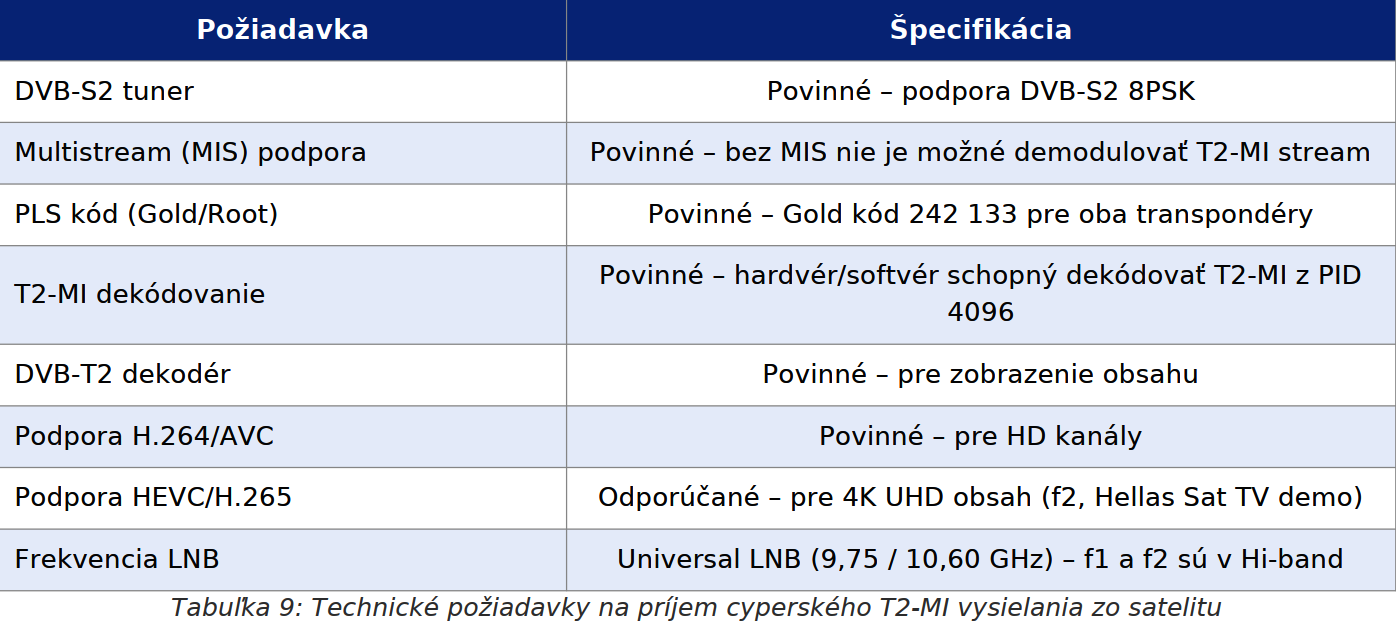
16. POROVNANIE T2-MI/SATELIT VS. IP/FIBER DISTRIBUČNÉHO RIEŠENIA
Z porovnania vyplýva, že pre ostrovné prostredie s hornatým terénom a geograficky rozptýlenými vysielacími miestami je T2-MI satelitná distribúcia jednoznačne ekonomicky aj technologicky výhodnejším riešením. Vyššia latencia GEO satelitu (cca. 240 ms) nemá žiadny negatívny dopad na jednosmerný broadcast reťazec DTT, keďže televízne vysielanie nie je interaktívna real-time aplikácia.
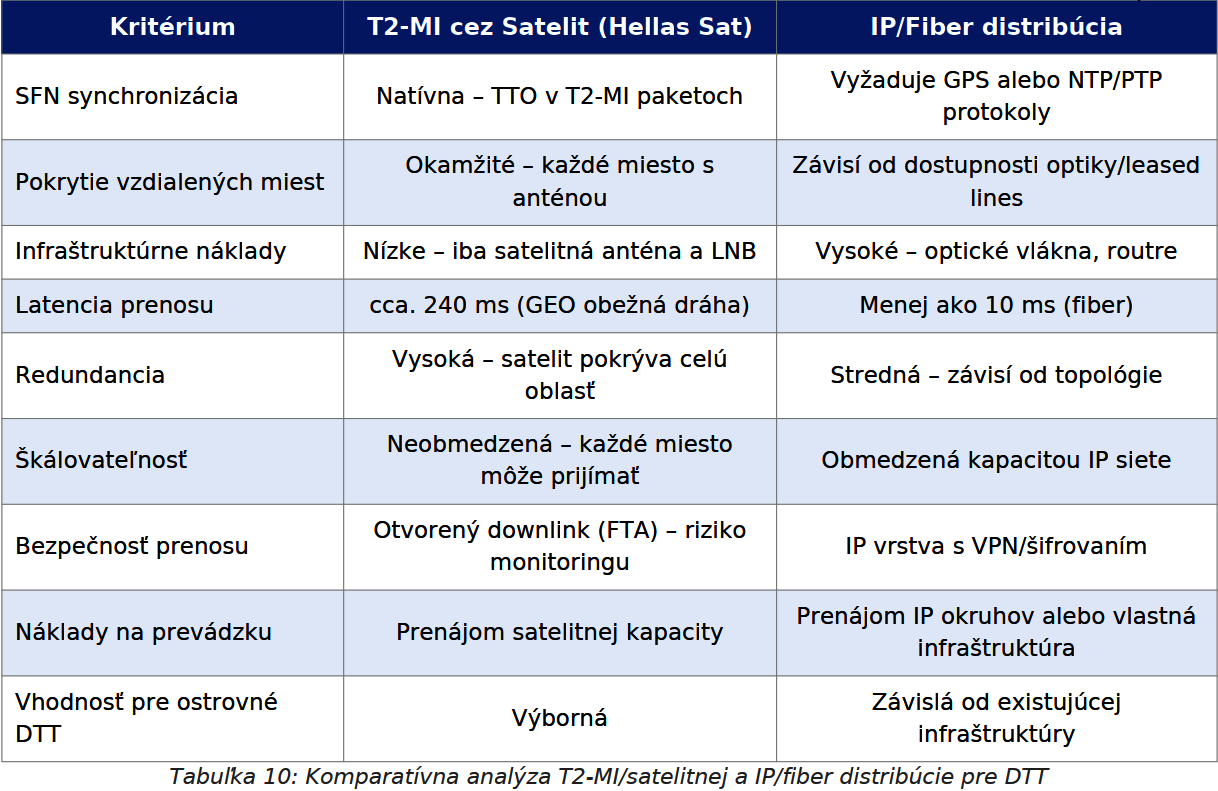
17. REGULAČNÝ A LICENČNÝ RÁMEC – HELLAS SAT AKO PREVÁDZKOVATEĽ DTT
Prevádzka DTT siete na Cypre je regulovaná Oddelením elektronických komunikácií Ministerstva výskumu Cyperskej republiky. Regulačný rámec zodpovedá európskej legislatíve – smernica EÚ o audiovizuálnych mediálnych službách (AVMS Directive) a Európsky kódex elektronických komunikácií (EECC). Hellas Sat obdržal licenciu na prevádzku DTT siete s nasledovnými parametrami:
• Dátum vydania: Február/Marec 2025
• Platnosť licencie: 1. december 2025 – 9. november 2040 (15 rokov)
• Rozsah licencie: Štyri SFN siete s dvoma prenosovými kanálmi každá (celkovo 8
kanálov)
• Pokryté oblasti: Pohorie Troodos a oblasť Famagusty (Ammochostos)
• Štandard vysielania: DVB-T2 (HD a UHD obsah povolený)
• Typ prevádzkovateľa: Výhradne distribučná platforma – obsah dodávajú licencovaní
vysielatelia
Hellas Sat je dcérskou spoločnosťou Arab Satellite Communications Organization (Arabsat), so sídlom v Rijáde (Saudská Arábia). Kyperská vláda schválila licenciu v súlade so štandardnými európskymi regulačnými postupmi. Generálny riaditeľ Hellas Sat Christodoulos Protopapas v súvislosti s licenciou uviedol, že spoločnosť je nadšená možnosťou poskytnúť cyperským domácnostiam prístup k HD a 4K televízii cez terestriálnu sieť. Toto vyhlásenie dokumentuje zámer prevádzkovateľa kontinuálne rozširovať kapacitu DTT siete smerom k UHD.
18. ZÁVER A VEDECKÉ ZHRNUTIE
Cyperský T2-MI/DVB-T2 distribučný systém reprezentuje moderný a technologicky vysoko rozvinutý prístup k budovaniu terestriálnej DTT infraštruktúry na menšom európskom ostrovnom štáte. Využitie satelitného T2-MI linku cez Hellas Sat 3/4 na 39,0°E ako primárneho distribučného reťazca je elegantným riešením, ktoré integruje výhody satelitného prenosu so technologickou precíznosťou DVB-T2 Physical Layer Pipe architektúry.
Kľúčové vedecké závery tejto analýzy:
1. Cyperský DTT systém je postavený na štandarde DVB-T2 s distribúciou prostredníctvom T2-MI protokolu zapúzd-reného v DVB-S2 signáli na Hellas Sat 3/4, 39,0°E.
2. Oba nosné f (f1 = 11 761 MHz H a f2 = 11 778 MHz H) využívajú identické parametre DVB-S2: 8PSK, SR 16 515 ksps, FEC 5/6, MIS, Gold PLS kód 242 133, T2-MI PID 4096, PLP ID 0.
3. T2-MI architektúra zaručuje SFN synchronizáciu prostredníctvom TTO časových značiek bez potreby externých GPS synchronizačných systémov na strane DVB-T2 modulátora.
4. Hellas Sat je nielen satelitným operátorom, ale zároveň prevádzkovateľom terestriálnej DVB-T2 siete na Cypre s licenciou platnou do roku 2040.
5. Obsahová štruktúra multiplexov zahŕňa HD kanály (H.264) aj 4K UHD demonštračný obsah (HEVC/H.265), čo pot-vrdzuje technologickú perspektívu cyperského DTT.
6. Satelitný T2-MI link je v kontexte cyperského hornatého terénu a ostrovnej geografie optimálnym distribučným riešením z technickej aj ekonomickej stránky.
7. Výskumná a monitorovacia hodnota cyperského T2-MI linku je celoeurópska – signál je prijímateľný s bežnými satelitnými anténami od Grécka až po krajiny strednej Európy
19. ZOZNAM NORIEM, ŠTANDARDOV A ODBORNÝCH REFERENCIÍ
[1] ETSI EN 302 755 V1.4.1 (2015): Digital Video Broadcasting (DVB); Frame structure, channel coding and modulation for a second generation digital terrestrial television broadcasting system (DVB-T2). European Telecommunications Standards Institute, Sophia Antipolis.
[2] ETSI TS 102 773 V1.3.1 (2012): Digital Video Broadcasting (DVB); Modulator Interface (T2-MI) for a second generation digital terrestrial television broadcasting system (DVB-T2). ETSI, Sophia Antipolis.
[3] DVB Bluebook A136 (rev. 2, 2012): DVB T2 Modulator Interface (T2-MI). Digital Video Broadcasting Project, Geneva.
[4] ETSI EN 302 307-1 V1.4.1 (2014): Digital Video Broadcasting (DVB); Second generation framing structure, channel coding and modulation systems for Broadcasting, Interactive Services, News Gathering and other broadband satellite applications (DVB-S2). ETSI, Sophia Antipolis.
[5] DVB Bluebook A175 / ETSI EN 302 755 V1.3.1 (2011): DVB-SIS – Single Illumination System for SFN distribution. DVB Project, Geneva.
[6] Broadband TV News (03.03.2025): Hellas Sat to run DTT network in Cyprus. URL: https://www.broadbandtvnews.com/2025/03/03/hellas-sat-to-run-dtt-networ…
[7] Cyprus Mail (25.02.2025): Hellas Sat to launch advanced digital TV network in Cyprus. URL: https://cyprus-mail.com/2025/02/25/hellas-sat-to-launch-advanced-digital-tv-network-in-cyprus/
[8] Wikipedia: Digital terrestrial television in Cyprus. URL: https://en.wikipedia.org/wiki/Digital_terrestrial_television_in_Cyprus
[09] Wikipedia: Cyprus Broadcasting Corporation (CyBC/RIK). URL: https://en.wikipedia.org/wiki/Cyprus_Broadcasting_Corporation
[10] Wikipedia: Television in Cyprus. URL: https://en.wikipedia.org/wiki/Television_in_Cyprus
[11] NTvsat: Hellas Sat 3 / Hellas Sat 4 technical data. URL: https://nt-vsat.com/hellassat/
[12] JustAboutCyprus: Digital TV FAQ (DTT Cyprus 2011). URL: https://www.justaboutcyprus.com/media/files/digital-tv-faq.pdf
[13] UN Population Division: World Population Prospects 2024 – Cyprus. URL: https://population.un.org
[14] Dávid, R. (2025): T2-MI/PLP Vyskumne centrum – Vedecko-výskumne záznamy a merania. dxsatcs.com, Slovenska republika.
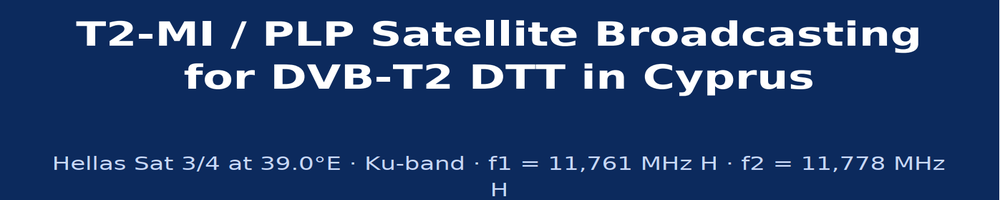
Comprehensive Scientific and Technical Analysis of the Satellite Distribution Chain for Digital Terrestrial Television (DTT) Broadcasting in the Republic of Cyprus.
TABLE OF CONTENTS
1. Abstract and Introduction
2. Contextualisation: Digital Television in Cyprus – Historical Development
3. Hellas Sat 3/4 – Technical Characterisation of the Satellite at 39.0°E
4. The DVB-T2 Standard: Architectural and Modulation Principles
5. T2-MI (T2 Modulator Interface) – Normative Definition and Technical Essence
6. Physical Layer Pipe (PLP) – Principle and Classification
7.Satellite T2-MI Broadcasting in Cyprus: Parameters of Frequency f1 = 11,761 MHz-H
8.Satellite T2-MI Broadcasting in Cyprus: Parameters of Frequency f2 = 11,778 MHz-H
9. DVB-S2 Layer: Modulation and Coding Parameters of the Transmission Chain
10. Multistream (MIS) and Gold/Root PLS Codes – Technical Analysis
11.Architecture of the Distribution Chain: From Production Studio to DVB-T2 Transmitter
12. SFN (Single Frequency Network) in Cyprus – Topology and Advantages
13. Multiplex Content: Channel Structure and Codecs
14. Cyprus DTT Coverage, Number of Viewers and Socio-Technical Context
15. Reception of T2-MI Signal in Europe: Technical Requirements for Equipment
16. Comparison of T2-MI/Satellite vs. Traditional IP/Fiber Distribution Solution
17. Regulatory and Licensing Framework – Hellas Sat as DTT Operator in Cyprus
18. Conclusion and Scientific Summary
19. List of Standards, Norms and Professional References
1. ABSTRACT AND INTRODUCTION
This scientific and technical document presents a comprehensive analysis of the satellite distribution system for Digital Terrestrial Television (DTT) in the Republic of Cyprus, implemented through the technological standard T2-MI (T2 Modulator Interface) in combination with Physical Layer Pipe (PLP) in accordance with ETSI TS 102 773. The satellite broadcasting is carried out from the geostationary position Hellas Sat 3/4 at 39.0° East in the Ku-band on two carrier frequencies: f1 = 11,761 MHz, horizontal polarisation (H) and f2 = 11,778 MHz, horizontal polarisation (H). Both transponders use DVB-S2 modulation with 8PSK coding and FEC 3/4 at a symbol rate of SR = 15,157 ksymbols/s.
The document addresses the technological, regulatory, historical and socio-media aspects of building a modern DTT infrastructure on the island of Cyprus. It explains the reasons for the transition to DVB-T2, describes in detail the architecture of the T2-MI distribution chain from the production studio to the antenna transmitter, defines the normative background of the PLP structure and provides a comprehensive overview of the content of the Cypriot multiplexes including HD and UHD services. The research results are supported by verified technical sources, European ETSI/DVB standards and publicly available parametric measurements.
1.1 Scientific Motivation and Research Objective
The development of digital terrestrial television broadcasting in smaller European islandstates presents a unique technological challenge. The island of Cyprus, with a populaton of approximately 1,380,000 inhabitants (UN estimate, 2026), has a geographically complex morphology – the Troodos mountain massif, seasonal climatic variations and the political division of the island – which requires an innovative approach to the distribution of television programme streams for the DVB-T2 terrestrial network. This is where the satellite T2-MI link finds its application as the primary distribution chain, replacing traditional terrestrial IP circuits or optical fibres in areas with limited infrastructure.The aim of this research document is: (1) to provide a technically precise and scientifically verifiable description of the Cypriot T2-MI satellite distribution system; (2) to analyse the parameters of both carrier frequencies in the context of applicable technical standards; (3) to explain the role of Hellas Sat as an integrated operator of both satellite distribution and the terrestrial DTT network; and (4) to place this solution in the broader European context of migration to the DVB-T2 standard.
2. DIGITAL TELEVISION IN CYPRUS – HISTORICAL DEVELOPMENT
Television broadcasting in Cyprus began in 1957. The Cyprus Broadcasting Corporation (CyBC / RIK – Radiofoniko Idryma Kyprou) was established as the first public television institution on the island. Private television was introduced on 26 April 1992 by the station Logos TV, financed by the Cyprus Orthodox Church, which broadcast in stereo format with teletext from its first day. By the mid-1990s, there were five free-to-air terrestrial television channels in Cyprus, including ANT1 Cyprus and Sigma TV.
2.1 Transition to Digital Terrestrial Television (2011)
In accordance with the obligations of the Republic of Cyprus as a European Union member state, the Analogue Switch-Off (ASO) was carried out on 1 July 2011, whereby Cyprus met the EU timetable for digital migration before the general European deadline of 2012. The initial DTT platform was built on the basis of the DVB-T standard with MPEG-4 encoding – rather than the original MPEG-2 – which allowed Cyprus to directly deploy an HD-ready solution. This was technologically progressive compared to many other EU countries at the time. Two licences were granted for the operation of DTT: the public platform CyBC (RIK) and the commercial platform Velister Ltd., which brought together the private stations
ANT1 Cyprus, Plus TV, Mega Channel Cyprus, Sigma and New Extra. CyBC operated its own DVB-T multiplexer, while Velister Ltd. provided commercial transmissions. The terrestrial broadcast sites covered the southern part of the island on several UHF frequencies.
2.2 Modernisation to DVB-T2 and the Role of Hellas Sat
The need for significantly higher spectral efficiency, HD and UHD capacity and synchronised single-frequency networks (SFN) prompted interest in migration to DVB-T2. The operator Hellas Sat – a subsidiary of the Arab Satellite Communications Organization (Arabsat) – was granted a licence by the Ministry of Research of the Republic of Cyprus (Department of Electronic Communications) for the operation of a DTT network with validity from 1 December 2025 to 9 November 2040. The new network consists of four Single Frequency Networks (SFN), each equipped with two transmission channels. One channel in each SFN covers the Troodos mountain area, the other the Famagusta area, making a total of eight transmission channels for the whole island. Hellas Sat is therefore not only the operator of the satellite distribution chain (via the T2-MI link) but also the operator of the entire terrestrial DVB-T2 network infrastructure. This model – where a single entity operates both the satellite feeding and the terrestrial network – is efficient in terms of SFN synchronisation, because the T2-MI packets from the satellite carry precise timing information needed for coherent radiation from all antenna masts of the SFN network without external GPS synchronisation protocols.
3. HELLAS SAT 3/4 – TECHNICAL CHARACTERISATION OF THE SATELLITE AT 39.0°E
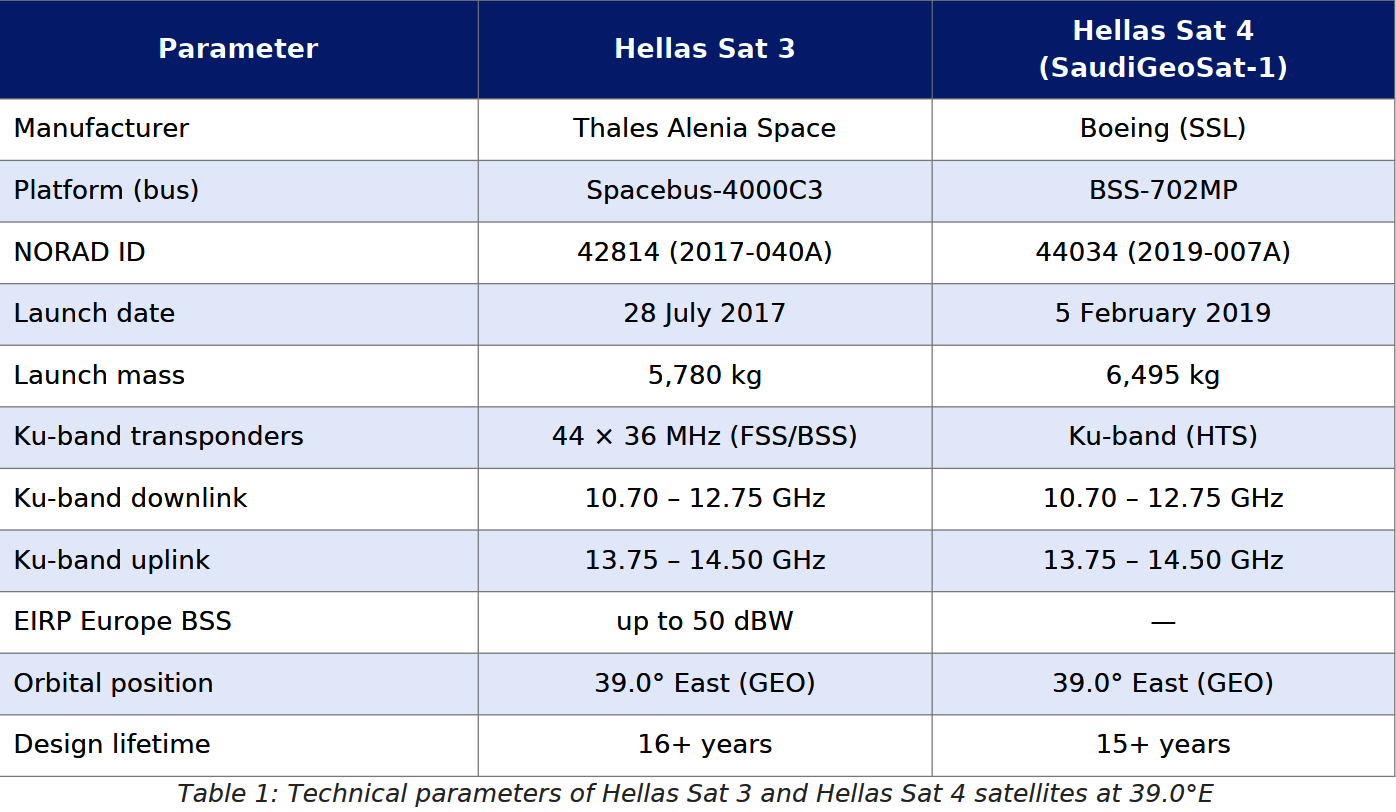
At the orbital position 39.0° East, two satellites are co-located: Hellas Sat 3 and Hellas Sat 4 (SaudiGeoSat-1). Hellas Sat 3 was launched on 28 July 2017 by an Ariane 5 ECA rocket from French Guiana. Hellas Sat 4 was launched on 5 February 2019, also by an Ariane 5 ECA rocket. Both satellites together cover the regions of Europe, the Middle East and sub-Saharan Africa.The European Ku-band beam of Hellas Sat 3 (FSS/BSS beam) achieves EIRP values of up to 50 dBW over Greece, Cyprus and the Balkan Peninsula. This high EIRP level enables reception with antennas of 70–80 cm diameter in Central Europe and with 45–60 cm antennas in Cyprus and Greece. The Cypriot T2-MI link can therefore be monitored in most European countries, which has scientific and observational value for research centres focused on DTT technologies.
4. THE DVB-T2 STANDARD – ARCHITECTURAL AND MODULATION PRINCIPLES
4.1 Key Technical Features of DVB-T2
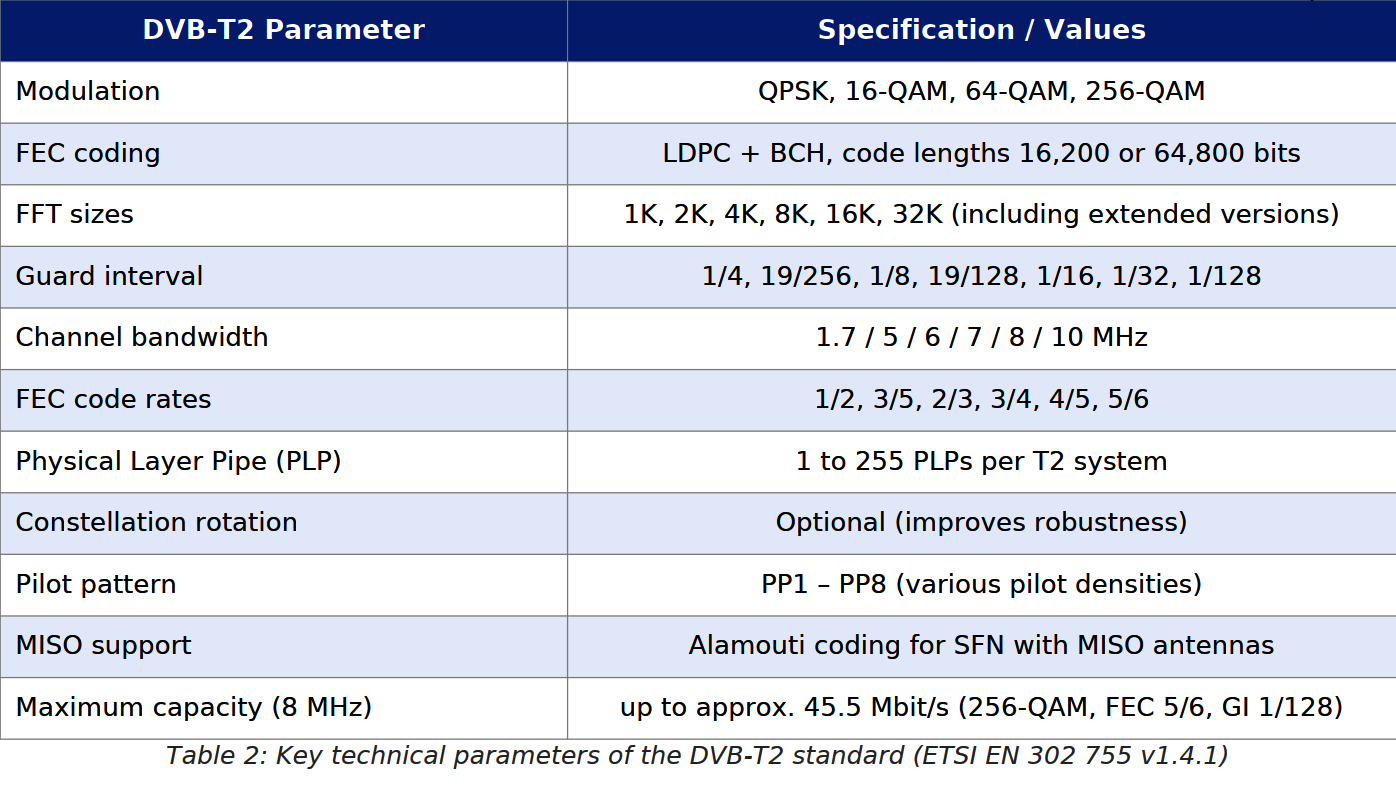
DVB-T2 (Digital Video Broadcasting – Second Generation Terrestrial) is defined by the standard ETSI EN 302 755 and represents the second generation of the European standard for digital terrestrial television broadcasting. Compared to DVB-T, it brings a 30–50% increase in spectral capacity thanks to these technological innovations: advanced LDPC+BCH coding, 256-QAM modulation, Physical Layer Pipes (PLP), extended FFT sizes (1K, 2K, 4K, 8K, 16K, 32K), longer guard intervals and full SFN network support.The ETSI EN 302 755 standard defines two profiles: T2-Base (the original profile for
stationary receivers) and T2-Lite (added in version 1.3.1 for mobile reception with low capacity). The Cypriot DTT network uses the T2-Base profile, which fully supports all modulation and coding parameters including 256-QAM and multi-PLP structure.
5. T2-MI (T2 MODULATOR INTERFACE) – NORMATIVE DEFINITION AND TECHNICAL ESSENCE
T2-MI (T2 Modulator Interface) is an interface defined by the standard ETSI TS 102 773 (DVB Bluebook A136), which serves to transport pre-processed but not yet modulated DVB-T2 data frames from the central T2-Gateway device to individual modulators in a distributed network. T2-MI is the fundamental building block that enables the operation of synchronised SFN networks without the need for a local multiplexer at each transmission node.
5.1 Operating Principle of T2-MI
In the T2-MI architecture, the central device is referred to as the T2-Gateway. This device receives input transport streams (MPEG-2 TS) or GSE (Generic Stream Encapsulation) data for individual PLPs and performs the following steps:
• Formatting input data into Baseband Frames (BBFRAME) for each PLP
• Generating L1 signalling (Layer 1 pre-/post-signalling) containing T2-frame
parameters
• Time scheduling of T2-frames and interleaving frames
• Inserting precise timing stamps TTO (Time to Output) for SFN synchronisation
• Encapsulation into T2-MI packets and their transmission towards the modulators
The T2-MI packet is the carrier unit of this interface. Each T2-MI packet has a header identifying the T2-MI_STREAM_ID, packet type (DATA, TIMESTAMP, GENERIC_STREAM) and length. Data are aligned into a uniform format compatible with
transport over IP networks or satellite transponders within an MPEG-2 TS container on the defined PID = 4096 (0x1000). The Cypriot T2-MI link uses PID 4096, which is the standard value defined by ETSI TS 102 773.
5.2 Advantages of T2-MI over Traditional IP Distribution Model
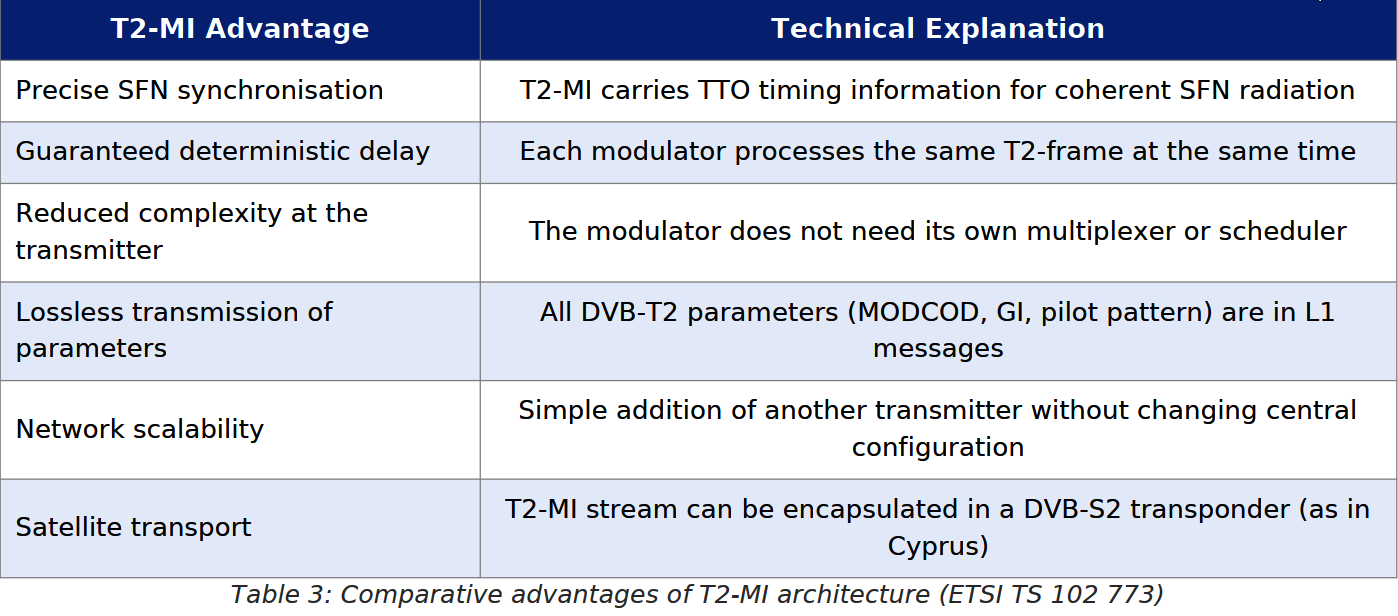
6. PHYSICAL LAYER PIPE (PLP) – PRINCIPLE AND CLASSIFICATION
Physical Layer Pipe (PLP) is a key concept of the DVB-T2 standard, defined in ETSI EN 302 755. PLP represents a logical data channel at the physical layer of the DVB-T2 system. The input to the T2 system consists of one or more logical data streams, each logical stream being carried by exactly one PLP. The PLP identifier is an 8-bit field (PLP_ID) that uniquely identifies the PLP within the T2 system identified by T2_system_id.
6.1 Types of PLP
DVB-T2 distinguishes two basic types of PLP:
• Data PLP: Carries data of one or more multimedia services (TV channels). It can be
statically or dynamically allocated within a T2-frame.
• Common PLP: Contains data common to a group of Data PLPs (e.g. common SI/PSI
tables). It is transmitted once per T2-frame immediately after L1 signalling.
Each PLP passes through a mode adaptation module, which includes the Input Stream Synchronizer (ISSY) to ensure a constant bit rate, Null Packet Deletion for efficient capacity utilisation and a CRC-8 encoder. The result is BBFRAMEs (Baseband Frames), which form the input for LDPC+BCH FEC coding.
6.2 Relationship between PLP and T2-MI
In the context of the Cypriot T2-MI link, each transmitted multiplex programme (channel) corresponds to one PLP identified by the value PLP_ID = 0. For both transponders f1 and f2 in Cyprus, T2MI-PLP ID 0 is declared, meaning that in each of the two T2-MI streams there is exactly one primary data stream. The ETSI EN 302 755 standard in clause 5 states that the input to the T2 system consists of one or more logical data streams, each of which is carried by exactly one PLP.
Note: T2MI-PLP ID 0x00 (value 0) is a valid and commonly used value for the basic (first) data PLP in a single-channel configuration.
7. SATELLITE T2-MI BROADCASTING: FREQUENCY f1 = 11,761 MHz H
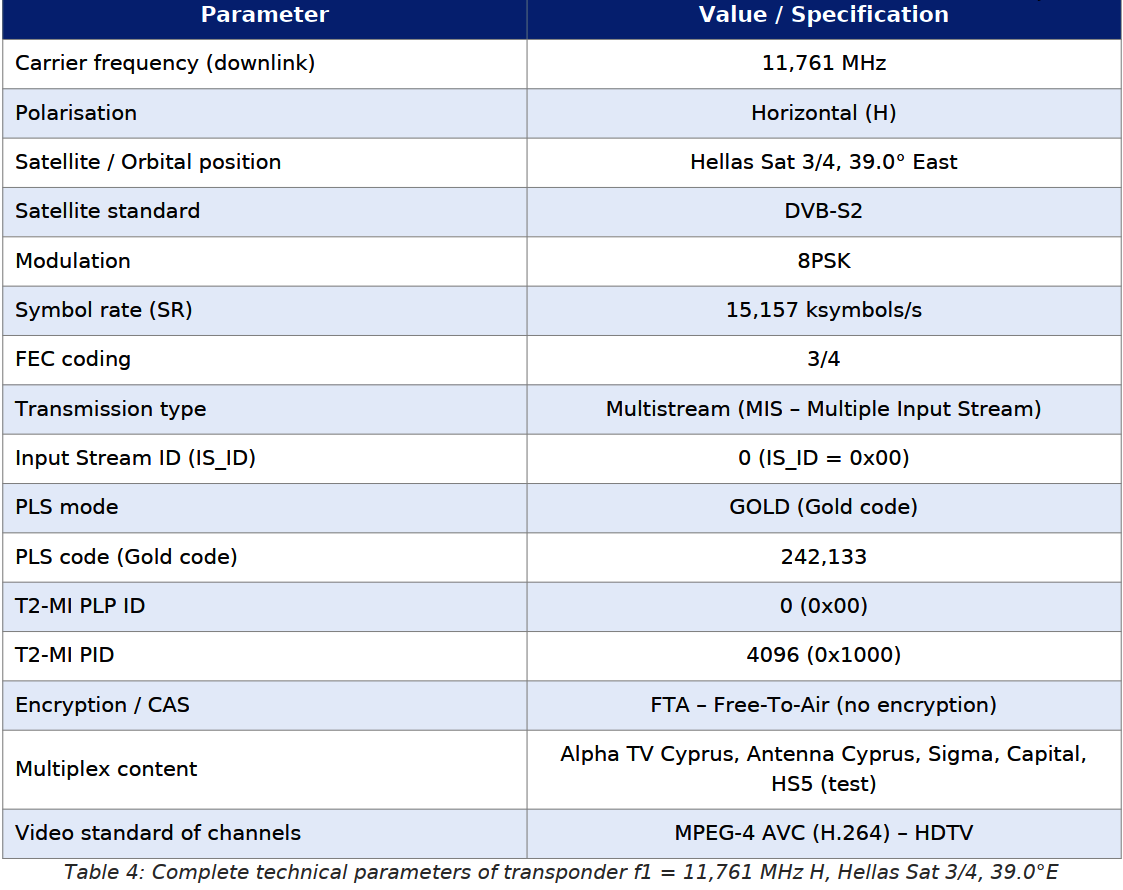
The first Cypriot T2-MI transponder operates at frequency f1 = 11,761 MHz, horizontal polarisation (H). The following table lists the complete technicalparameters of the transponder:Gold PLS code 242,133 identifies the physical layer of the Multistream packet. The PLS code in Gold mode enables unambiguous identificationof a specific Input Stream within a MIS transponder, which is essential when transmitting multiple logically independent data streams on a single DVB-S2 carrier signal.Without the correct PLS code it is impossible to demodulate T2-MI content even if thehardware supports MIS and T2-MI. Alpha TV Cyprus is a commercial television station with a Greek-Cypriot programmefocus. Antenna Cyprus (subsidiary of the Greek Antenna Group) broadcasts Greek content adapted for the Cypriot market. Sigma TV is one of the oldest commercial channels in Cyprus, operating since 1995. Capital TV is a news and information channel. All stations are broadcast in HD resolution (HDTV) with H.264/AVC encoding.
8. SATELLITE T2-MI BROADCASTING: FREQUENCY f2 = 11,778 MHz H
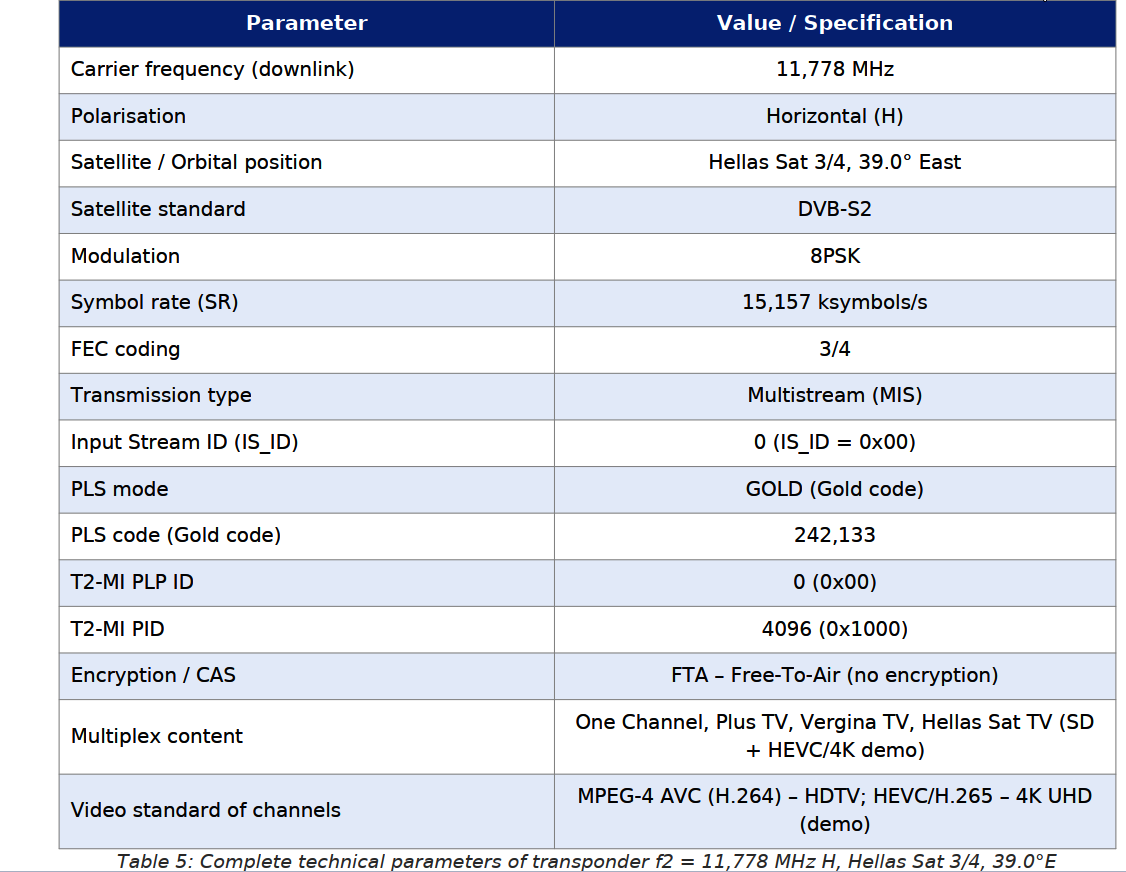
The second Cypriot T2-MI transponder operates at frequency f2 = 11,778 MHz, horizontal polarisation (H). The parameters are largely identical to f1, but the multiplex content and PLS configuration differ: Transponder f2 is notable for the presence of a demonstration channel Hellas Sat TV in 4K UHD (Ultra High Definition) resolution with HEVC (H.265) encoding. This is consistent with the licensing conditions of Cypriot DTT, which explicitly permit broadcasting in HD and UHD resolution. HEVC encoding offers up to 50% lower bit rate compared to H.264 at equivalent visual quality, which is crucial for efficient use of the capacity of the T2-MI link and the terrestrial DVB-T2 multiplex. Vergina TV is a Greek thematic channel (politics, documentaries). Plus TV is a Cypriot commercial channel. One Channel is a Cypriot lifestyle and news channel. The combination of these channels with the 4K demonstration service reflects Hellas Sat's technological ambition to present Cyprus as a showcase market for UHD DTT broadcasting.
9. DVB-S2 LAYER – MODULATION AND CODING PARAMETERS
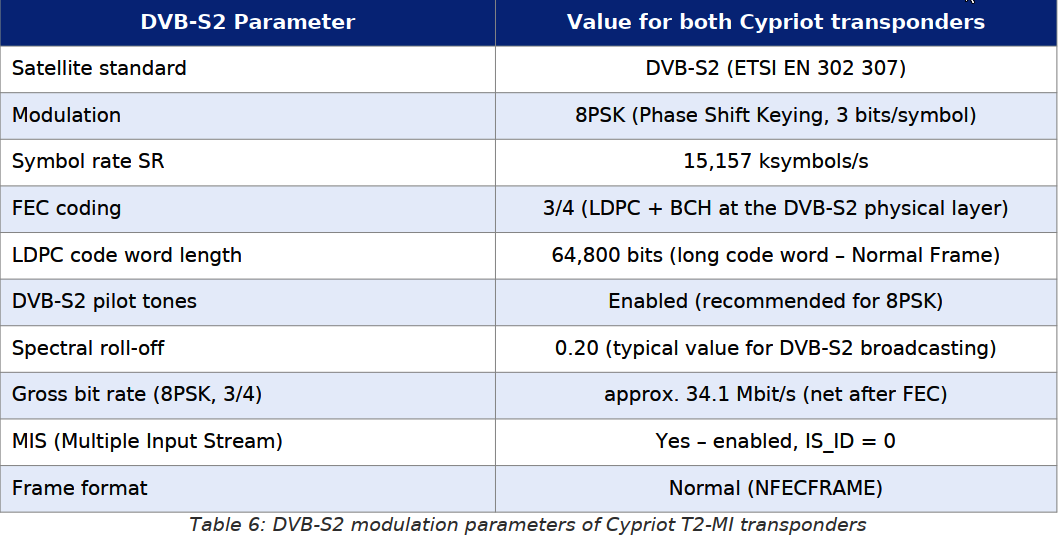
The T2-MI stream is transported via the satellite chain built on the standard DVB-S2 (Digital Video Broadcasting – Satellite – Second Generation), defined by ETSI EN 302 307. DVB-S2 is designed for efficient satellite transmission of digital services including direct-to-home (DTH) reception, television distribution and data services. 8PSK modulation represents a compromise between spectral efficiency and transmission robustness. Compared to QPSK (2 bits/symbol), 8PSK offers 3 bits/symbol, increasing capacity by 50%. Compared to 16APSK (4 bits/symbol), 8PSK is less sensitive to the non-linearity of the satellite amplifier (TWTA), which allows operation closer to the amplifier's saturation point and thus higher satellite signal power. For T2-MI distribution, where transmission reliability is the priority rather than maximum capacity, 8PSK with FEC 3/4 is a standard and proven combination.
10. MULTISTREAM (MIS) AND GOLD/ROOT PLS CODES – TECHNICAL ANALYSIS
The DVB-S2 standard (ETSI EN 302 307) defines two input stream modes: SIS (Single Input Stream) and MIS (Multiple Input Stream). The Cypriot T2-MI link uses MIS mode, which allows the transmission of multiple logically independent input streams on a single carrier signal. Each input stream is identified by an 8-bit Input Stream Identifier (ISI / IS_ID). On both Cypriot frequencies IS_ID = 0, meaning there is a single active input stream.
10.1 PLS (Physical Layer Scrambling) Code
The physical differentiation of MIS streams (and prevention of interference with neighbouring satellite systems) is ensured by the PLS (Physical Layer Scrambling) sequence. DVB-S2 defines two types of PLS codes:
• Root code: Generated by a degree-18 M-sequence polynomial. Each Root code
corresponds to a unique original code without transformation. For the Cypriot f1
transponder, a Root PLS code of 211,867 was identified in the initial phase.
• Gold code: Generated by cyclic shift from the Root M-sequence. Gold codes allow the
creation of 262,143 unique codes. Both the Cypriot f1 and f2 transponders use Gold
code 242,133.
Note: In the satellite receiver, both the PLS mode (ROOT or GOLD) and the specific PLS code
must be configured before decoding the DVB-S2 physical layer. Incorrect configuration will
cause the tuner to recognise the transponder but be unable to demodulate any data.
Technical note on f1: Some sources previously reported a Root code of 211,867 and a
newer Gold code of 242,133 for f1 = 11,761 MHz – this reflects the historical evolution
of the transponder settings. Currently (2025–2026) both transponders f1 and f2
consistently use Gold code 242,133.
11. ARCHITECTURE OF THE DISTRIBUTION CHAIN: FROM STUDIO TO DVB-T2 TRANSMITTER
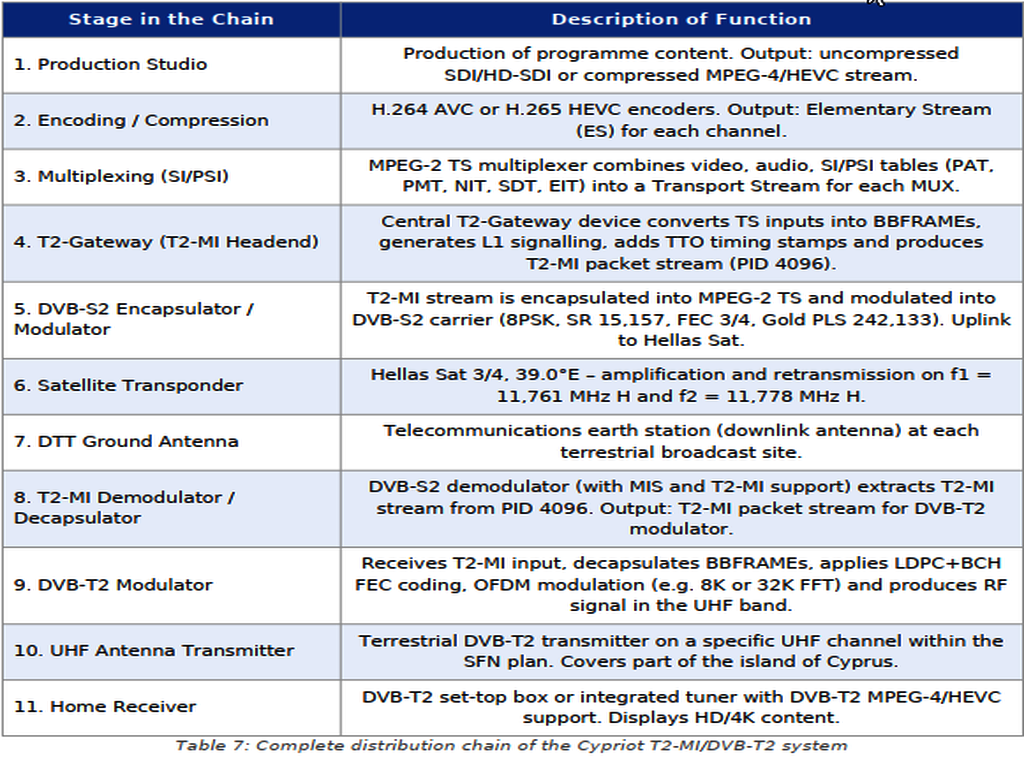
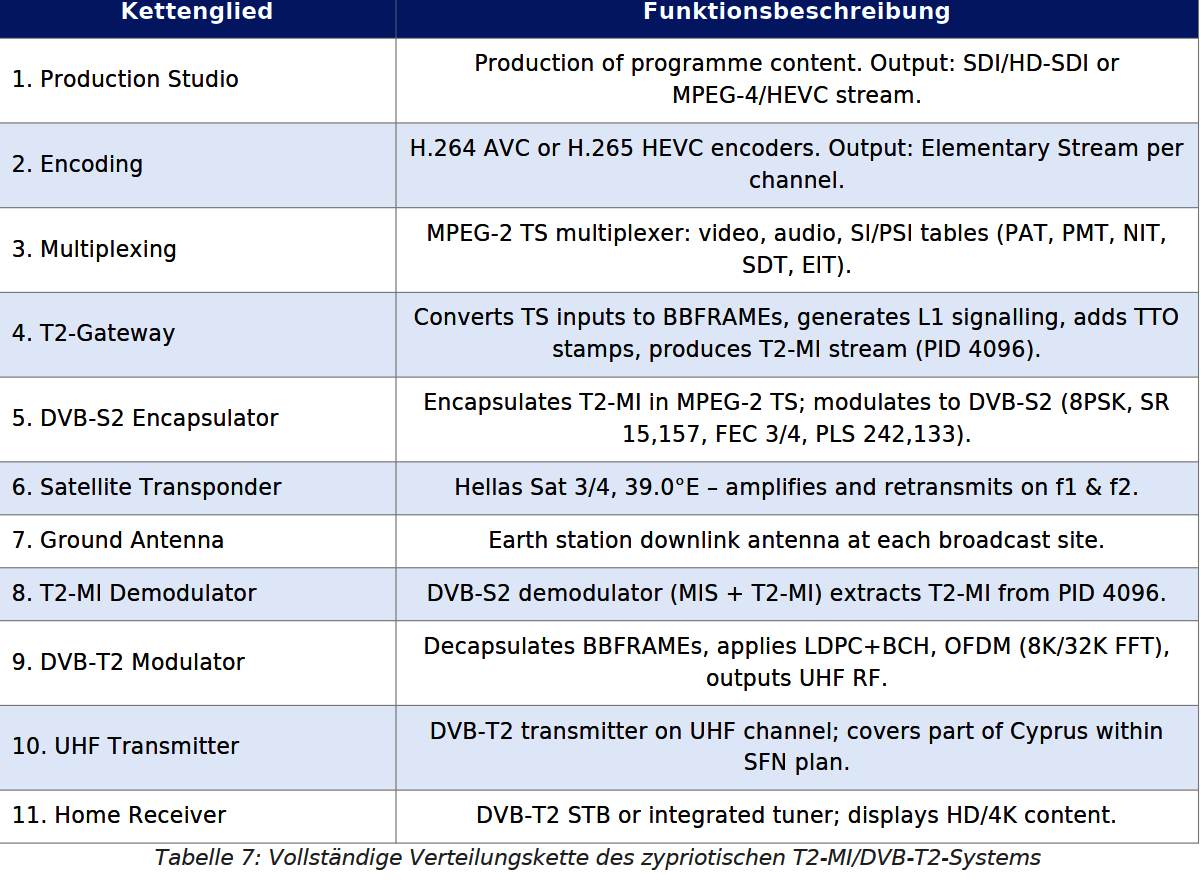
The complete distribution chain of the Cypriot T2-MI/DVB-T2 system consists of several technologically distinct but functionally interconnected layers:
12. SFN (SINGLE FREQUENCY NETWORK) IN CYPRUS – TOPOLOGY AND ADVANTAGES
A Single Frequency Network (SFN) is a network of transmitters that broadcast the same programme on the same frequency simultaneously with precise mutual phase synchronisation. From the viewer's perspective, an SFN network acts as a single super-transmitter with very extensive coverage. The key prerequisite for SFN operation is that the DVB-T2 guard interval must be longer than the maximum propagation delay difference between signals arriving from different transmitters at the reception point. The Cypriot DTT system is designed as four SFN networks with a total of eight transmission channels: each SFN covers a different area of the island (Troodos, Famagusta and others). T2-MI distribution via satellite ensures that all DVB-T2 modulators in a given SFN network receive identical T2-MI packets with the same TTO
values, thereby ensuring SFN synchronisation without GPS receivers or dedicated IP synchronisation protocols.
12.1 Advantages of SFN for Cyprus
• Efficient spectrum utilisation: The same programme on one frequency rather than multiple frequencies for different areas.
• Greater coverage: Combining signals from multiple transmitters improves coverage in shadow zones on the slopes of the Troodos mountains.
• Interference resilience: Signals from neighbouring transmitters add constructively (when within the guard interval).
• Simple backup system: Failure of one transmitter does not cause signal loss across the entire covered territory.
• Suitability for island topography: The mountainous terrain of Cyprus (Troodos max. 1,952 m a.s.l.) requires multiple broadcast sites.
13. MULTIPLEX CONTENT – CHANNEL STRUCTURE AND CODECS
Abbreviations: CY = Cyprus, GR = Greece, HS = Hellas Sat. Resolution values are indicative. Channel HS5 serves as a test feed for technological verification of the DVB-T2 chain parameters. The presence of the 4K HEVC Hellas Sat TV channel on f2 represents the platform's technological outlook towards UHD DTT broadcasting.
14. CYPRUS DTT COVERAGE, NUMBER OF VIEWERS AND SOCIAL CONTEXT
The Republic of Cyprus has a population of approximately 1,379,000 inhabitants in the controlled part of the island (UN estimate, 2026). Cyprus has historically ranked among European countries with the highest density of television receivers per household. The total number of TV households is estimated at 200,000 – 260,000,corresponding to a TV receiver penetration approaching 100%. The operation of the DTT network on the DVB-T2 standard creates the potential for access to free-to-air (FTA) HD and UHD content for all households without the need for paid satellite or IPTV subscriptions (e.g. Nova Cyprus). The availability of FTA DTT is consistent with the media policy of the Republic of Cyprus, which since the beginning of digitalisation (2011) has prioritised free terrestrial reception as a basic public service.
14.1 Geographical Coverage Challenges
Cyprus has an area of 9,250 km² (controlled area). The Troodos mountain range (max. 1,952 m a.s.l.) forms the central geographical node that casts shadows over lower areas. The significant terrain diversity requires a greater number of broadcast sites compared to flat terrain. This is precisely why SFN architecture and T2-MI satellite distribution chain is a particularly suitable solution – there is no need to build expensive terrestrial IP circuits to every mountain broadcast site.
14.2 DTT Penetration and Subscribers
FTA DTT broadcasting in Cyprus does not require any subscription – reception is free for all owners of DVB-T2 compatible equipment. Commercial paid services are available via the Nova (Multichoice Cyprus) satellite platform, not via terrestrial DTT. The new Hellas Sat DVB-T2 network thus directly competes with satellite subscriptions by offering HD and potentially UHD content free of charge via DVB-T2 antenna. The estimated number of DTT viewers after the full launch of the network (2025–2026) is 150,000 – 200,000 active DTT households.
15. RECEPTION OF T2-MI SIGNAL IN EUROPE – TECHNICAL REQUIREMENTS
The satellite T2-MI stream from Hellas Sat 3/4 is advantageous in terms of monitoring across Europe: the European Ku-band beam achieves EIRP of 40–50 dBW, enabling reception with standard antennas:
• Cyprus, Greece, Turkey, Egypt: An antenna of 45–60 cm is sufficient.
• Balkans, Romania, Bulgaria, Italy: An antenna of 75–90 cm is recommended.
• Central Europe (Slovakia, Czech Republic, Poland, Hungary): Antenna 90–120
cm, a low-noise LNB with NF ≤ 0.3 dB is recommended.
• Northern Europe (Netherlands, Belgium): Antenna 100–120 cm, reception is
possible under favourable atmospheric conditions.
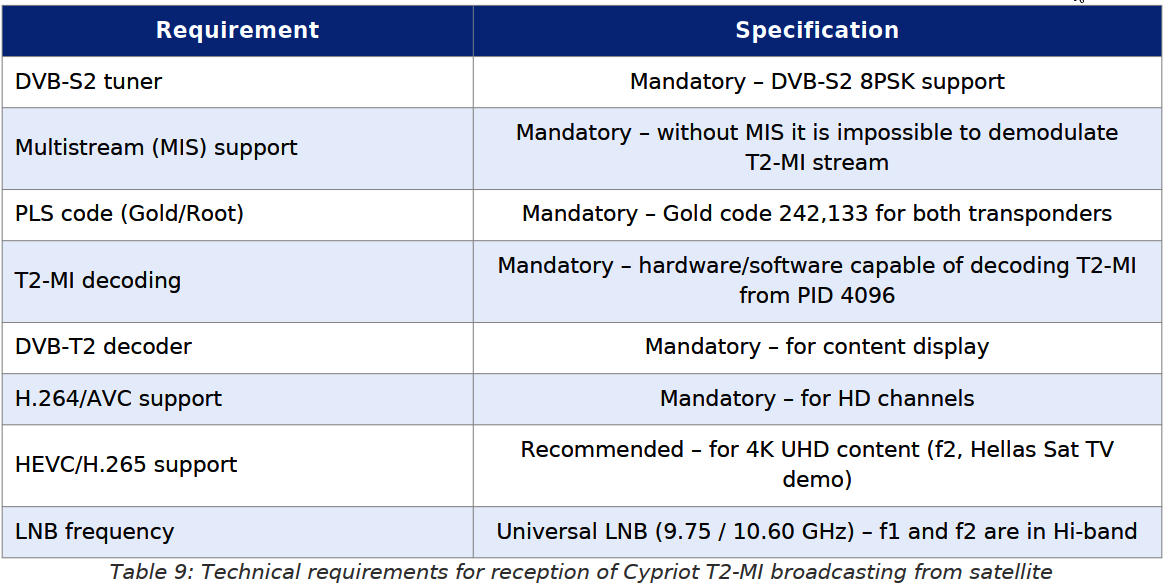
15.1 Requirements for Receiving Equipment
16. COMPARISON: T2-MI/SATELLITE VS. IP/FIBER DISTRIBUTION SOLUTION
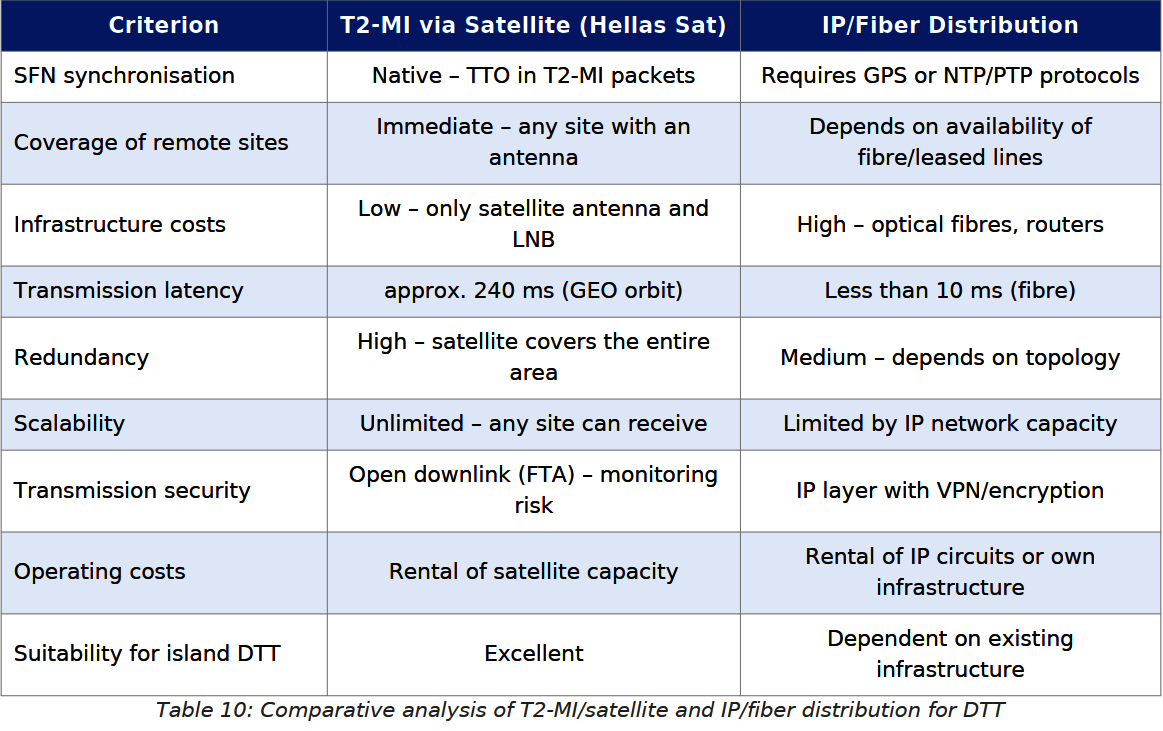
The comparison shows that for an island environment with mountainous terrain and geographically dispersed broadcast sites, T2-MI satellite distribution is clearly the more economically and technologically advantageous solution. The higher latency of the GEO satellite (approx. 240 ms) has no negative impact on the unidirectional broadcast DTT chain, since television broadcasting is not an interactive real-time application.
17. REGULATORY AND LICENSING FRAMEWORK – HELLAS SAT AS DTT OPERATOR
The operation of the DTT network in Cyprus is regulated by the Department of Electronic Communications of the Ministry of Research of the Republic of Cyprus. The regulatory framework corresponds to European legislation – the EU Audiovi-sual Media Services Directive (AVMS Directive) and the European Electronic Communications Code (EECC).
Hellas Sat received a licence for the operation of the DTT network with the following parameters:
• Date of issue: February/March 2025
• Licence validity: 1 December 2025 – 9 November 2040 (15 years)
• Scope of licence: Four SFN networks with two transmission channels each (8
channels in total)
• Areas covered: Troodos mountain range and the Famagusta (Ammochostos) area
• Broadcasting standard: DVB-T2 (HD and UHD content permitted)
• Type of operator: Exclusively a distribution platform – content is supplied by licensed
broadcasters Hellas Sat is a subsidiary of the Arab Satellite Communications Organization (Arabsat), headquartered in Riyadh, Saudi Arabia. The Cypriot government approved the licence in accordance with standard European regulatory procedures. Hellas Sat CEO Christodoulos Protopapas stated in connection with the licence that the company is excited about the opportunity to provide Cypriot households with access to HD and 4K television via the terrestrial network. This statement documents the operator's intention to continuously expand the DTT network capacity towards UHD.
18. CONCLUSION AND SCIENTIFIC SUMMARY
The Cypriot T2-MI/DVB-T2 distribution system represents a modern and technologically highly advanced approach to building terrestrial DTT infrastructure in a smaller European island state. The use of the satellite T2-MI link via Hellas Sat 3/4 at 39.0°Eas the primary distribution chain is an elegant solution that integrates the advantages of satellite transmission with the technological precision of the DVB-T2 Physical Layer Pipe architecture.
Key scientific conclusions of this analysis:
1. The Cypriot DTT system is built on the DVB-T2 standard with distribution via the T2-MI protocol encapsulated in the DVB-S2 signal on Hellas Sat 3/4, 39.0°E.
2. Both transponders (f1 = 11,761 MHz H and f2 = 11,778 MHz H) use identical DVB-S2 parameters: 8PSK, SR 16 515 ksps, FEC 5/6, MIS, Gold PLS code 242,133, T2-MI PID 4096, PLP ID 0.
3. T2-MI architecture guarantees SFN synchronisation through TTO timing stamps without the need for external GPS synchronisation systems on the DVB-T2 modulator side.
4. Hellas Sat is not only a satellite operator but also the operator of the terrestrial DVB-T2 network in Cyprus with a licence valid until 2040.
5. The content structure of the multiplexes includes HD channels (H.264) and 4K UHD demonstration content (HEVC/H.265), confirming the technological perspective of Cypriot DTT.
6. The satellite T2-MI link is the optimal distribution solution in the context of Cyprus's mountainous terrain and island geography from both a technical and economic perspective.
7. The research and monitoring value of the Cypriot T2-MI link is pan-European – the signal can be received with standard satellite antennas from Greece to Central European countries.
19. LIST OF STANDARDS, NORMS AND PROFESSIONAL REFERENCES
[1] ETSI EN 302 755 V1.4.1 (2015): Digital Video Broadcasting (DVB); Frame structure, channel
coding and modulation for a second generation digital terrestrial television broadcasting system
(DVB-T2). ETSI, Sophia Antipolis.
[2] ETSI TS 102 773 V1.3.1 (2012): Digital Video Broadcasting (DVB); Modulator Interface (T2-MI)
for a second generation digital terrestrial television broadcasting system (DVB-T2). ETSI, Sophia
Antipolis.
[3] DVB Bluebook A136 (rev. 2, 2012): DVB T2 Modulator Interface (T2-MI). Digital Video
Broadcasting Project, Geneva.
[4] ETSI EN 302 307-1 V1.4.1 (2014): Digital Video Broadcasting (DVB); Second generation
framing structure, channel coding and modulation systems for Broadcasting, Interactive Services,
News Gathering and other broadband satellite applications (DVB-S2). ETSI.
[5] DVB Bluebook A175 (2011): DVB-SIS – Single Illumination System for SFN distribution. DVB
Project, Geneva.
[6] Broadband TV News (03.03.2025): Hellas Sat to run DTT network in Cyprus.
https://www.broadbandtvnews.com/2025/03/03/hellas-sat-to-run-dtt-networ…
[7] Cyprus Mail (25.02.2025): Hellas Sat to launch advanced digital TV network in Cyprus.
https://cyprus-mail.com/
[8] Wikipedia: Digital terrestrial television in Cyprus.
https://en.wikipedia.org/wiki/Digital_terrestrial_television_in_Cyprus
[09] Wikipedia: Cyprus Broadcasting Corporation.
https://en.wikipedia.org/wiki/Cyprus_Broadcasting_Corporation
[10] Wikipedia: Hellas Sat 3. https://en.wikipedia.org/wiki/Hellas_Sat_3
[11] NTvsat: Hellas Sat 3 / Hellas Sat 4 technical data. https://nt-vsat.com/hellassat/
[12] UN Population Division: World Population Prospects 2024 – Cyprus. https://population.un.org
[13] Dávid, R. (2025): T2-MI/PLP Research Centre – Scientific records and measurements.
dxsatcs.com
Umfassende wissenschaftlich-technische Analyse der Satellitenverteilungskette für digitales terrestrisches Fernsehen(DTT) in der Republik Zypern
INHALTSVERZEICHNIS
1. Kurzfassung und Einleitung
2. Kontextualisierung: Digitales Fernsehen auf Zypern – historische Entwicklung
3. Hellas Sat 3/4 – technische Charakterisierung des Satelliten bei 39,0°O
4. DVB-T2-Standard: architektonische und Modulationsprinzipien
5. T2-MI (T2 Modulator Interface) – normative Definition und technisches Wesen
6. Physical Layer Pipe (PLP) – Prinzip und Klassifizierung
7.Satellit T2-MI-Ausstrahlung auf Zypern: Parameter der Frequenz f1 = 11.761 MHz-H
8.Satellit T2-MI-Ausstrahlung auf Zypern: Parameter der Frequenz f2 = 11.778 MHz-H
9. DVB-S2-Schicht: Modulations- und Codierungsparameter
10. Multistream (MIS) und Gold/Root-PLS-Codes
11. Architektur der Verteilungskette: Vom Produktionsstudio zum DVB-T2-Sender
12. SFN-Netz (Single Frequency Network) auf Zypern
13. Multiplexinhalt: Kanalstruktur und Codecs
14. Zypriotische DTT-Versorgung, Zuschauerzahl und sozialer Kontext
15. Empfang des T2-MI-Signals in Europa
16. Vergleich T2-MI/Satellit vs. IP/Glasfaser-Verteilungslösung
17. Regulierungs- und Lizenzrahmen
18. Schlussfolgerung und wissenschaftliche Zusammenfassung
19. Verzeichnis der Normen, Standards und Referenzen
1. KURZFASSUNG UND EINLEITUNG
Das vorliegende wissenschaftlich-technische Dokument präsentiert eine umfassende Analyse des Satellitenverteilungs-systems für das digitale terrestrische Fernsehen (DTT) in der Republik Zypern, das über den Technologiestandard T2-MI (T2 Modulator Interface) in Kombination mit Physical Layer Pipe (PLP) gemäß ETSI TS 102 773 realisiert wird. Die Satelli-tenausstrahlung erfolgt von der geostationären Position HellasSat 3/4 bei 39,0° Ost im Ku-Band auf zwei Träger-frequenzen: f1 = 11.761 MHz, horizontale Polarisation (H) und f2 = 11.778 MHz, horizontale Polarisation (H). Beide Transponder verwenden DVB-S2-Modulation mit 8PSK-Codierung und FEC 3/4 bei einer Symbolrate von SR = 15.157 kSymbole/s.
Das Dokument befasst sich mit den technologischen, regulatorischen, historischen und sozialmedialen Aspekten des Aufbaus einer modernen DTT-Infrastruktur auf der Insel Zypern. Es erläutert die Gründe für den Übergang zu DVB-T2, beschreibt detailliert die Architektur der T2-MI-Verteilungskette vom Produktionsstudio bis zur Sendeantenne, definiert den normativen Hintergrund der PLP-Struktur und gibt einen umfassenden Überblick über den Inhalt der zypriotischen Multiplexe einschließlich HD- und UHD-Dienste.
1.1 Wissenschaftliche Motivation und Forschungsziel
Die Entwicklung des digitalen terrestrischen Fernsehens in kleineren europäischen Inselstaaten stellt eine einzigartige technologische Herausforderung dar. Die Insel Zypern mit einer Bevölkerung von ca. 1.380.000 Einwohnern (UN-Schätzung 2026) verfügt über eine geografisch komplexe Morphologie – das Troodos-Gebirgsmassiv, saisonale Klimaschwankungen und die politische Teilung der Insel – was einen innovativen Ansatz für die Verteilung von Fernseh-programmströmen im DVB-T2-Terrestrialnetz erfordert. Genau hier findet der Satelliten-T2-MI-Link als primäre Verteilungskette Anwendung, die herkömmliche terrestrische IP-Leitungen oder Glasfasern in Gebieten mit einges-chränkter Infrastruktur ersetzt. Ziel dieses Forschungsdokuments ist es: (1) eine technisch präzise und wissenschaftlich
überprüfbare Beschreibung des zypriotischen T2-MI-Satellitenverteilungssystems bereitzustellen; (2) die Parameter beider Trägerfrequenzen im Kontext geltender technischer Normen zu analysieren; (3) die Rolle von Hellas Sat als integrierter Betreiber von Satellitenverteilung und terrestrischem DTT-Netz zu erläutern; und (4) diese Lösung in den breiteren europäischen Kontext der Migration zum DVB-T2-Standard einzubetten.
2. DIGITALES FERNSEHEN AUF ZYPERN – HISTORISCHE ENTWICKLUNG
Die Fernsehausstrahlung auf Zypern begann 1957. Die Zypriotische Rundfunkkorporation (CyBC / RIK) wurde als erste öffentlich-rechtliche Fernsehanstalt der Insel gegründet. Das Privatfernsehen wurde am 26. April 1992 mit dem Sender
Logos TV eingeführt. Bis Mitte der 1990er Jahre gab es auf Zypern fünf frei empfangbare terrestrische Fernsehsender.
2.1 Übergang zum digitalen terrestrischen Fernsehen (2011)
In Übereinstimmung mit den Verpflichtungen der Republik Zypern als EU-Mitgliedsstaat wurde der Analogabschalter (Analogue Switch-Off, ASO) am 1. Juli 2011 durchgeführt. Die ursprüngliche DTT-Plattform wurde auf Basis des
DVB-T-Standards mit MPEG-4-Codierung aufgebaut, was Zypern ermöglichte, direkt eine HD-taugliche Lösung einzusetzen. Für den Betrieb von DTT wurden zwei Lizenzen vergeben: die öffentlich-rechtliche Plattform CyBC (RIK) und die
kommerzielle Plattform Velister Ltd.
2.2 Modernisierung auf DVB-T2 und die Rolle von Hellas Sat
Der Bedarf an deutlich höherer Spektraleffizienz, HD- und UHD-Kapazität sowie synchronisierten Gleichwellennetzen (SFN) führte zum Interesse an der Migration zu DVB-T2. Der Betreiber Hellas Sat – Tochtergesellschaft der Arab Satellite
Communications Organization (Arabsat) – erhielt eine Lizenz für den Betrieb eines DTT-Netzes mit Gültigkeit vom
1. Dezember 2025 bis 9. November 2040.
Das neue Netz besteht aus vier Gleichwellennetzen (SFN), jeweils mit zwei Übertragungskanälen ausgestattet. Hellas Sat ist damit nicht nur Betreiber der Satellitenverteilungskette (über den T2-MI-Link), sondern auch Betreiber der gesamten
terrestrischen DVB-T2-Netzinfrastruktur.
3. HELLAS SAT 3/4 – TECHNISCHE CHARAKTERISIERUNG DESSATELLITEN BEI 39,0°Ost
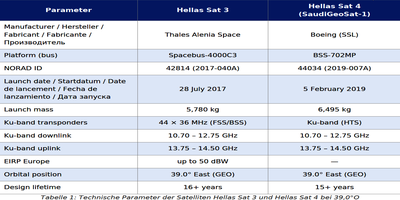
An der Orbitalposition 39,0° Ost befinden sich zwei ko-lokalisierte Satelliten: Hellas Sat 3 und Hellas Sat 4 (SaudiGeoSat-1). Hellas Sat 3 wurde am 28. Juli 2017 mit einer Ariane-5-ECA-Rakete aus Französisch-Guayana gestartet. Hellas Sat 4 wurde am 5. Februar 2019 ebenfalls mit einer Ariane-5-ECA-Rakete gestartet. Der europäische Ku-Band-Strahl von Hellas Sat 3 (FSS/BSS-Strahl) erreicht EIRP-Werte von bis zu 50 dBW über Griechenland, Zypern und dem Balkan. Diese hohe EIRP ermöglicht den Empfang mit Antennen von 70–80 cm Durchmesser in Mitteleuropa und mit 45–60 cm Antennen auf Zypern und in Griechenland.
4. DVB-T2-STANDARD – ARCHITEKTONISCHE UND MODULATIONSPRINZIPIEN
DVB-T2 ist in der Norm ETSI EN 302 755 definiert und stellt die zweite Generation des europäischen Standards für digitales terrestrisches Fernsehen dar. Im Vergleich zu DVB-T bringt er eine 30–50%ige Steigerung der Spektralkapazität durch: fortschrittliche LDPC+BCH-Codierung, 256-QAM-Modulation, Physical Layer Pipes (PLP), erweiterte FFT-Größen (1K bis 32K), längere Schutzintervalle und vollständige SFN-Unterstützung.Die Norm ETSI EN 302 755 definiert zwei Profile: T2-Base (ursprüngliches Profil für stationäre Empfänger) und T2-Lite (für mobilen Empfang). Das zypriotische DTT-Netz nutzt das T2-Base-Profil.
4.1 Wichtigste technische Merkmale von DVB-T2
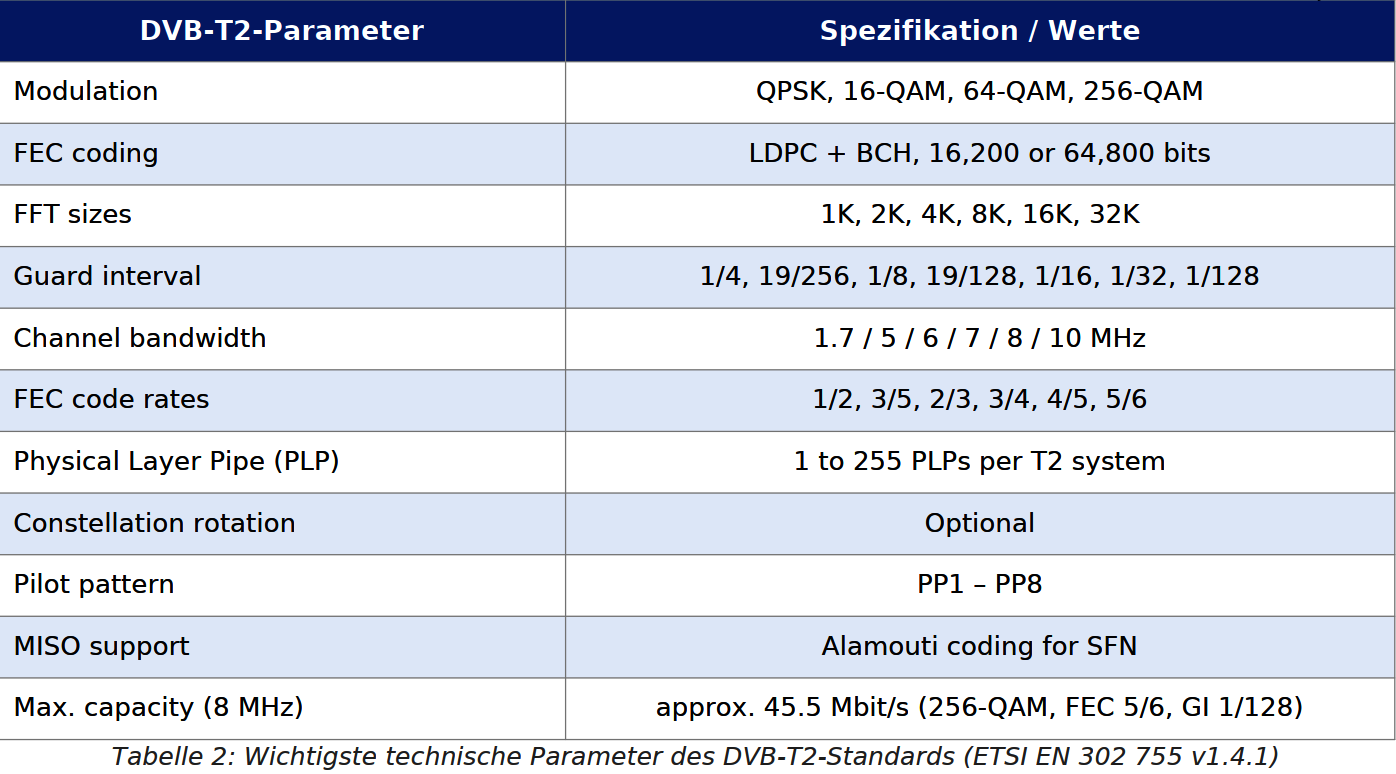
5. T2-MI (T2 MODULATOR INTERFACE) – NORMATIVE DEFINITION UND TECHNISCHES WESEN
T2-MI (T2 Modulator Interface) ist eine Schnittstelle, die in der Norm ETSI TS 102 773 (DVB Bluebook A136) definiert ist. Sie dient dem Transport vorverarbeiteter DVB-T2-Datenrahmen vom zentralen T2-Gateway-Gerät zu den einzelnen Modulatoren im verteilten Netz. T2-MI ermöglicht den Betrieb synchronisierter SFN-Netze ohne lokalen Multiplexer an jedem Sendeknoten.
5.1 Funktionsprinzip von T2-MI
Das zentrale Gerät wird als T2-Gateway bezeichnet. Es empfängt Eingangs-Transportströme (MPEG-2 TS) oder GSE Daten für die einzelnen PLPs und führt folgende Schritte durch:
• Formatierung der Eingangsdaten in Baseband Frames (BBFRAME) für jeden PLP
• Generierung der L1-Signalisierung mit T2-Rahmen-Parametern
• Zeitplanung der T2-Rahmen und Interleaving-Rahmen
• Einfügen präziser Zeitmarken TTO (Time to Output) für SFN-Synchronisation
• Einkapselung in T2-MI-Pakete und Weiterleitung zu den Modulatoren Der T2-MI-PID = 4096 (0x1000) ist der in der Norm ETSI TS 102 773 festgelegte Standardwert, der auch vom zypriotischen T2-MI-Link verwendet wird.
5.2 Vorteile von T2-MI gegenüber dem traditionellen IP-Verteilungsmodell
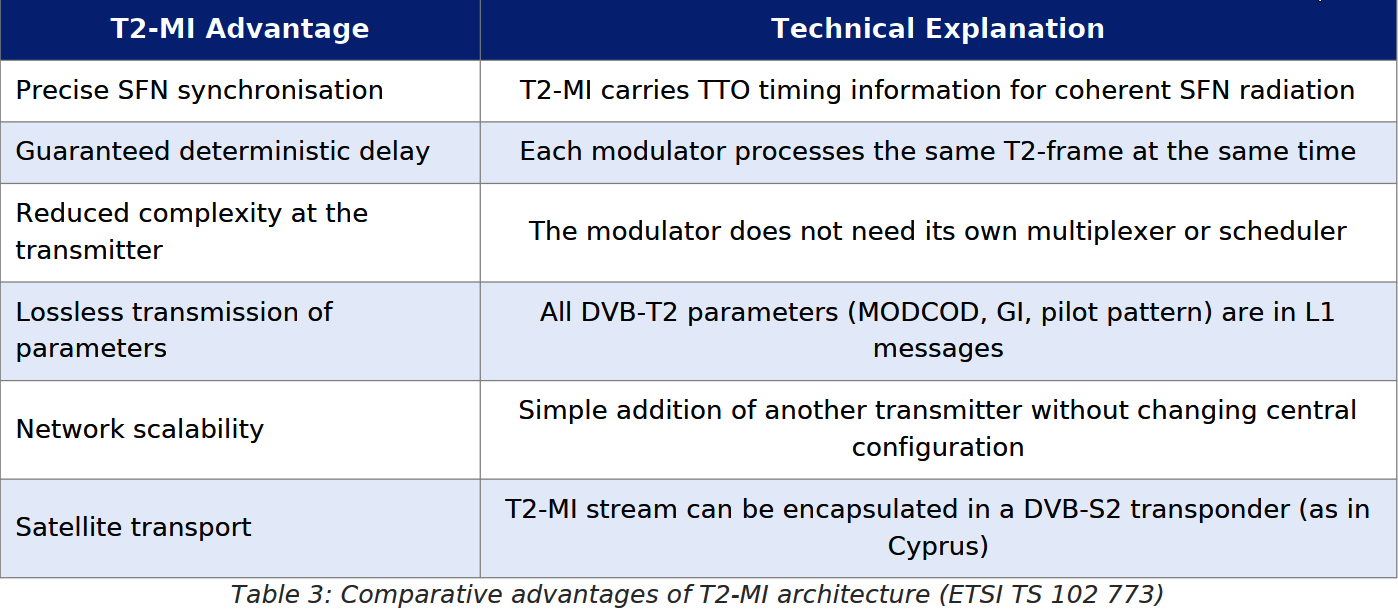
6. PHYSICAL LAYER PIPE (PLP) – PRINZIP UND KLASSIFIZIERUNG
Physical Layer Pipe (PLP) ist ein Schlüsselkonzept des DVB-T2-Standards (ETSI EN 302 755). Eine PLP stellt einen logischen Datenkanal auf der physikalischen Schicht des DVB-T2-Systems dar. Der Eingang des T2-Systems besteht aus einem oder mehreren logischen Datenströmen, wobei jeder Datenstrom von genau einer PLP getragen wird.
Der PLP-Bezeichner ist ein 8-Bit-Feld (PLP_ID).
6.1 Typen von PLP
DVB-T2 unterscheidet zwei grundlegende PLP-Typen:
• Data PLP: Trägt Daten eines oder mehrerer Multimediadienste (TV-Kanäle). Kann im T2-Rahmen statisch oder dynami-sch zugewiesen werden.
• Common PLP: Enthält Daten, die für eine Gruppe von Data-PLPs gemeinsam sind (z.B. SI/PSI-Tabellen). Wird einmal pro T2-Rahmen unmittelbar nach der L1-Signalisierung übertragen.Jede PLP durchläuft ein Modenadaptationsmodul mit Input Stream Synchronizer (ISSY), Null Packet Deletion und CRC-8-Encoder. Das Ergebnis sind BBFRAMEs als Eingang für die LDPC+BCH-FEC-Codierung.
6.2 Zusammenhang zwischen PLP und T2-MI
Beim zypriotischen T2-MI-Link entspricht jedes übertragene Multiplexprogramm einer PLP mit PLP_ID = 0. Für beide Transponder f1 und f2 auf Zypern ist T2MI-PLP ID 0 deklariert.
Hinweis: T2MI-PLP ID 0x00 (Wert 0) ist ein gültiger und häufig verwendeter Wert für die erste Daten-PLP in einer Einkanal-Konfiguration.
7. SATELLIT T2-MI-AUSSTRAHLUNG: FREQUENZ f1 = 11,761 MHz H
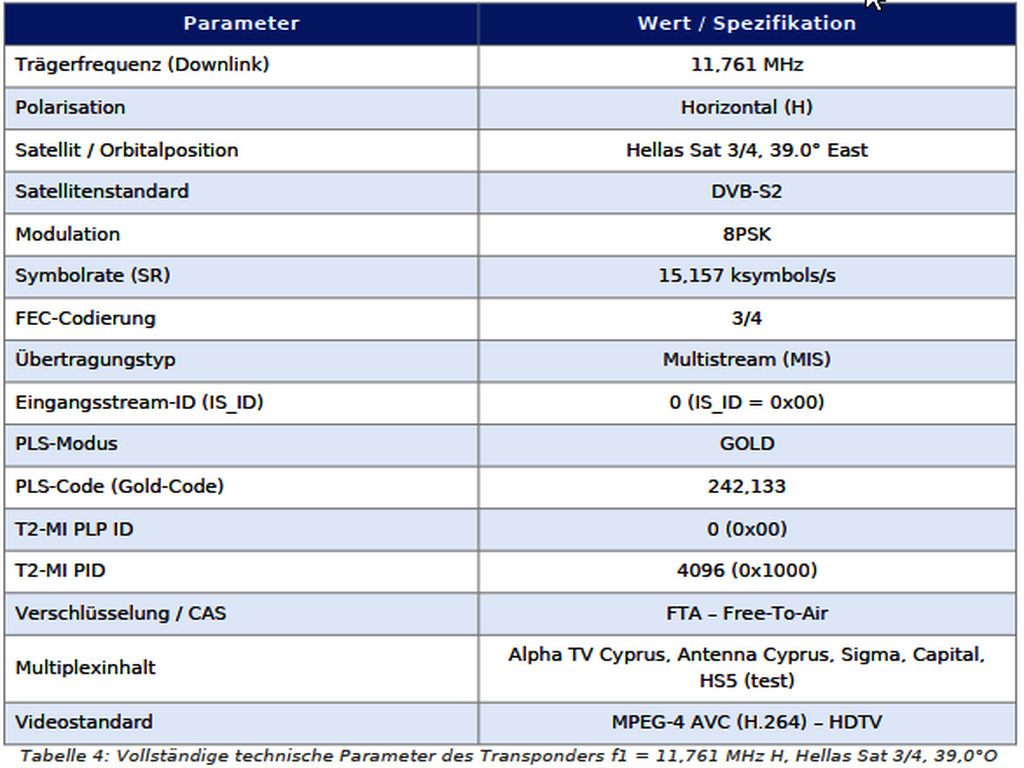
Der erste zypriotische T2-MI-Transponder arbeitet auf der Frequenz f1 = 11,761 MHz, horizontale Polarisation (H). Die folgende Tabelle enthält die vollständigen technischen Parameter:
8. SATELLIT T2-MI-AUSSTRAHLUNG: FREQUENZ f2 = 11,778 MHz H
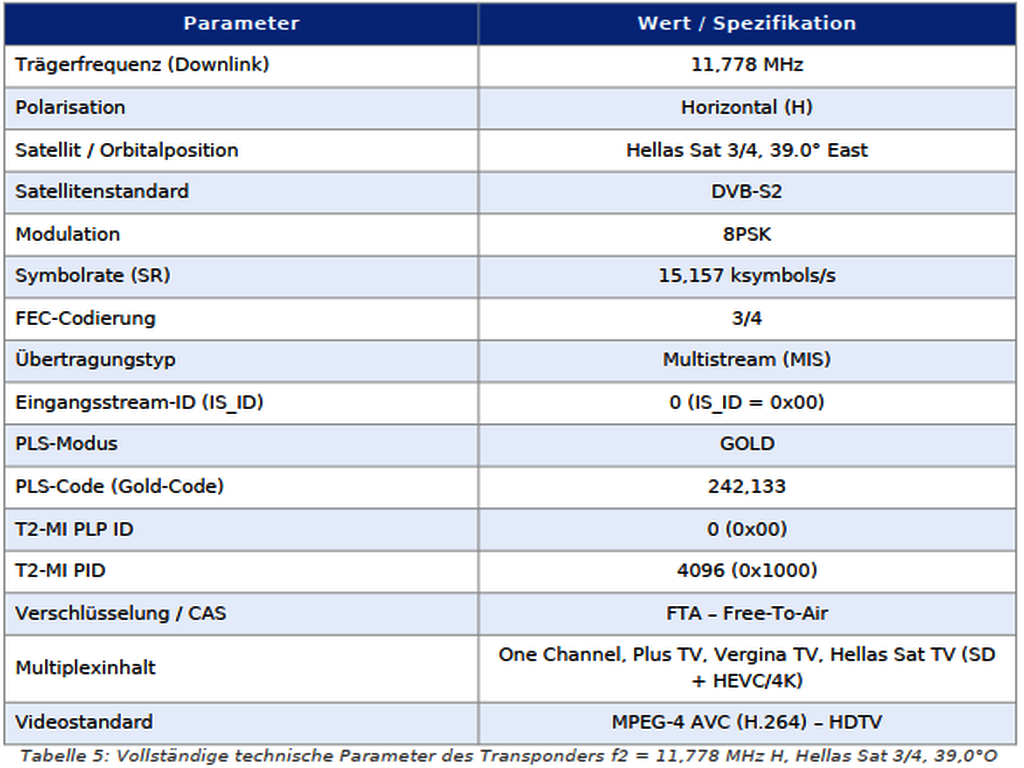
Der zweite zypriotische T2-MI-Transponder arbeitet auf der Frequenz f2 = 11,778 MHz, horizontale Polarisation (H). Die folgende Tabelle enthält die vollständigen technischen Parameter:
9. DVB-S2-SCHICHT – MODULATIONS- UND CODIERUNGSPARAMETER
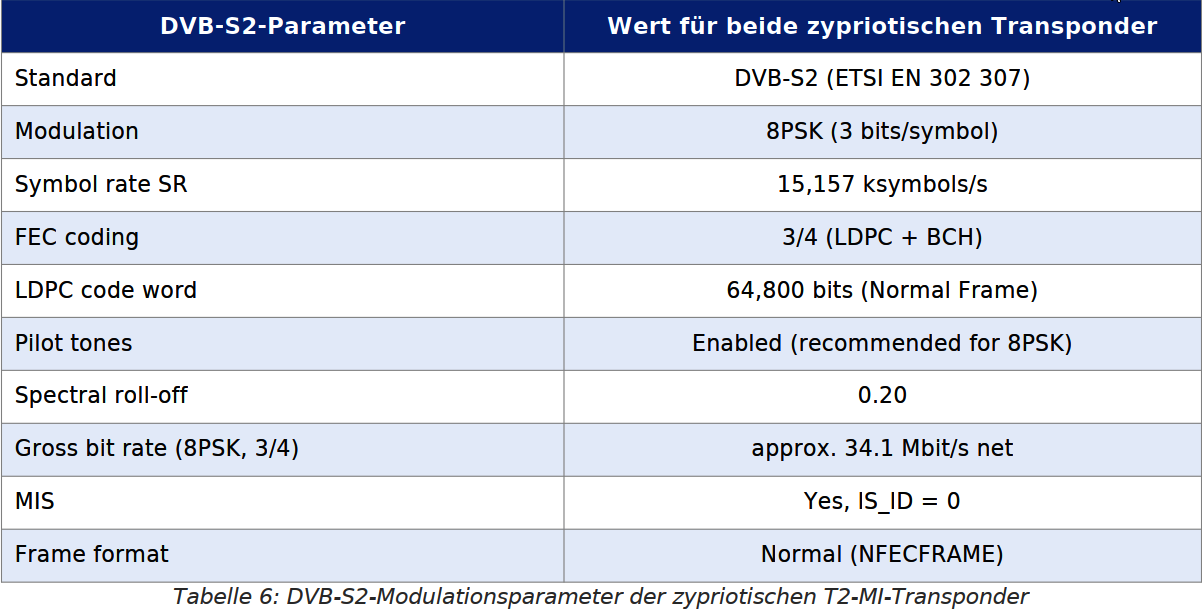
Der T2-MI-Strom wird über die Satellitenkette übertragen, die auf dem Standard DVB-S2 (ETSI EN 302 307) aufgebaut ist. Die Modulation 8PSK ist ein Kompromiss zwischen Spektraleffizienz und Übertragungsrobustheit. Im Vergleich zu QPSK (2 Bit/Symbol) bietet 8PSK 3 Bit/Symbol und erhöht damit die Kapazität um 50 %.
10. MULTISTREAM (MIS) UND GOLD/ROOT-PLS-CODES – TECHNISCHE ANALYSE
DVB-S2 (ETSI EN 302 307) definiert zwei Eingangsstrommodi: SIS (Single Input Stream) und MIS (Multiple Input Stream). Der zypriotische T2-MI-Link nutzt den MIS-Modus. Auf beiden zypriotischen Frequenzen ist IS_ID = 0. 10.1 PLS (Physical Layer Scrambling)-Code DVB-S2 definiert zwei Typen von PLS-Codes:
• Root-Code: Erzeugt durch ein M-Sequenz-Polynom vom Grad 18. Für den
zypriotischen f1-Transponder wurde in der Anfangsphase Root-PLS-Code 211.867
identifiziert.
• Gold-Code: Erzeugt durch zyklische Verschiebung aus der Root-M-Sequenz.
Ermöglicht 262.143 eindeutige Codes. Beide Transponder f1 und f2 verwenden
Gold-Code 242.133.
Hinweis: Im Satellitenempfänger müssen sowohl der PLS-Modus (ROOT oder GOLD) als auch
der spezifische PLS-Code vor der Decodierung der DVB-S2-Physikalschicht konfiguriert werden.
11. ARCHITEKTUR DER VERTEILUNGSKETTE: VOM STUDIO ZUM DVB-T2-SENDER
Die vollständige Verteilungskette des zypriotischen T2-MI/DVB-T2-Systems besteht aus mehreren technologisch unterschiedlichen, aber funktional verbundenen Schichten:
12. SFN-NETZ (SINGLE FREQUENCY NETWORK) AUF ZYPERN – TOPOLOGIE UND VORTEILE
Ein Single Frequency Network (SFN) ist ein Sendernetz, das dasselbe Programm auf derselben Frequenz gleichzeitig mit präziser gegenseitiger Phasensynchronisation ausstrahlt. Das zypriotische DTT-System ist als vier SFN-Netze mit insgesamt acht Übertragungskanälen konzipiert. Die T2-MI-Verteilung per Satellit stellt sicher, dass alle DVB-T2-Modulatoren in einem SFN-Netz identische T2-MI-Pakete mit denselben TTO-Werten empfangen.
12.1 Vorteile des SFN für Zypern
• Effiziente Spektrumnutzung: Dasselbe Programm auf einer Frequenz statt mehrerer Frequenzen für verschiedene Gebiete.
• Größere Versorgung: Addierung von Signalen mehrerer Sender verbessert die Versorgung in Abschattungsbereichen am Troodos-Gebirge.
• Interferenzresistenz: Signale benachbarter Sender addieren sich konstruktiv (bei Empfang innerhalb des Schutzintervalls).
• Einfaches Redundanzsystem: Ausfall eines Senders führt nicht zum Signalverlust im gesamten Versorgungsgebiet.
• Eignung für Inseltopografie: Das bergige Gelände Zyperns (Troodos max. 1.952 m ü. NN) erfordert mehrere Sendestandorte.
13. MULTIPLEXINHALT – KANALSTRUKTUR UND CODECS
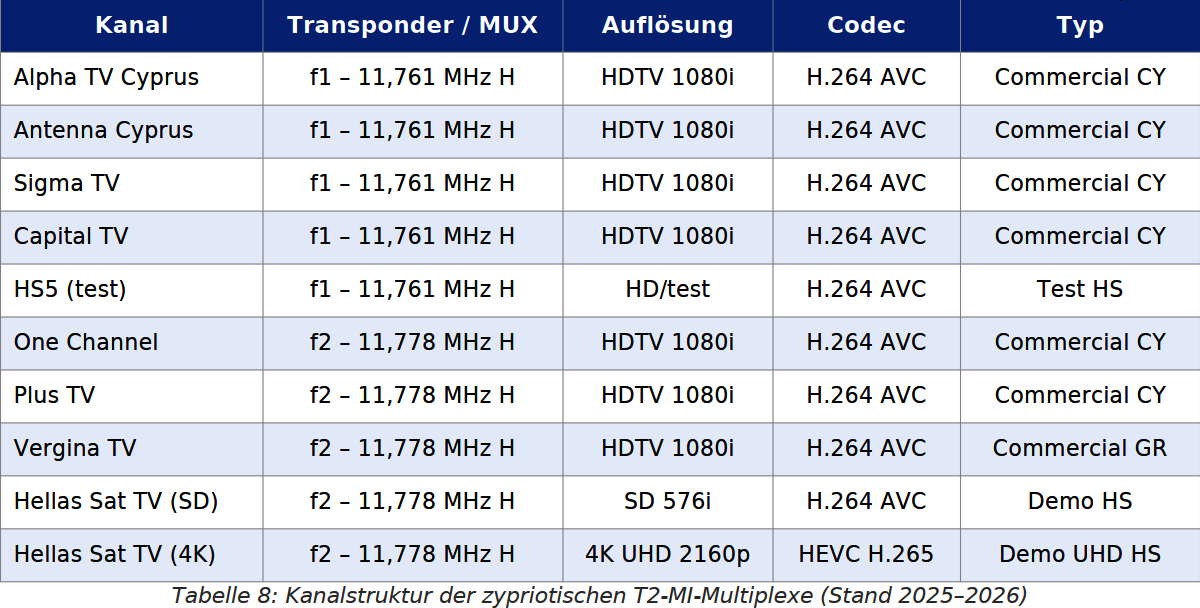
Abkürzungen: CY = Zypern, GR = Griechenland, HS = Hellas Sat. Der 4K-HEVC-Kanal Hellas Sat TV auf f2 repräsentiert den technologischen Ausblick der Plattform in Richtung UHD-DTT-Ausstrahlung.
14. ZYPRIOTISCHE DTT-VERSORGUNG, ZUSCHAUERZAHL UND SOZIALER KONTEXT
Die Republik Zypern hat etwa 1.379.000 Einwohner im kontrollierten Teil der Insel (UN-Schätzung 2026). Die Gesamtzahl der TV-Haushalte wird auf 200.000 – 260.000 geschätzt, was einer TV-Empfängerpenetration von nahezu 100 % entspricht. Das Troodos-Gebirge (max. 1.952 m ü. NN) bildet den zentralen geografischen Knoten, der tiefer gelegene Gebiete abschattet. Die ausgeprägte Geländevielfalt erfordert eine größere Anzahl von Sendestandorten im Vergleich zum Flachland. Die geschätzte Anzahl der DTT-Zuschauer nach der vollständigen Netzinbetriebnahme (2025–2026) beträgt 150.000 – 200.000 aktive DTT-Haushalte.
15. EMPFANG DES T2-MI-SIGNALS IN EUROPA – TECHNISCHE ANFORDERUNGEN
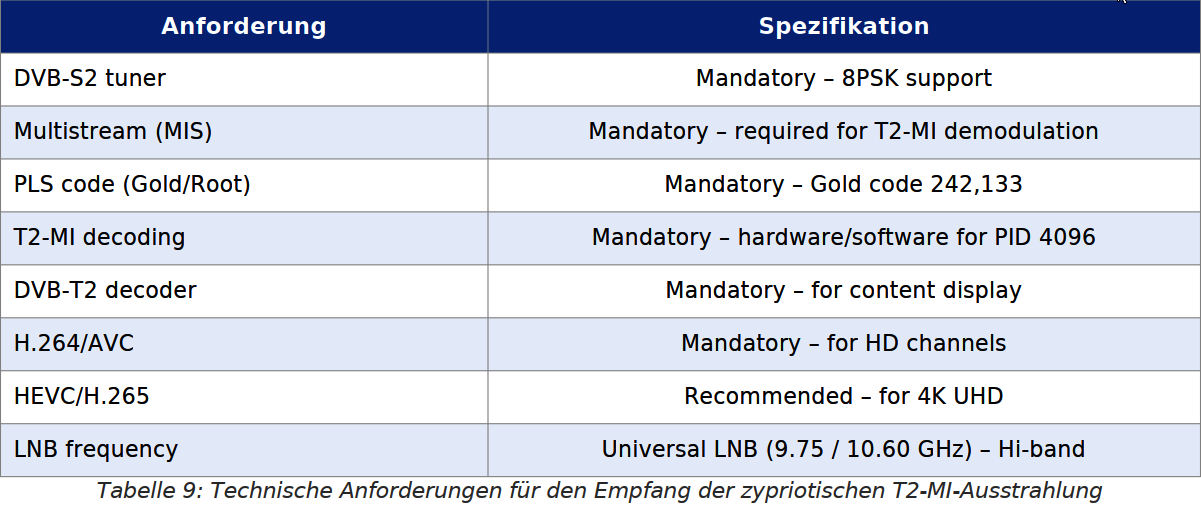
Der europäische Ku-Band-Strahl erreicht EIRP von 40–50 dBW, was den Empfang mit Standardantennen ermöglicht:
• Zypern, Griechenland, Türkei, Ägypten: Antenne 45–60 cm ausreichend.
• Balkan, Rumänien, Bulgarien, Italien: Antenne 75–90 cm empfohlen.
• Mitteleuropa (Slowakei, Tschechien, Polen, Ungarn): Antenne 90–120 cm, rauscharmes LNB mit NF ≤ 0,3 dB empfohlen.
• Nordeuropa (Niederlande, Belgien): Antenne 100–120 cm, Empfang unter günstigen Bedingungen möglich.
15.1 Anforderungen an die Empfangsgeräte
16. VERGLEICH T2-MI/SATELLIT vs. IP/GLASFASER-VERTEILUNGSLÖSUNG
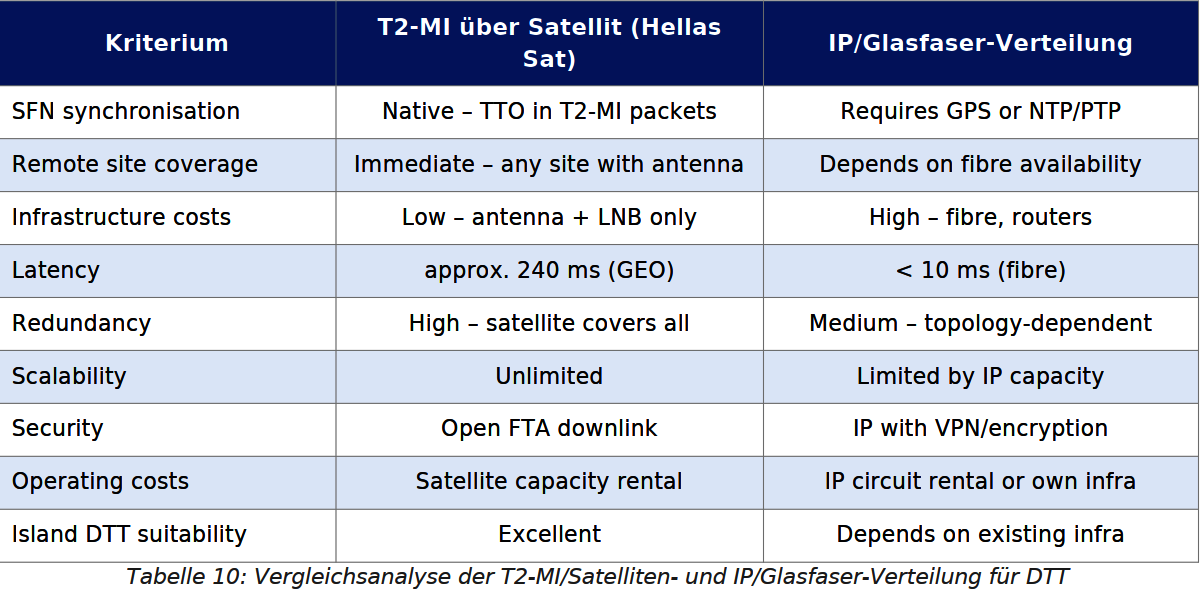
Der Vergleich zeigt, dass für eine Inselumgebung mit bergigem Gelände und geografisch verstreuten Sendestandorten die T2-MI-Satellitenverteilung die wirtschaftlich und technologisch vorteilhaftere Lösung ist. Die höhere Latenz des
GEO-Satelliten (ca. 240 ms) hat keinen negativen Einfluss auf die unidirektionale Broadcast-DTT-Kette.
17. REGULIERUNGS- UND LIZENZRAHMEN – HELLAS SAT ALS DTT-BETREIBER
Der Betrieb des DTT-Netzes auf Zypern wird von der Abteilung für elektronische Kommunikation des Forschungs-ministeriums der Republik Zypern reguliert. Hellas Sat erhielt eine DTT-Betreiberlizenz mit Gültigkeit vom 1. Dezember 2025 bis 9. November 2040 für vier SFN-Netze. Hellas Sat ist eine Tochtergesellschaft der Arab Satellite Communications Organization (Arabsat) mit Sitz in Riad (Saudi-Arabien).
18. SCHLUSSFOLGERUNG UND WISSENSCHAFTLICHE ZUSAMMENFASSUNG
Das zypriotische T2-MI/DVB-T2-Verteilungssystem repräsentiert einen modernen und technologisch hochentwickelten Ansatz zum Aufbau einer terrestrischen DTT-Infrastruktur in einem kleineren europäischen Inselstaat. Die Nutzung des
Satelliten-T2-MI-Links über Hellas Sat 3/4 bei 39,0°O als primäre Verteilungskette ist eine elegante Lösung.
Wissenschaftliche Schlussfolgerungen:
1. Das zypriotische DTT-System basiert auf DVB-T2 mit Verteilung über T2-MI, eingebettet im DVB-S2-Signal auf Hellas Sat 3/4, 39,0°O.
2. Beide Transponder (f1 = 11.761 MHz H und f2 = 11.778 MHz H) verwenden identische DVB-S2-Parameter: 8PSK, ,SR=16 515 ksps, FEC 5/6, MIS, Gold-PLS-Code 242.133, T2-MI PID 4096, PLP ID 0.
3. Die T2-MI-Architektur garantiert SFN-Synchronisation über TTO-Zeitmarken ohne externe GPS-Systeme.
4. Hellas Sat ist nicht nur Satellitenbetreiber, sondern auch Betreiber des terrestrischen DVB-T2-Netzes auf Zypern mit einer Lizenz bis 2040.
5. Die Inhaltsstruktur der Multiplexe umfasst HD-Kanäle (H.264) und 4K UHD-Demonstrationsinhalt (HEVC/H.265).
6. Der Satelliten-T2-MI-Link ist angesichts des bergigen Geländes und der Insellage Zyperns die optimale Verteil-ungslösung.
7. Der Forschungs- und Monitoringwert des zypriotischen T2-MI-Links ist gesamteuropäisch.
19. VERZEICHNIS DER NORMEN, STANDARDS UND FACHLICHEN REFERENZEN
[1] ETSI EN 302 755 V1.4.1 (2015): DVB; Frame structure, channel coding and modulation for
DVB-T2. ETSI, Sophia Antipolis.
[2] ETSI TS 102 773 V1.3.1 (2012): DVB; Modulator Interface (T2-MI) for DVB-T2. ETSI, Sophia
Antipolis.
[3] DVB Bluebook A136 (rev. 2, 2012): DVB T2 Modulator Interface (T2-MI). DVB Project, Geneva.
[4] ETSI EN 302 307-1 V1.4.1 (2014): DVB-S2; Second generation framing structure. ETSI.
[5] DVB Bluebook A175 (2011): DVB-SIS – Single Illumination System for SFN. DVB Project.
[6] Broadband TV News (03.03.2025): Hellas Sat to run DTT network in Cyprus.
[7] Cyprus Mail (25.02.2025): Hellas Sat to launch advanced digital TV network in Cyprus.
[8] SatKurier.pl (2025): Cypryjskie kanaly DVB-T2 na satelicie.
[9] OpenPLi Forums (2025): Cyprus, fta op Hellas Sat (39 oost).
[10] Wikipedia: Digital terrestrial television in Cyprus.
[11] Wikipedia: Cyprus Broadcasting Corporation (CyBC/RIK).
[12] Wikipedia: Hellas Sat 3.
[13] NTvsat: Hellas Sat 3 / Hellas Sat 4 technical data. https://nt-vsat.com/hellassat/
[14] UN Population Division: World Population Prospects 2024 – Cyprus.
[15] Dávid, R. (2025): T2-MI/PLP Research Centre – Scientific records. dxsatcs.com.
Analyse scientifique et technique complète de la chaîne de distribu- tion satellite pour la télévision numérique terrestre (TNT) en République de Chypre.
TABLE DES MATIÈRES
1. Résumé et Introduction
2. Contextualisation: Télévision numérique à Chypre – développement historique
3. Hellas Sat 3/4 – caractérisation technique du satellite à 39,0°E
4. Norme DVB-T2: principes architecturaux et de modulation
5. T2-MI (T2 Modulator Interface) – définition normative et essence technique
6. Physical Layer Pipe (PLP) – principe et classification
7. Diffusion satellite T2-MI à Chypre: paramètres de la fréquence f1 = 11 761 MHz H
8. Diffusion satellite T2-MI à Chypre: paramètres de la fréquence f2 = 11 778 MHz H
9. Couche DVB-S2: paramètres de modulation et de codage
10. Multistream (MIS) et codes PLS Gold/Root
11. Architecture de la chaîne de distribution: du studio à l'émetteur DVB-T2
12. Réseau SFN (Single Frequency Network) à Chypre
13. Contenu des multiplex: structure des chaînes et codecs
14. Couverture TNT chypriote, téléspectateurs et contexte social
15. Réception du signal T2-MI en Europe
16. Comparaison T2-MI/Satellite vs. distribution IP/Fibre
17. Cadre réglementaire et de licence
18. Conclusion et résumé scientifique
19. Liste des normes, standards et références
1. RÉSUMÉ ET INTRODUCTION
Le présent document scientifique et technique présente une analyse complète du système de distribution par satellite pour la télévision numérique terrestre (TNT) en République de Chypre, mis en œuvre via la norme technologique T2-MI (T2 Modulator Interface) en combinaison avec Physical Layer Pipe (PLP) conformément à la norme ETSI TS 102 773. La diffusion par satellite est réalisée depuis la position géostationnaire Hellas Sat 3/4 à 39,0° Est en bande Ku sur deux fréquences porteuses: f1 = 11 761 MHz, polarisation horizontale (H) et f2 = 11 778 MHz, polarisation horizontale (H). Les deux transpondeurs utilisent la modulation DVB-S2 avec codage 8PSK et FEC 3/4 à un débit symbole de SR = 15 157 ksymboles/s. Le document traite des aspects technologiques, réglementaires, historiques et sociomédiatiques de la construction d'une infrastructure TNT moderne sur l'île de Chypre. Il explique les raisons de la transition vers DVB-T2, décrit en détail l'architecture de la chaîne de distribution T2-MI depuis le studio de production jusqu'à l'émetteur d'antenne, définit le contexte normatif de la structure PLP et donne un aperçu complet du contenu des multiplex chypriotes, y compris les services HD et UHD.
1.1 Motivation scientifique et objectif de recherche
Le développement de la télévision numérique terrestre dans les petits États insulaires européens représente un défi technologique unique. L'île de Chypre, avec une population d'environ 1 380 000 habitants (estimation ONU, 2026), présente une morphologie géographiquement complexe – le massif montagneux du Troodos, des variations climatiques saisonnières et la division politique de l'île – ce qui nécessite une approche innovante de la distribution des flux de programmes télévisés pour le réseau terrestre DVB-T2. L'objectif de ce document de recherche est: (1) fournir une description techniquement précise et scientifiquement vérifiable du système de distribution satellite T2-MI chypriote; (2) analyser les paramètres des deux fréquences porteuses dans le contexte des normes techniques applicables; (3) expliquer le rôle d'Hellas Sat en tant qu'opérateur intégré de la distribution satellite et du réseau TNT terrestre; et (4) situer cette solution dans le contexte européen plus large de la migration vers la norme DVB-T2.
2. TÉLÉVISION NUMÉRIQUE À CHYPRE – DÉVELOPPEMENT HISTORIQUE
La radiodiffusion télévisée à Chypre a débuté en 1957. La Société de radiodiffusion chypriote (CyBC / RIK) a été créée comme première institution télévisuelle publique de l'île. La télévision privée a été introduite le 26 avril 1992 avec la chaîne Logos TV. Jusqu'au milieu des années 1990, Chypre comptait cinq chaînes de télévision hertziennes gratuites.
2.1 Transition vers la télévision numérique terrestre (2011) Conformément aux obligations de la République de Chypre en tant qu'État membre de l'Union européenne, le passage au numérique (Analogue Switch-Off, ASO) a été réalisé le 1er juillet 2011. La plateforme TNT initiale a été construite sur la base du standard DVB-T avec codage MPEG-4, ce qui a permis à Chypre de déployer directement une solution compatible HD. Deux licences ont été accordées pour l'exploitation de la TNT: la plateforme publique CyBC (RIK) et la plateforme commerciale Velister Ltd.
2.2 Modernisation vers DVB-T2 et rôle d'Hellas Sat
Le besoin d'une efficacité spectrale nettement plus élevée, d'une capacité HD et UHD et de réseaux monofréquence synchronisés (SFN) a suscité un intérêt pour la migration vers DVB-T2. L'opérateur Hellas Sat – filiale de l'Organisation arabe des communications par satellite (Arabsat) – a obtenu une licence pour l'exploitation d'un réseau TNT valable du 1er décembre 2025 au 9 novembre 2040. Le nouveau réseau se compose de quatre réseaux monofréquence (SFN), chacun équipé de deux canaux de transmission. Hellas Sat n'est donc pas seulement l'opérateur de la chaîne de distribution satellite (via le lien T2-MI), mais aussi l'opérateur de toute l'infrastructure du réseau DVB-T2 terrestre.
3. HELLAS SAT 3/4 – CARACTÉRISATION TECHNIQUE DU SATELLITE À 39,0°E
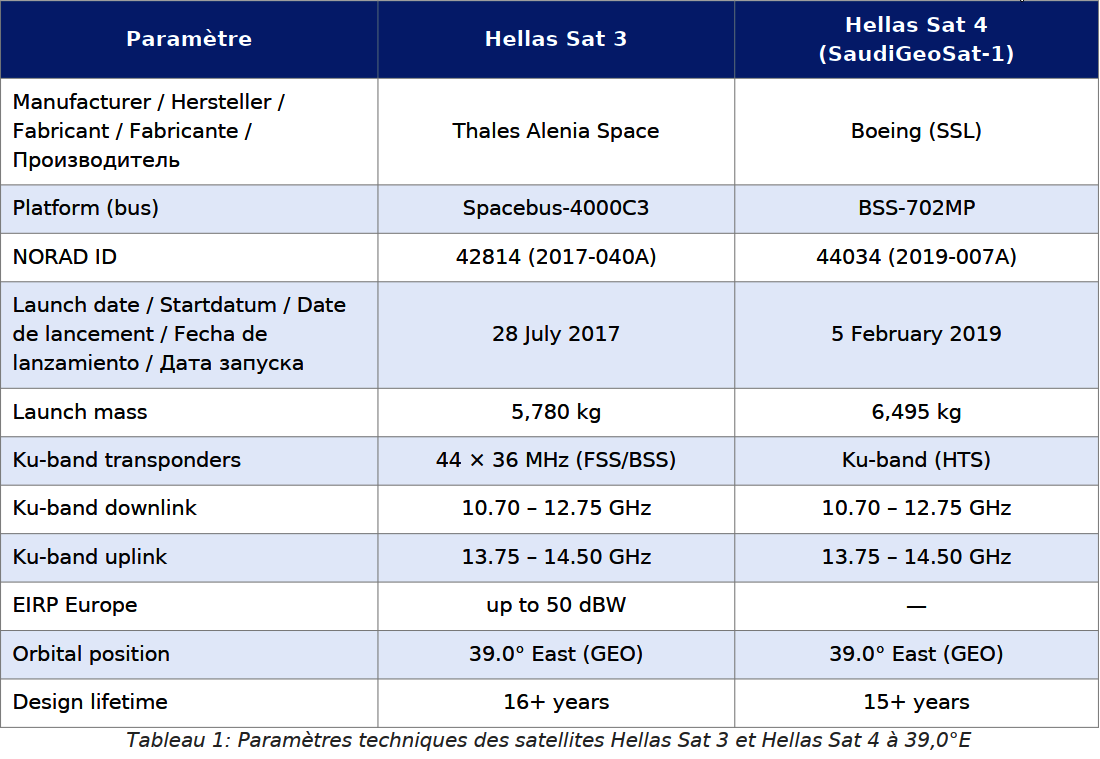
À la position orbitale 39,0° Est se trouvent deux satellites co-localisés: Hellas Sat 3 et Hellas Sat 4 (SaudiGeoSat-1). Hellas Sat 3 a été lancé le 28 juillet 2017 par une fusée Ariane 5 ECA depuis la Guyane française. Hellas Sat 4 a été lancé le 5 février 2019, également par une fusée Ariane 5 ECA.Le faisceau européen en bande Ku d'Hellas Sat 3 (faisceau FSS/BSS) atteint des valeurs PIRE allant jusqu'à 50 dBW au-dessus de la Grèce, de Chypre et de la péninsule balkanique.
4. NORME DVB-T2 – PRINCIPES ARCHITECTURAUX ET DE MODULATION
4.1 Principales caractéristiques techniques de DVB-T2
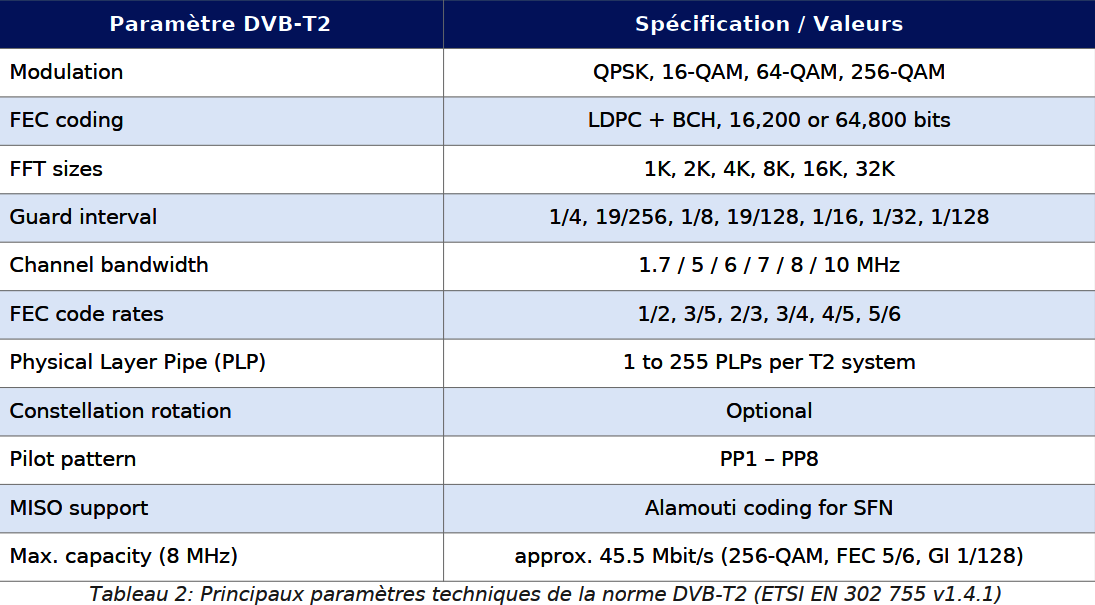
DVB-T2 est défini par la norme ETSI EN 302 755 et représente la deuxième génération de la norme européenne pour la télévision numérique terrestre. Par rapport au DVB-T, il apporte une augmentation de 30 à 50 % de la capacité spectrale grâce à: le codage LDPC+BCH avancé, la modulation 256-QAM, les Physical Layer Pipes (PLP), les tailles FFT étendues (1K à 32K), des in ervalles de garde plus longs et un support complet des réseaux SFN.La norme ETSI EN 302 755 définit deux profils: T2-Base (profil d'origine pour les récepteurs fixes) et T2-Lite (pour la réception mobile). Le réseau TNT chypriote utilise le profil T2-Base.
5. T2-MI (T2 MODULATOR INTERFACE) – DÉFINITION NORMATIVE ET ESSENCE TECHNIQUE
T2-MI (T2 Modulator Interface) est une interface définie par la norme ETSI TS 102 773 (DVB Bluebook A136). Elle sert à transporter des trames de données DVB-T2 prétraitées depuis le dispositif central T2-Gateway vers les modulateurs individuels du réseau distribué. T2-MI est le bloc de construction fondamental qui permet le fonctionnement de réseaux SFN synchronisés sans multiplexeur local à chaque nœud d'émission.
5.1 Principe de fonctionnement de T2-MI
Le dispositif central est appelé T2-Gateway. Il reçoit les flux de transport d'entrée (MPEG-2 TS) ou les données GSE pour les PLP individuels et effectue les étapes suivantes:
• Formatage des données d'entrée en Baseband Frames (BBFRAME) pour chaque PLP
• Génération de la signalisation L1 contenant les paramètres de trame T2
• Ordonnancement temporel des trames T2 et des trames d'entrelacement
• Insertion de tampons horaires précis TTO (Time to Output) pour la synchronisation
SFN
• Encapsulation dans des paquets T2-MI et transmission vers les modulateurs Le PID T2-MI = 4096 (0x1000) est la valeur standard définie par la norme ETSI TS 102 773, également utilisée par le lien T2-MI chypriote.
5.2 Avantages de T2-MI par rapport au modèle de distribution IP traditionnel
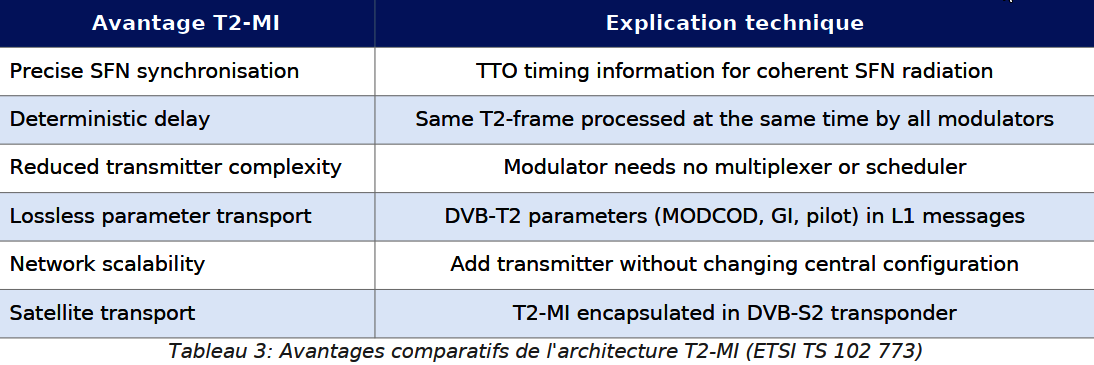
6. PHYSICAL LAYER PIPE (PLP) – PRINCIPE ET CLASSIFICATION
Physical Layer Pipe (PLP) est un concept clé de la norme DVB-T2 (ETSI EN 302 755). Une PLP représente un canal de données logique au niveau de la couche physique du système DVB-T2. L'entrée du système T2 se compose d'un ou plusieurs flux de données logiques, chaque flux logique étant transporté par exactement une PLP. L'identifiant
PLP est un champ de 8 bits (PLP_ID).
6.1 Types de PLP
DVB-T2 distingue deux types fondamentaux de PLP:
• Data PLP: Transporte les données d'un ou plusieurs services multimédia (chaînes TV). Peut être alloué statiquement ou dynamiquement dans une trame T2.
• Common PLP: Contient les données communes à un groupe de Data PLP (par ex. les tables SI/PSI communes). Transmis une fois par trame T2 immédiatement après la signalisation L1.
Chaque PLP passe par un module d'adaptation de mode comprenant l'Input Stream Synchronizer (ISSY), la Null Packet Deletion et un encodeur CRC-8. Le résultat sont des BBFRAMEs servant d'entrée pour le codage FEC LDPC+BCH.
6.2 Relation entre PLP et T2-MI
Dans le contexte du lien T2-MI chypriote, chaque programme de multiplex transmis correspond à une PLP avec PLP_ID = 0. Pour les deux transpondeurs f1 et f2 à Chypre, T2MI-PLP ID 0 est déclaré.
Note: T2MI-PLP ID 0x00 (valeur 0) est une valeur valide et couramment utilisée pour la PLP de données de base dans une configuration monocanal.
7. DIFFUSION SATELLITE T2-MI À CHYPRE: FRÉQUENCE f1 = 11 761 MHz H
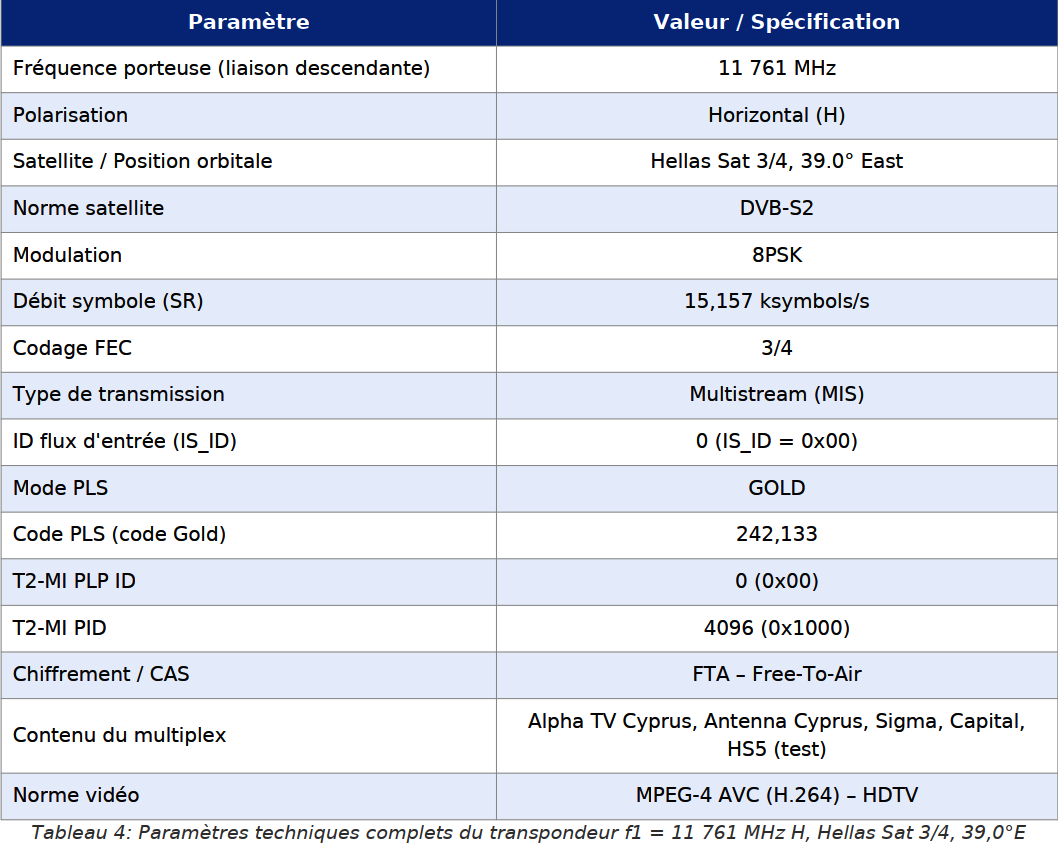
Le premier transpondeur T2-MI chypriote fonctionne à la fréquence f1 = 11 761 MHz, polarisation horizontale (H). Le tableau suivant répertorie les paramètres techniques complets:
8. DIFFUSION SATELLITE T2-MI À CHYPRE: FRÉQUENCE f2 = 11 778 MHz H
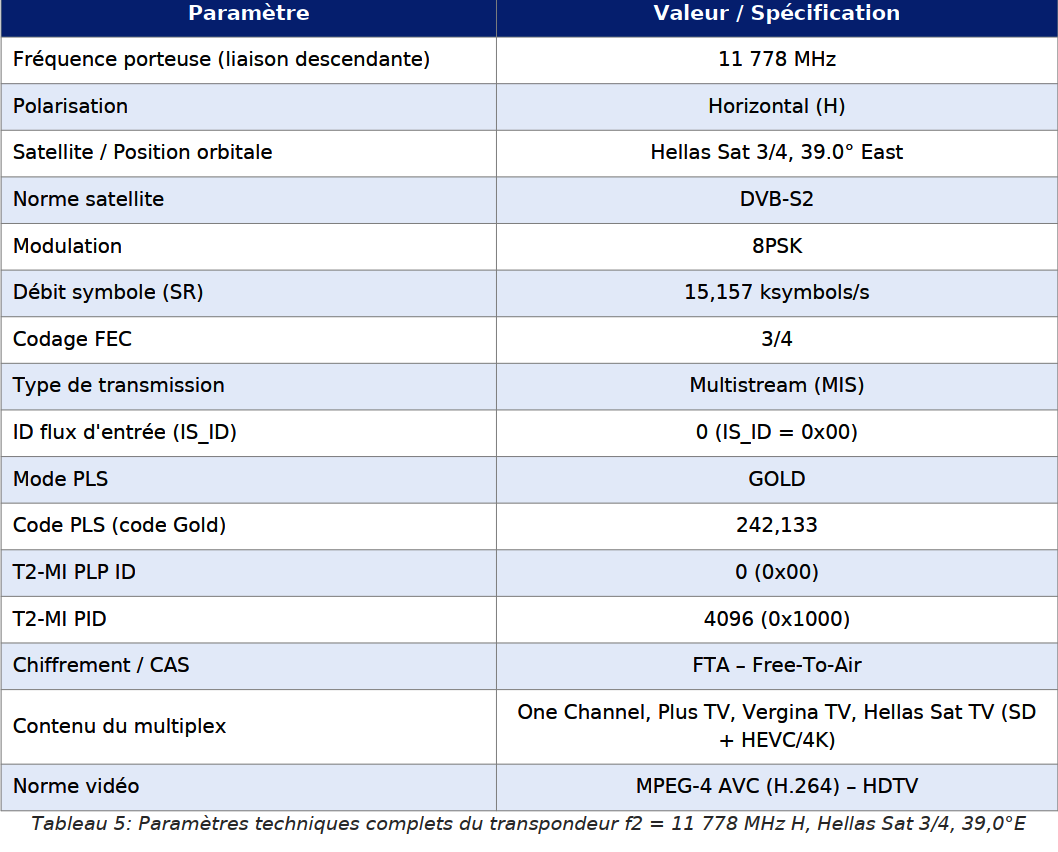
Le deuxième transpondeur T2-MI chypriote fonctionne à la fréquence f2 = 11 778 MHz, polarisation horizontale (H). Le tableau suivant répertorie les paramètres techniques complets:
9. COUCHE DVB-S2 – PARAMÈTRES DE MODULATION ET DE CODAGE
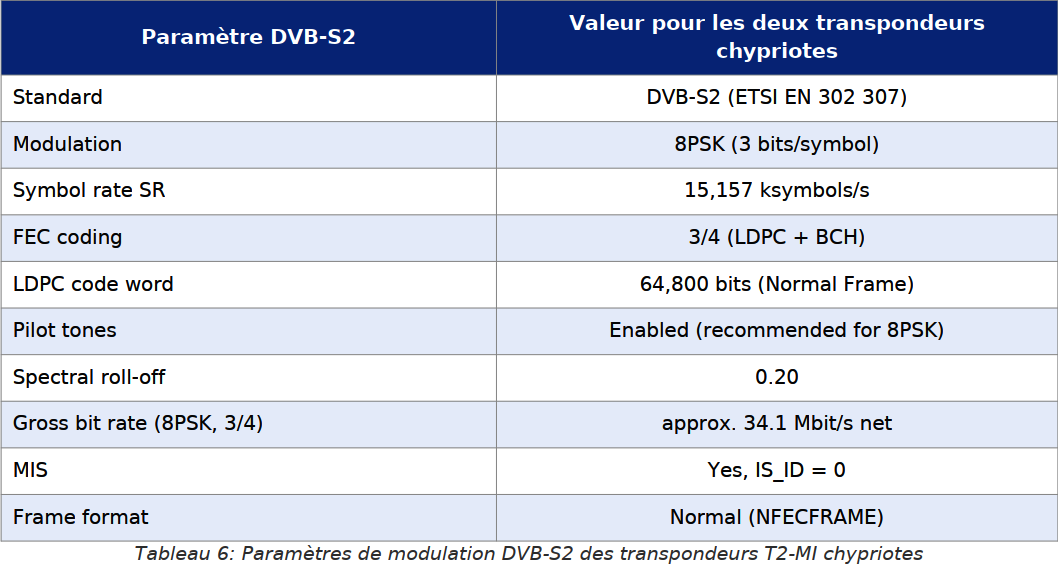
Le flux T2-MI est transporté via la chaîne satellite construite sur le standard DVB-S2 (ETSI EN 302 307). La modulation 8PSK représente un compromis entre l'efficacité spectrale et la robustesse de transmission. Par rapport au QPSK (2 bits/symbole), le 8PSK offre 3 bits/symbole, augmentant ainsi la capacité de 50 %.
10. MULTISTREAM (MIS) ET CODES PLS GOLD/ROOT – ANALYSE TECHNIQUE
DVB-S2 (ETSI EN 302 307) définit deux modes de flux d'entrée: SIS (Single Input Stream) et MIS (Multiple Input Stream). Le lien T2-MI chypriote utilise le mode MIS. Sur les deux fréquences chypriotes IS_ID = 0.
10.1 Code PLS (Physical Layer Scrambling)
DVB-S2 définit deux types de codes PLS:
• Code Root: Généré par un polynôme M-séquence de degré 18. Pour le transpondeur chypriote f1, un code PLS Root de 211 867 a été identifié dans la phase initiale.
• Code Gold: Généré par décalage cyclique à partir de la M-séquence Root. Permet la création de 262 143 codes uniques. Les deux transpondeurs f1 et f2 utilisent le code Gold 242 133.
Note: Dans le récepteur satellite, le mode PLS (ROOT ou GOLD) et le code PLS spécifique
doivent être configurés avant le décodage de la couche physique DVB-S2.
11. ARCHITECTURE DE LA CHAÎNE DE DISTRIBUTION: DU STUDIO À L'ÉMETTEUR DVB-T2
La chaîne de distribution complète du système T2-MI/DVB-T2 chypriote comprend plusieurs couches technologiquement distinctes mais fonctionnellement interconnectées:
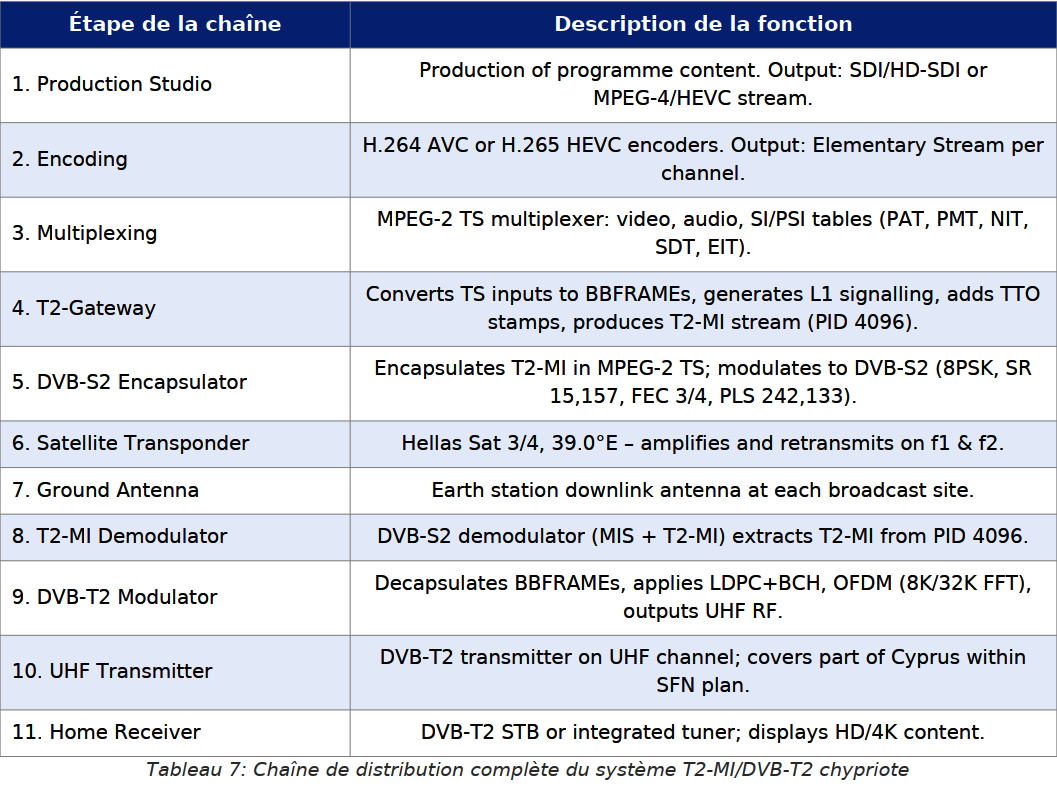
12. RÉSEAU SFN (SINGLE FREQUENCY NETWORK) À CHYPRE – TOPOLOGIE ET AVANTAGES
Un Single Frequency Network (SFN) est un réseau d'émetteurs qui diffusent le même programme sur la même fréquence simultanément avec une synchronisation de phase mutuelle précise. Le système TNT chypriote est conçu comme quatre réseaux SFNavec un total de huit canaux de transmission. La distribution T2-MI par satellite garantit que tous les modulateurs DVB-T2 d'un réseau SFN reçoivent des paquets T2-MI identiques avec les mêmes valeurs TTO.
12.1 Avantages du SFN pour Chypre
• Utilisation efficace du spectre: Le même programme sur une fréquence plutôt que plusieurs fréquences pour différentes zones.
• Plus grande couverture: La sommation des signaux de plusieurs émetteurs améliore la couverture dans les zones d'ombre du massif du Troodos.
• Résistance aux interférences: Les signaux des émetteurs voisins s'additionnent de manière constructive (dans l'intervalle de garde).
• Système de redondance simple: La panne d'un émetteur ne provoque pas de perte de signal sur tout le territoire couvert.
• Adéquation à la topographie insulaire: Le terrain montagneux de Chypre (Troodos max. 1 952 m d'altitude) nécessite plusieurs sites d'émission.
13. CONTENU DES MULTIPLEX – STRUCTURE DES CHAÎNES ET CODECS
Abréviations: CY = Chypre, GR = Grèce, HS = Hellas Sat. La présence de la chaîne 4K HEVC Hellas Sat TV sur f2 représente la perspective technologique de la plateforme vers la diffusion TNT en UHD.
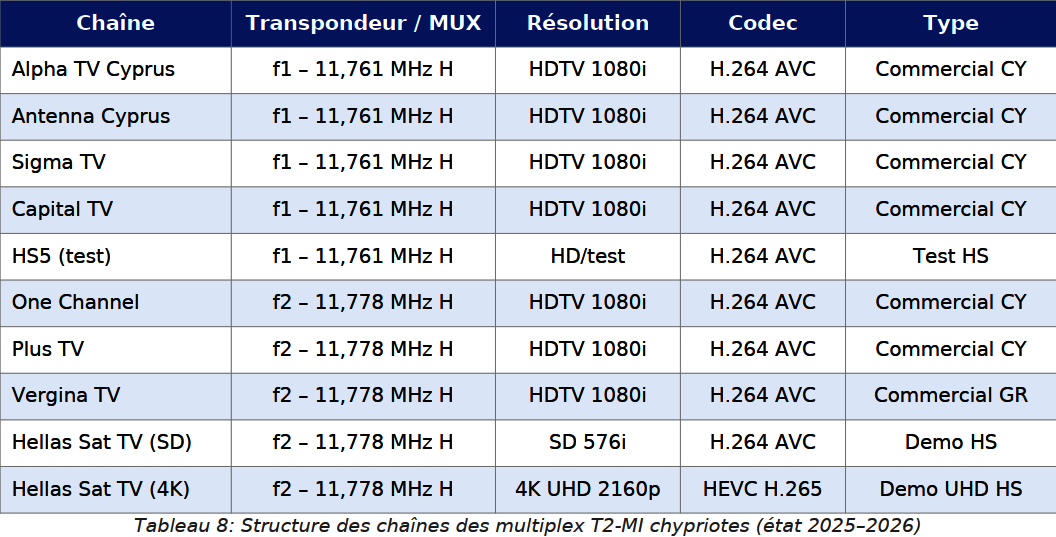
14. COUVERTURE TNT CHYPRIOTE, NOMBRE DE TÉLÉSPECTATEURS ET CONTEXTE SOCIAL
La République de Chypre compte environ 1 379 000 habitants dans la partie contrôlée de l'île (estimation ONU, 2026). Le nombre total de foyers TV est estimé à 200 000 – 260 000, correspondant à une pénétration des récepteurs TV proche de 100 %. La chaîne de distribution TNT sur la norme DVB-T2 crée un potentiel d'accès à la réception gratuite (FTA) en HD et UHD pour tous les foyers sans nécessité d'abonnement satellite ou IPTV payant. Le nombre estimé de télé-spectateurs TNT après le lancement complet du réseau (2025–2026) est de 150 000 – 200 000 foyers TNT actifs.
15. RÉCEPTION DU SIGNAL T2-MI EN EUROPE – EXIGENCES TECHNIQUES
15.1 Exigences pour les équipements de réception
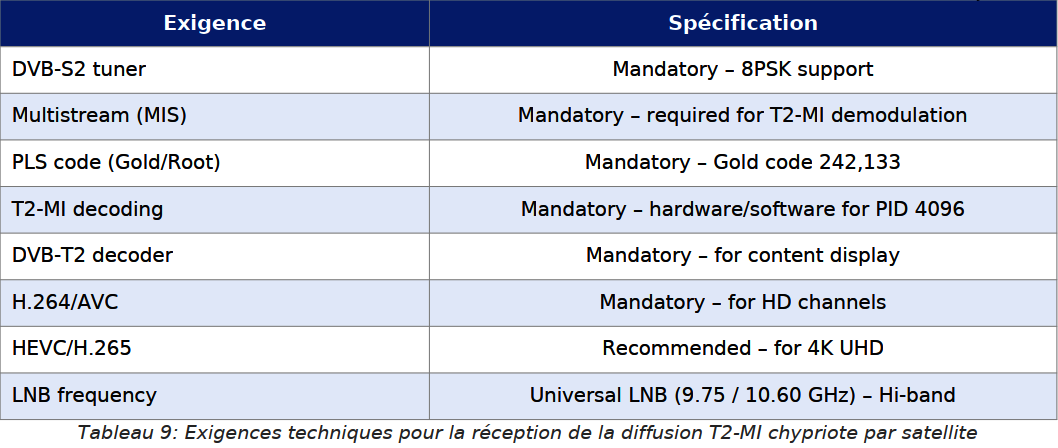
Le faisceau européen en bande Ku atteint une PIRE de 40–50 dBW, permettant la réception avec des antennes standard:
• Chypre, Grèce, Turquie, Égypte: Antenne 45–60 cm suffisante.
• Balkans, Roumanie, Bulgarie, Italie: Antenne 75–90 cm recommandée.
• Europe centrale (Slovaquie, Tchéquie, Pologne, Hongrie): Antenne 90–120 cm,
LNB à faible bruit avec NF ≤ 0,3 dB recommandé.
• Europe du Nord (Pays-Bas, Belgique): Antenne 100–120 cm, réception possible
dans des conditions atmosphériques favorables.
16. COMPARAISON T2-MI/SATELLITE vs. SOLUTION DE DISTRIBUTION IP/FIBRE
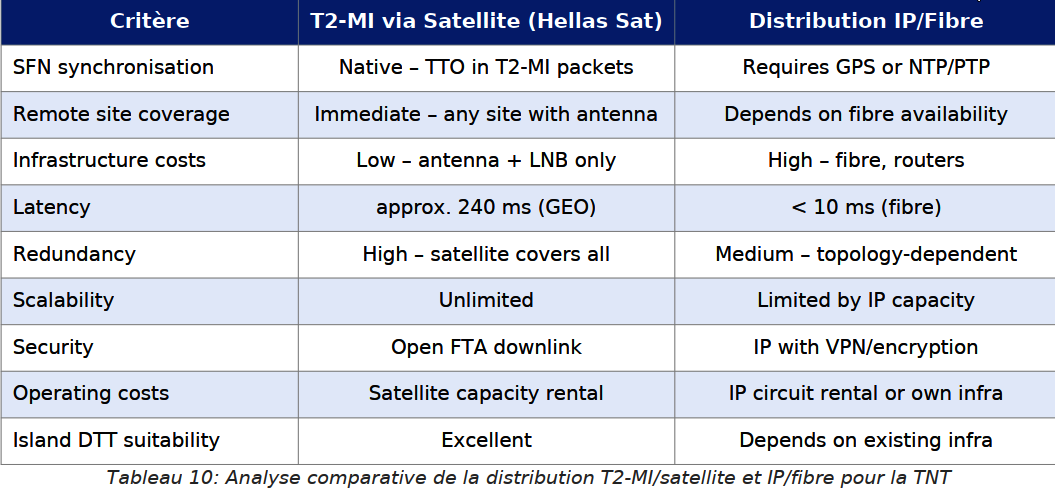
La comparaison montre que pour un environnement insulaire avec un terrain montagneux et des sites d'émission géographiquement dispersés, la distribution satellite T2-MI est clairement la solution la plus avantageuse économiquement et technologiquement.
17. CADRE RÉGLEMENTAIRE ET DE LICENCE – HELLAS SAT EN TANT QU'OPÉRATEUR TNT
L'exploitation du réseau TNT à Chypre est réglementée par le Département des communications électroniques du Ministère de la Recherche de la République de Chypre. Hellas Sat a reçu une licence d'exploitation du réseau TNT valable du 1er décembre 2025 au 9 novembre 2040 pour quatre réseaux SFN. Hellas Sat est une filiale de l'Organisation arabe des communications par satellite (Arabsat), dont le siège est à Riyad (Arabie Saoudite).
18. CONCLUSION ET RÉSUMÉ SCIENTIFIQUE
Le système de distribution T2-MI/DVB-T2 chypriote représente une approche moderne et technologiquement très avancée de la construction d'une infrastructure TNT terrestre dans un petit État insulaire européen. L'utilisation du lien satellite T2-MI via Hellas Sat 3/4 à 39,0°E comme chaîne de distribution principale est une solution élégante.
Conclusions scientifiques clés:
1. Le système TNT chypriote est construit sur la norme DVB-T2 avec distribution via le protocole T2-MI encapsulé dans le signal DVB-S2 sur Hellas Sat 3/4, 39,0°E.
2. Les deux transpondeurs (f1 = 11 761 MHz H et f2 = 11 778 MHz H) utilisent des paramètres DVB-S2 identiques: 8PSK, SR 16 515 ksps, FEC 5/6, MIS, code Gold PLS 242 133, T2-MI PID 4096, PLP ID 0.
3. L'architecture T2-MI garantit la synchronisation SFN via les horodatages TTO sans
systèmes GPS externes.
4. Hellas Sat est non seulement opérateur satellite, mais aussi opérateur du réseau DVB-T2 terrestre à Chypre avec une licence valable jusqu'en 2040.
5. La structure du contenu des multiplex comprend des chaînes HD (H.264) et du contenu de démonstration 4K UHD (HEVC/H.265).
6. Le lien satellite T2-MI est la solution de distribution optimale compte tenu du terrain montagneux et de la géographie insulaire de Chypre.
7. La valeur de recherche et de surveillance du lien T2-MI chypriote est paneuropéenne.
19. LISTE DES NORMES, STANDARDS ET RÉFÉRENCES PROFESSIONNELLES
[1] ETSI EN 302 755 V1.4.1 (2015): DVB; Frame structure, channel coding and modulation for
DVB-T2. ETSI, Sophia Antipolis.
[2] ETSI TS 102 773 V1.3.1 (2012): DVB; Modulator Interface (T2-MI) for DVB-T2. ETSI, Sophia
Antipolis.
[3] DVB Bluebook A136 (rev. 2, 2012): DVB T2 Modulator Interface (T2-MI). DVB Project, Geneva.
[4] ETSI EN 302 307-1 V1.4.1 (2014): DVB-S2; Second generation framing structure. ETSI.
[5] DVB Bluebook A175 (2011): DVB-SIS – Single Illumination System for SFN. DVB Project.
[6] Broadband TV News (03.03.2025): Hellas Sat to run DTT network in Cyprus.
[7] Cyprus Mail (25.02.2025): Hellas Sat to launch advanced digital TV network in Cyprus.
[8] Wikipedia: Digital terrestrial television in Cyprus.
[09] Wikipedia: Cyprus Broadcasting Corporation (CyBC/RIK).
[10] Wikipedia: Hellas Sat 3.
[11] NTvsat: Hellas Sat 3 / Hellas Sat 4 technical data. https://nt-vsat.com/hellassat/
[12] UN Population Division: World Population Prospects 2024 – Cyprus.
[13] Dávid, R. (2025): T2-MI/PLP Research Centre – Scientific records. dxsatcs.
Análisis científico-técnico completo de la cadena de distribución satelital para la televisión digital terrestre (TDT) en la República de Chipre
ÍNDICE DE CONTENIDOS
1. Resumen e Introducción
2. Contextualización: Televisión digital en Chipre – desarrollo histórico
3. Hellas Sat 3/4 – caracterización técnica del satélite en 39,0°E
4. Estándar DVB-T2: principios arquitectónicos y de modulación
5. T2-MI (T2 Modulator Interface) – definición normativa y esencia técnica
6. Physical Layer Pipe (PLP) – principio y clasificación
7. Emisión satelital T2-MI en Chipre: parámetros de la frecuencia f1 = 11 761 MHz H
8. Emisión satelital T2-MI en Chipre: parámetros de la frecuencia f2 = 11 778 MHz H
9. Capa DVB-S2: parámetros de modulación y codificación
10. Multistream (MIS) y códigos PLS Gold/Root
11. Arquitectura de la cadena de distribución
12. Red SFN (Single Frequency Network) en Chipre
13. Contenido de los múltiplexes: estructura de canales y códecs
14. Cobertura TDT chipriota, espectadores y contexto social
15. Recepción de la señal T2-MI en Europa
16. Comparación T2-MI/Satélite vs. distribución IP/Fibra
17. Marco regulatorio y de licencias
18. Conclusión y resumen científico
19. Lista de normas, estándares y referencias
1. RESUMEN E INTRODUCCIÓN
El presente documento científico-técnico presenta un análisis completo del sistema de distribución por satélite para la televisión digital terrestre (TDT) en la República de Chipre, implementado mediante el estándar tecnológico T2-MI (T2 Modulator Interface) en combinación con Physical Layer Pipe (PLP) de conformidad con la norma ETSI TS 102 773. La radiodifusión por satélite se lleva a cabo desde la posición geoestacionaria Hellas Sat 3/4 a 39,0° Este en la banda Ku en dos frecuencias portadoras: f1 = 11 761 MHz, polarización horizontal (H) y f2 = 11 778 MHz, polarización horizontal (H). Ambos transpondedores utilizan modulación DVB-S2 con codificación 8PSK y FEC 3/4 a una velocidad de símbolo de SR = 15 157 ksimbolos/s. El documento aborda los aspectos tecnológicos, regulatorios, históricos y sociomediáticos de la construcción de una infraestructura TDT moderna en la isla de Chipre. Explica las razones de la transición a DVB-T2, describe en detalle la arquitectura de la cadena de distribución T2-MI desde el estudio de producción hasta el transmisor de antena, define el contexto normativo de la estructura PLP y ofrece una visión general completa del contenido de los múltiplexes chipriotas, incluidos los servicios HD y UHD.
1.1 Motivación científica y objetivo de investigación
El desarrollo de la televisión digital terrestre en los pequeños estados insulares europeos representa un desafío tecnológico único. La isla de Chipre, con una población de aproximadamente 1 380 000 habitantes (estimación ONU, 2026), presenta una morfología geográficamente compleja – el macizo montañoso de Troodos, variaciones
climáticas estacionales y la división política de la isla – lo que requiere un enfoque innovador para la distribución de los flujos de programas televisivos en la red terrestre DVB-T2. El objetivo de este documento de investigación es: (1) proporcionar una descripción técnicamente precisa y científicamente verificable del sistema de distribución satelital T2-MI chipriota; (2) analizar los parámetros de ambas frecuencias portadoras en el contexto de las normas técnicas aplicables; (3) explicar el papel de Hellas Sat como operador integrado de la distribución por satélite y la red TDT terrestre; y (4) situar esta solución en el contexto europeo más amplio de la migración al estándar DVB-T2.
2. TELEVISIÓN DIGITAL EN CHIPRE – DESARROLLO HISTÓRICO
La radiodifusión televisiva en Chipre comenzó en 1957. La Corporación de Radiodifusión de Chipre (CyBC / RIK) fue creada como primera institución televisiva pública de la isla. La televisión privada se introdujo el 26 de abril de 1992 con la cadena Logos TV. Hasta mediados de los años noventa, Chipre contaba con cinco canales de televisión terrestres de libre acceso.
2.1 Transición a la televisión digital terrestre (2011)
De conformidad con las obligaciones de la República de Chipre como Estado miembro de la Unión Europea, el apagón analógico (Analogue Switch-Off, ASO) se realizó el 1 de julio de 2011. La plataforma TDT inicial se construyó sobre la base del estándar DVB-T con codificación MPEG-4, lo que permitió a Chipre desplegar directamente una solución compatible con HD. Se otorgaron dos licencias para la operación de la TDT: la plataforma pública CyBC (RIK) y la plataforma comercial Velister Ltd.
2.2 Modernización a DVB-T2 y el papel de Hellas Sat
La necesidad de una eficiencia espectral significativamente mayor, capacidad HD y UHD y redes de frecuencia única sincronizadas (SFN) suscitó interés en la migración a DVB-T2. El operador Hellas Sat – filial de la Organización Árabe de Comunicaciones por Satélite (Arabsat) – obtuvo una licencia para la operación de una red TDT con validez del 1 de diciembre de 2025 al 9 de noviembre de 2040. La nueva red consta de cuatro redes de frecuencia única (SFN), cada una equipada con dos canales de transmisión. Hellas Sat no es solo el operador de la cadena de distribución satelital (a través del enlace T2-MI), sino también el operador de toda la infraestructura de la red DVB-T2 terrestre.
3. HELLAS SAT 3/4 – CARACTERIZACIÓN TÉCNICA DEL SATÉLITE EN 39,0°E
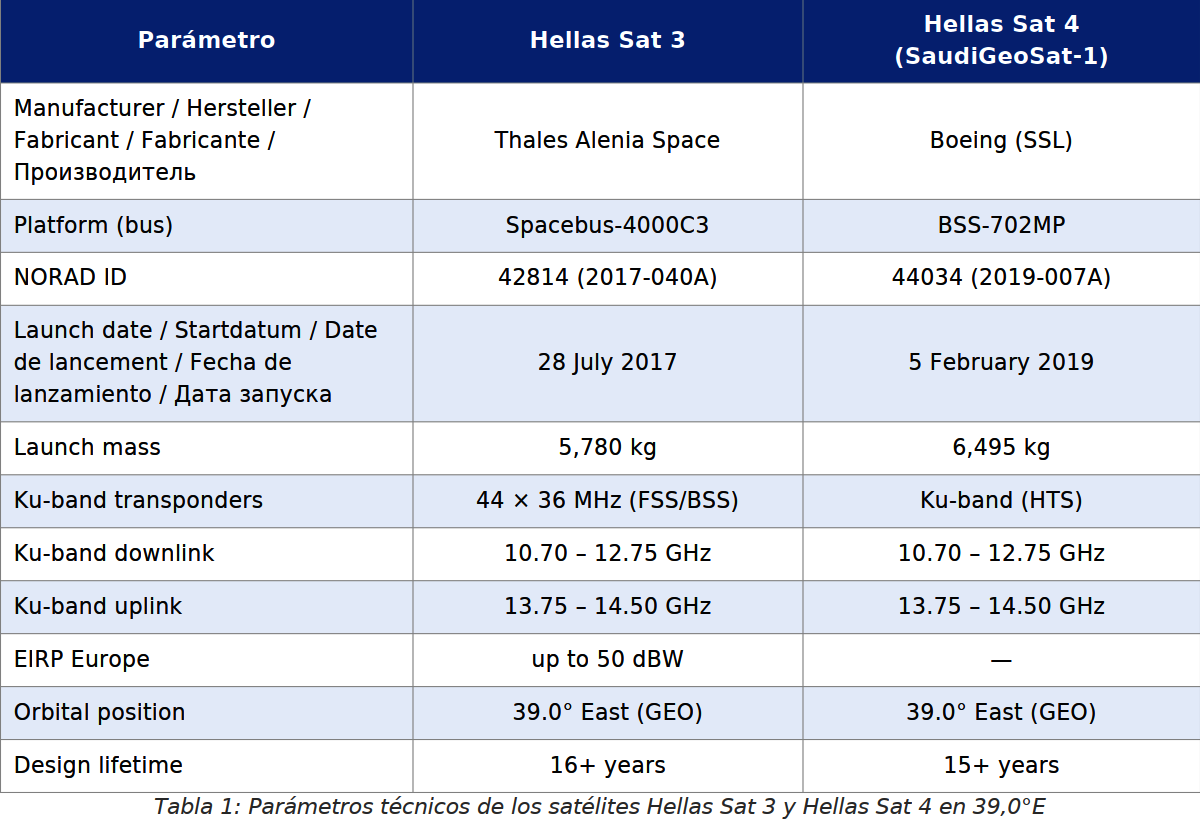
En la posición orbital 39,0° Este se encuentran dos satélites co-localizados: Hellas Sat 3 y Hellas Sat 4 (SaudiGeoSat-1). Hellas Sat 3 fue lanzado el 28 de julio de 2017 mediante un cohete Ariane 5 ECA desde la Guayana Francesa. Hellas Sat 4 fue lanzado el 5 de febrero de 2019, también mediante un cohete Ariane 5 ECA.El haz europeo en banda Ku de Hellas Sat 3 (haz FSS/BSS) alcanza valores PIRE de hasta 50 dBW sobre Grecia, Chipre y la Península Balcánica. Este alto nivel de PIRE permite la recepción con antenas de 70–80 cm de diámetro en Europa Central y con antenas de 45–60 cm en Chipre y Grecia.
4. ESTÁNDAR DVB-T2 – PRINCIPIOS ARQUITECTÓNICOS Y DE MODULACIÓN
4.1 Principales características técnicas de DVB-T2
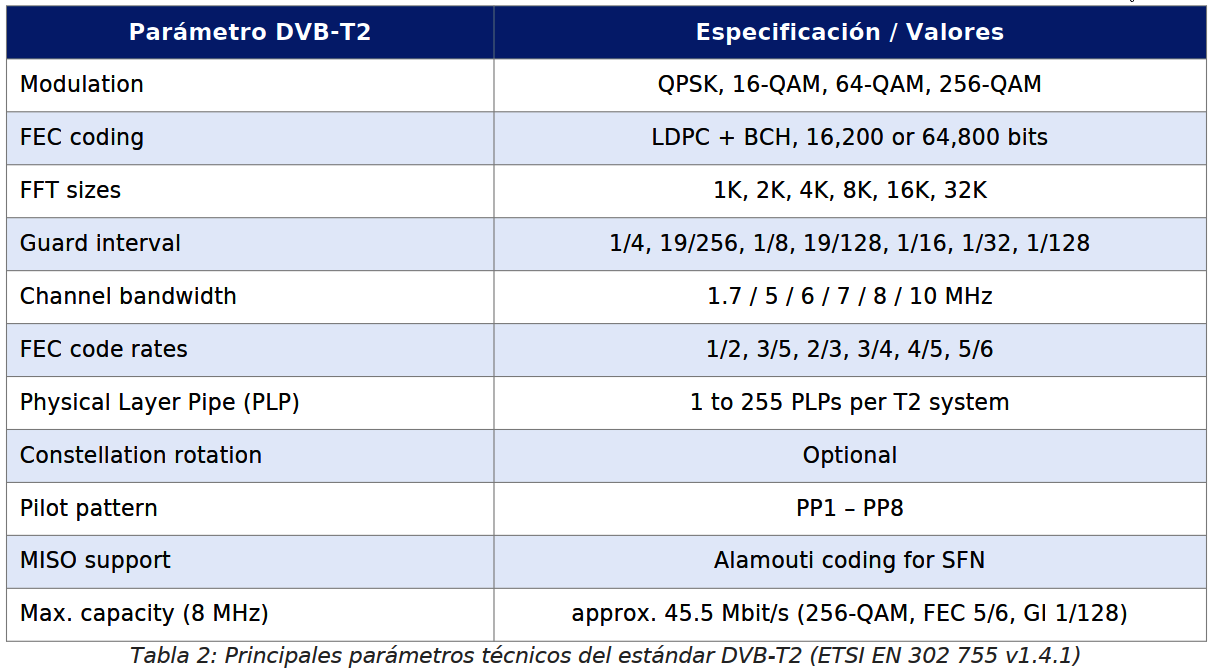
DVB-T2 está definido por la norma ETSI EN 302 755 y representa la segunda generación del estándar europeo para la televisión digital terrestre. Comparado con DVB-T, aporta un incremento del 30–50% en la capacidad espectral gracias a:
codificación LDPC+BCH avanzada, modulación 256-QAM, Physical Layer Pipes (PLP), tamaños de FFT extendidos (1K a 32K), intervalos de guarda más largos y soporte completo de redes SFN.La norma ETSI EN 302 755 define dos perfiles: T2-Base (perfil original para receptores fijos) y T2-Lite (para recepción móvil). La red TDT chipriota utiliza el perfil T2-Base.
5. T2-MI (T2 MODULATOR INTERFACE) – DEFINICIÓN NORMATIVA Y ESENCIA TÉCNICA
T2-MI (T2 Modulator Interface) es una interfaz definida por la norma ETSI TS 102 773 (DVB Bluebook A136). Sirve para el transporte de tramas de datos DVB-T2 preprocesadas desde el dispositivo central T2-Gateway hacia los moduladores
individuales en la red distribuida. T2-MI es el bloque constructivo fundamental que permite el funcionamiento de redes SFN sincronizadas sin multiplexor local en cada nodo de transmisión.
5.1 Principio de funcionamiento de T2-MI
El dispositivo central se denomina T2-Gateway. Recibe flujos de transporte de entrada (MPEG-2 TS) o datos GSE para los PLP individuales y realiza los siguientes pasos:
• Formateo de los datos de entrada en Baseband Frames (BBFRAME) para cada PLP
• Generación de señalización L1 que contiene los parámetros de trama T2
• Planificación temporal de las tramas T2 y tramas de entrelazamiento
• Inserción de marcas de tiempo precisas TTO (Time to Output) para sincronización SFN
• Encapsulación en paquetes T2-MI y transmisión hacia los moduladores El PID T2-MI = 4096 (0x1000) es el valor estándar definido por la norma ETSI TS 102 773, utilizado también por el enlace T2-MI chipriota.
5.2 Ventajas de T2-MI frente al modelo de distribución IP tradicional
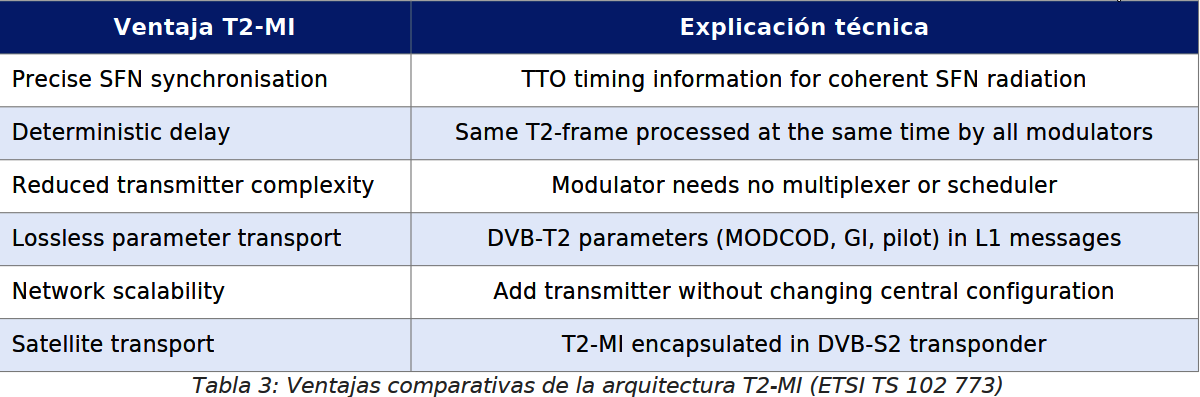
6. PHYSICAL LAYER PIPE (PLP) – PRINCIPIO Y CLASIFICACIÓN
Physical Layer Pipe (PLP) es un concepto clave del estándar DVB-T2 (ETSI EN 302 755). Un PLP representa un canal de datos lógico en la capa física del sistema DVB-T2. La entrada del sistema T2 consta de uno o más flujos de datos lógicos, siendo cada flujo lógico transportado por exactamente un PLP. El identificador PLP es un campo de 8 bits (PLP_ID).
6.1 Tipos de PLP
DVB-T2 distingue dos tipos básicos de PLP:
• Data PLP: Transporta datos de uno o más servicios multimedia (canales de TV). Puede asignarse de forma estática o dinámica dentro de una trama T2.
• Common PLP: Contiene datos comunes para un grupo de Data PLP (por ejemplo, tablas SI/PSI comunes). Se transmite una vez por trama T2 inmediatamente después de la señalización L1. Cada PLP pasa por un módulo de adaptación de modo que incluye el Input Stream Synchronizer (ISSY), la Null Packet Deletion y un codificador CRC-8. El resultado
son BBFRAMEs como entrada para la codificación FEC LDPC+BCH.
6.2 Relación entre PLP y T2-MI
En el contexto del enlace T2-MI chipriota, cada programa de múltiplex transmitido corresponde a un PLP con PLP_ID = 0. Para ambos transpondedores f1 y f2 en Chipre se declara T2MI-PLP ID 0.
Nota: T2MI-PLP ID 0x00 (valor 0) es un valor válido y comúnmente usado para el PLP de datos básico en una configuración de un solo canal.
7.EMISIÓN SATELLITE T2-MI EN CHIPRE: FRECUENCIA f1=11 761 MHz-H
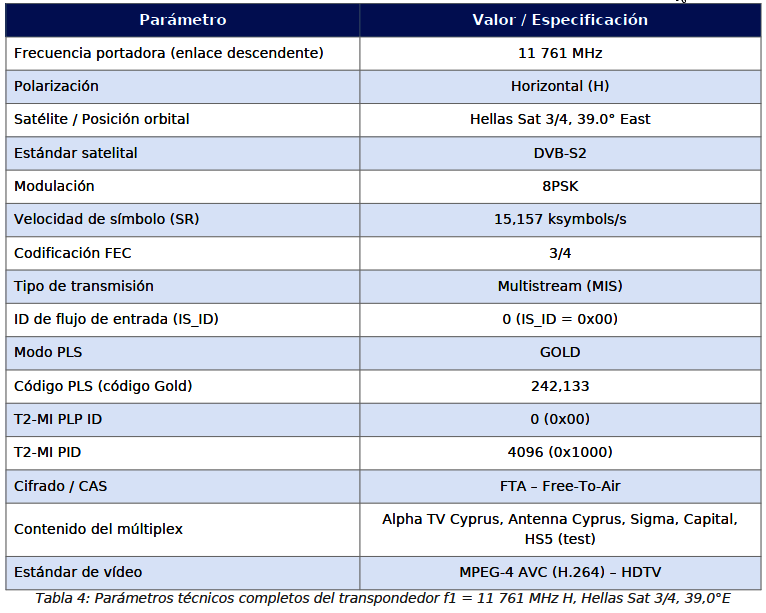
El primer transpondedor T2-MI chipriota opera en la frecuencia f1 = 11 761 MHz, polarización horizontal (H). La siguiente tabla muestra los parámetros técnicos completos:
8. EMISIÓN SATELLITE T2-MI EN CHIPRE: FRECUENCIA f2=11 778 MHz - H.
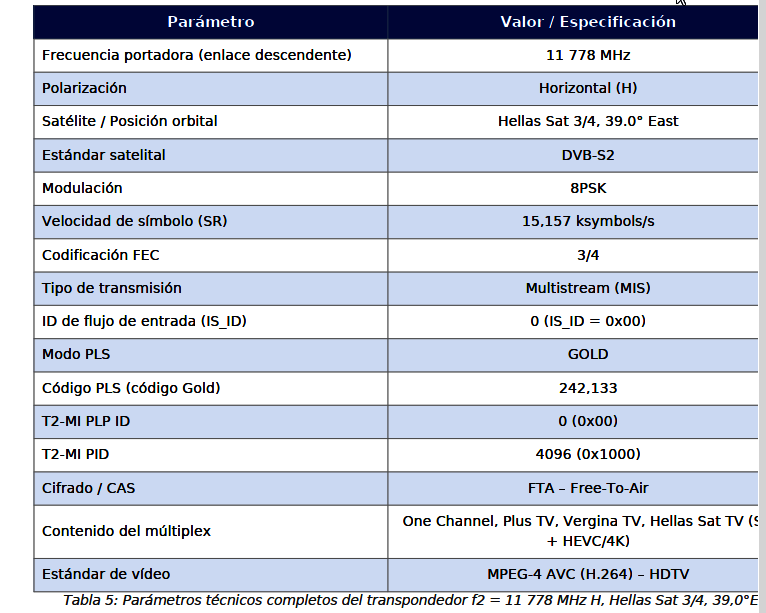
El segundo transpondedor T2-MI chipriota opera en la frecuencia f2 = 11 778 MHz, polarización horizontal (H). La siguiente tabla muestra los parámetros técnicos completos:
9. CAPA DVB-S2 – PARÁMETROS DE MODULACIÓN Y CODIFICACIÓN
El flujo T2-MI se transporta a través de la cadena satelital construida sobre el estándar DVB-S2 (ETSI EN 302 307). La modulación 8PSK representa un compromiso entre eficiencia espectral y robustez de transmisión. Comparado con QPSK (2 bits/símbolo), 8PSK ofrece 3 bits/símbolo, aumentando la capacidad en un 50 %.
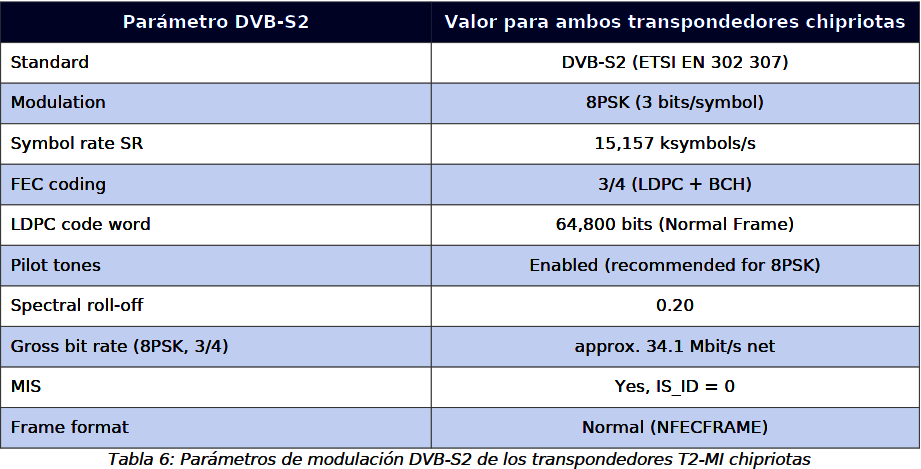
10. MULTISTREAM (MIS) Y CÓDIGOS PLS GOLD/ROOT – ANÁLISIS TÉCNICO
DVB-S2 (ETSI EN 302 307) define dos modos de flujo de entrada: SIS (Single Input Stream) y MIS (Multiple Input Stream). El enlace T2-MI chipriota utiliza el modo MIS. En ambas frecuencias chipriotas IS_ID = 0.
10.1 Código PLS (Physical Layer Scrambling)
DVB-S2 define dos tipos de códigos PLS:
• Código Root: Generado por un polinomio de secuencia M de grado 18. Para el transpondedor f1 chipriota se identificó un código PLS Root de 211 867 en la fase inicial.
• Código Gold: Generado por desplazamiento cíclico a partir de la secuencia M Root. Permite la creación de 262 143 códigos únicos. Ambos transpondedores f1 y f2 utilizan el código Gold 242 133.
Nota: En el receptor satelital, tanto el modo PLS (ROOT o GOLD) como el código PLS específico
deben configurarse antes de la decodificación de la capa física DVB-S2
11. ARQUITECTURA DE LA CADENA DE DISTRIBUCIÓN: DEL ESTUDIO AL TRANSMISOR DVB-T2
La cadena de distribución completa del sistema T2-MI/DVB-T2 chipriota consta de varias capas tecnológicamente distintas pero funcionalmente interconectadas:
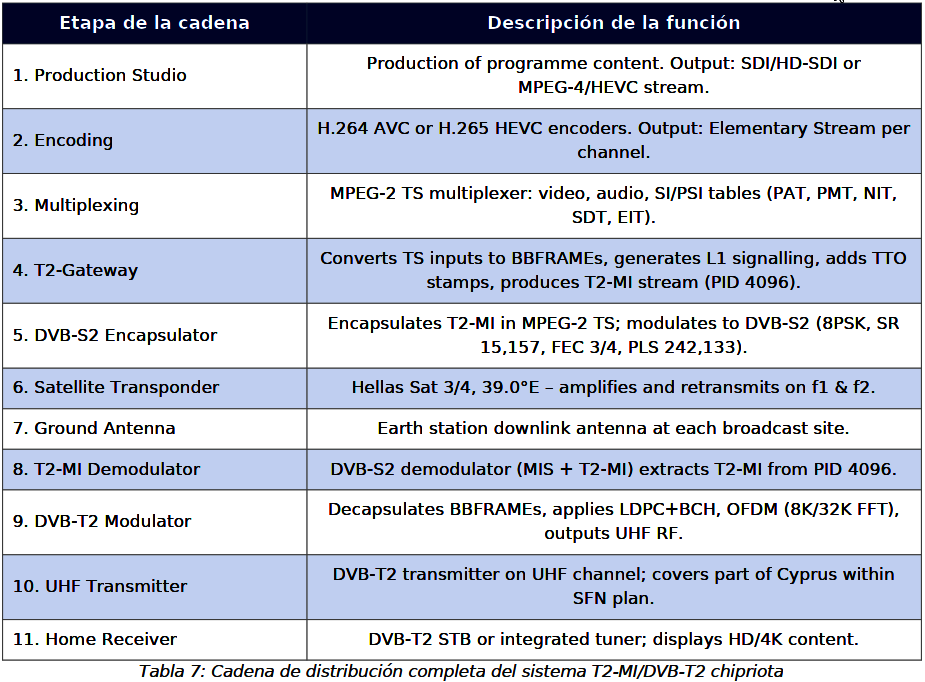
12. RED SFN (SINGLE FREQUENCY NETWORK) EN CHIPRE–TOPOLOGÍA Y VENTAJAS
Una Single Frequency Network (SFN) es una red de transmisores que emiten el mismo programa en la misma frecuencia simultáneamente con precisión de sincronización de fase mutua. El sistema TDT chipriota está diseñado como cuatro
redes SFN con un total de ocho canales de transmisión. La distribución T2-MI vía satélite garantiza que todos los moduladores DVB-T2 de una red SFN reciben paquetes T2-MI idénticos con los mismos valores TTO.
12.1 Ventajas del SFN para Chipre
• Uso eficiente del espectro: El mismo programa en una frecuencia en lugar de varias frecuencias para diferentes zonas.
• Mayor cobertura: La suma de señales de múltiples transmisores mejora la cobertura en las zonas de sombra del macizo de Troodos.
• Resistencia a interferencias: Las señales de transmisores vecinos se suman constructivamente (dentro del intervalo de guarda).
• Sistema de redundancia simple: El fallo de un transmisor no provoca pérdida de señal en todo el territorio cubierto.
• Adecuación a la topografía insular: El terreno montañoso de Chipre (Troodos máx. 1 952 m s. n. m.) requiere múltiples emplazamientos de transmisión.
13. CONTENIDO DE LOS MÚLTIPLEXES – ESTRUCTURA DE CANALES Y CÓDECS
Abreviaturas: CY = Chipre, GR = Grecia, HS = Hellas Sat. La presencia del canal 4K HEVC Hellas Sat TV en f2 representa la perspectiva tecnológica de la plataforma hacia la emisión TDT en UHD.
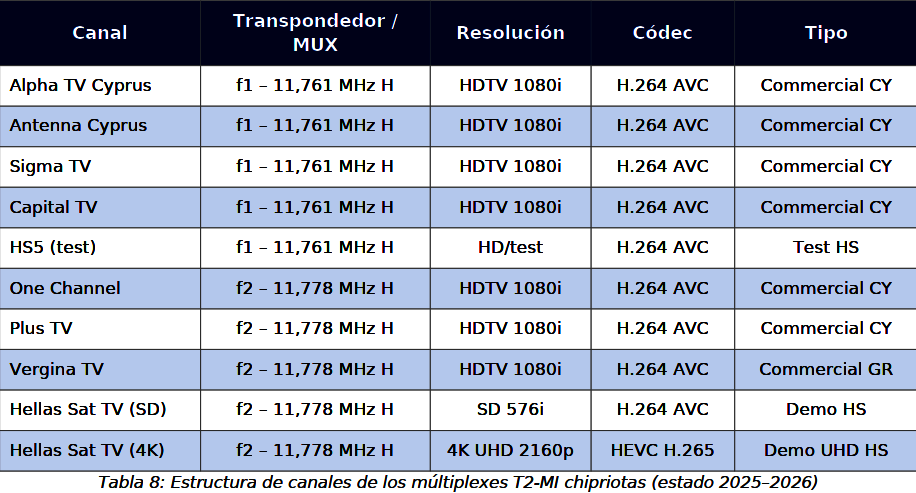
14. COBERTURA TDT CHIPRIOTA, NÚMERO DE ESPECTADORES Y CONTEXTO SOCIAL
La República de Chipre tiene aproximadamente 1 379 000 habitantes en la parte controlada de la isla (estimación ONU, 2026). El número total de hogares con TV se estima en 200 000 – 260 000, correspondiendo a una penetración de receptores de TV cercana al 100 %.
La operación de la red TDT en el estándar DVB-T2 crea el potencial de acceso a la recepción gratuita (FTA) de contenidos HD y UHD para todos los hogares sin necesidad de suscripciones satelitales o IPTV de pago. El número estimado de espectadores TDT tras el pleno lanzamiento de la red (2025–2026) es de 150 000 – 200 000 hogares TDT activos.
15. RECEPCIÓN DE LA SEÑAL T2-MI EN EUROPA – REQUISITOS TÉCNICOS
El haz europeo en banda Ku alcanza PIRE de 40–50 dBW, permitiendo la recepción con antenas estándar:
• Chipre, Grecia, Turquía, Egipto: Antena de 45–60 cm suficiente.
• Balcanes, Rumanía, Bulgaria, Italia: Antena de 75–90 cm recomendada.
• Europa Central (Eslovaquia, República Checa, Polonia, Hungría): Antena
90–120 cm, LNB de bajo ruido con NF ≤ 0,3 dB recomendado.
• Europa del Norte (Países Bajos, Bélgica): Antena 100–120 cm, recepción posible
en condiciones atmosféricas favorables.
15.1 Requisitos para equipos de recepción
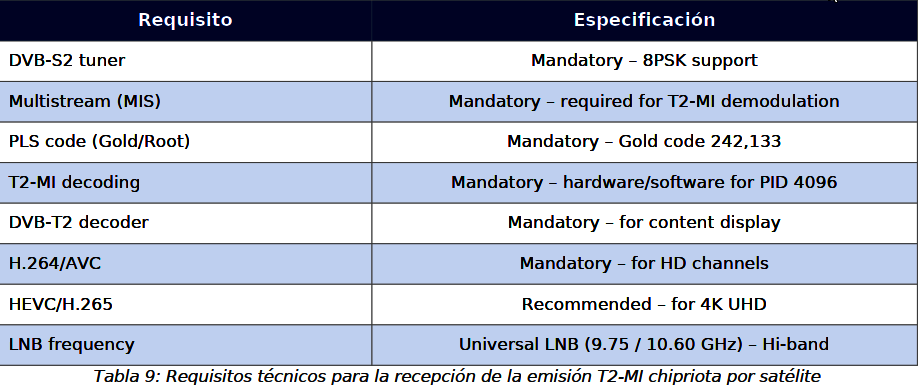
16. COMPARACIÓN T2-MI/SATÉLITE vs. SOLUCIÓN DE DISTRIBUCIÓN IP/FIBRA
La comparación muestra que para un entorno insular con terreno montañoso y emplazamientos de transmisión geográficamente dispersos, la distribución satelital T2-MI es claramente la solución más ventajosa económica y tecnológicamente.
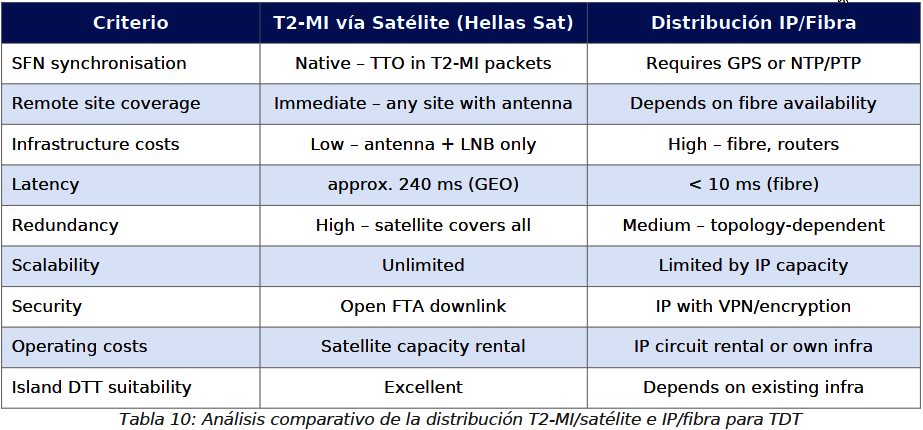
17. MARCO REGULATORIO Y DE LICENCIAS – HELLAS SAT COMO OPERADOR TDT
La operación de la red TDT en Chipre está regulada por el Departamento de Comunicaciones Electrónicas del Ministerio de Investigación de la República de Chipre. Hellas Sat recibió una licencia para operar la red TDT con validez del 1 de
diciembre de 2025 al 9 de noviembre de 2040 para cuatro redes SFN. Hellas Sat es una filial de la Organización Árabe de Comunicaciones por Satélite (Arabsat), con sede en Riad (Arabia Saudita).
18. CONCLUSIÓN Y RESUMEN CIENTÍFICO
El sistema de distribución T2-MI/DVB-T2 chipriota representa un enfoque moderno y tecnológicamente muy avanzado para la construcción de infraestructura TDT terrestre en un pequeño estado insular europeo. El uso del enlace satelital T2-MI a través de Hellas Sat 3/4 en 39,0°E como cadena de distribución principal es una solución elegante.
Conclusiones científicas clave:
1. El sistema TDT chipriota está construido sobre el estándar DVB-T2 con distribución mediante el protocolo T2-MI encapsulado en la señal DVB-S2 en Hellas Sat 3/4, 39,0°E.
2. Ambos transpondedores (f1 = 11 761 MHz H y f2 = 11 778 MHz H) utilizan parámetros DVB-S2 idénticos: 8PSK, SR 16 515 ksps, FEC 5/6, MIS, código Gold PLS 242 133, T2-MI PID 4096, PLP ID 0.
3. La arquitectura T2-MI garantiza la sincronización SFN a través de marcas de tiempo TTO sin sistemas GPS externos.
4. Hellas Sat no solo es operador satelital, sino también operador de la red DVB-T2 terrestre en Chipre con licencia válida hasta 2040.
5. La estructura de contenido de los múltiplexes incluye canales HD (H.264) y contenido de demostración 4K UHD (HEVC/H.265).
6. El enlace satelital T2-MI es la solución de distribución óptima dado el terreno montañoso y la geografía insular de Chipre.
7. El valor de investigación y monitorización del enlace T2-MI chipriota es paneuropeo.
19. LISTA DE NORMAS, ESTÁNDARES Y REFERENCIAS PROFESIONALES
[1] ETSI EN 302 755 V1.4.1 (2015): DVB; Frame structure, channel coding and modulation for
DVB-T2. ETSI, Sophia Antipolis.
[2] ETSI TS 102 773 V1.3.1 (2012): DVB; Modulator Interface (T2-MI) for DVB-T2. ETSI, Sophia
Antipolis.
[3] DVB Bluebook A136 (rev. 2, 2012): DVB T2 Modulator Interface (T2-MI). DVB Project, Geneva.
[4] ETSI EN 302 307-1 V1.4.1 (2014): DVB-S2; Second generation framing structure. ETSI.
[5] DVB Bluebook A175 (2011): DVB-SIS – Single Illumination System for SFN. DVB Project.
[6] Broadband TV News (03.03.2025): Hellas Sat to run DTT network in Cyprus.
[7] Cyprus Mail (25.02.2025): Hellas Sat to launch advanced digital TV network in Cyprus.
[8] Wikipedia: Digital terrestrial television in Cyprus.
[9] Wikipedia: Cyprus Broadcasting Corporation (CyBC/RIK).
[10] Wikipedia: Hellas Sat 3.
[11] NTvsat: Hellas Sat 3 / Hellas Sat 4 technical data. https://nt-vsat.com/hellassat/
[12] UN Population Division: World Population Prospects 2024 – Cyprus.
[13] Dávid, R. (2025): T2-MI/PLP Research Centre – Scientific records. dxsatcs.com.
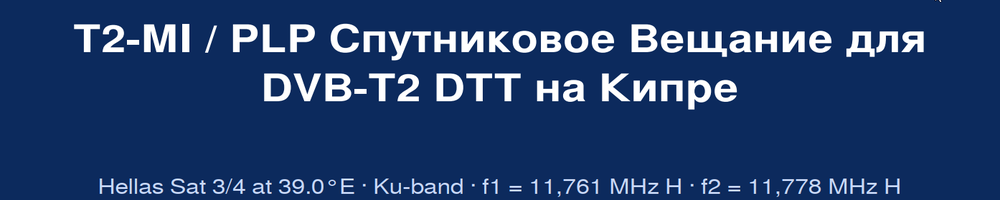
Комплексный научно-технический анализ спутниковой цепочки распределения для цифрового эфирного телевидения (DTT) в Республике Кипр
СОДЕРЖАНИЕ ДОКУМЕНТА
1. Аннотация и введение
2. Цифровое телевидение на Кипре — историческое развитие
3. Hellas Sat 3/4 — техническая характеристика спутника на 39,0° в.д.
4. Стандарт DVB-T2: архитектурные и модуляционные принципы
5. T2-MI (T2 Modulator Interface) — нормативное определение и техническая сущность
6. Physical Layer Pipe (PLP) — принцип и классификация
7. Спутниковое вещание T2-MI на Кипре: параметры частоты f1 = 11 761 МГц H
8. Спутниковое вещание T2-MI на Кипре: параметры частоты f2 = 11 778 МГц H
9. Уровень DVB-S2: параметры модуляции и кодирования
10. Multistream (MIS) и коды PLS Gold/Root — технический анализ
11. Архитектура цепочки распределения: от студии до передатчика DVB-T2
12. Сеть SFN (Single Frequency Network) на Кипре — топология и преимущества
13. Содержимое мультиплексов: структура каналов и кодеки
14. Покрытие DTT Кипра, число зрителей и социальный контекст
15. Приём сигнала T2-MI в Европе: технические требования
16. Сравнение T2-MI/спутник и IP/волоконно-оптического распределения
17. Регуляторная и лицензионная база
18. Заключение и научное резюме
19. Перечень норм, стандартов и ссылок
1. АННОТАЦИЯ И ВВЕДЕНИЕ
Настоящий научно-технический документ представляет собой комплексный анализ спутниковой системы распределения для цифрового эфирного телевидения (DVB-T2 DTT) в Республике Кипр, реализованной посредством технологического стандарта T2-MI (T2 Modulator Interface) в сочетании с Physical LayerbPipe (PLP) в соответствии с нормой ETSI TS 102 773. Спутниковое вещание осуществляется с геостационарной позиции Hellas Sat 3/4 на 39,0° в.д. в диапазоне Ku на двух несущих частотах: f1 = 11 761 МГц, горизонтальная поляризация (H) и f2 = 11 778 МГц, горизонтальная поляризация (H). Оба транспондера используют модуляцию DVB-S2 с кодированием 8PSK и FEC 3/4 при скорости символов SR = 15 157 ксим/с.
Документ охватывает технологические, регуляторные, исторические и социально-медийные аспекты построения современной DTT-инфраструктуры на острове Кипр. В нём объясняются причины перехода на DVB-T2, подробно описывается архитектура цепочки распределения T2-MI от производственной студии до антенного передатчика, определяется нормативный контекст структуры PLP и даётся исчерпывающий обзор содержимого кипрских мультиплексов, включая HD- и UHD-сервисы.
1.1 Научная мотивация и цель исследования
Развитие цифрового эфирного телевещания в небольших европейских островных государствах представляет собой уникальную технологическую задачу. Остров Кипр с населением около 1 380 000 жителей (оценка ООН, 2026 г.) отличается географически сложным рельефом — горный массив Троодос, сезонные климатические вариации и политическое разделение острова, — что требует инновационного подхода к распределению телевизионных программных потоков для наземной сети DVB-T2. Именно здесь спутниковый канал T2-MI находит применение в качестве основной цепочки распределения, заменяя традиционные наземные IP-каналы или волоконно-оптические линии в районах с ограниченной инфраструктурой.
Цель настоящего исследовательского документа: (1) предоставить технически точное и научно
верифицируемое описание кипрской спутниковой системы распределения T2-MI; (2) проанализировать
параметры обеих несущих частот в контексте действующих технических норм; (3) раскрыть роль Hellas Sat
как интегрированного оператора спутникового распределения и наземной DTT-сети; (4) вписать данное
решение в более широкий европейский контекст миграции на стандарт DVB-T2.
2. ЦИФРОВОЕ ТЕЛЕВИДЕНИЕ НА КИПРЕ — ИСТОРИЧЕСКОЕ РАЗВИТИЕ
Телевизионное вещание на Кипре началось в 1957 году. Кипрская радиовещательная корпорация (CyBC /
RIK) была основана как первое государственное телевизионное учреждение острова. Частное телевидение
появилось 26 апреля 1992 года с запуском канала Logos TV. До середины 1990-х годов на Кипре насчитывалось пять бесплатных наземных телевизионных каналов. 2.1 Переход на цифровое эфирное телевидение (2011)
В соответствии с обязательствами Республики Кипр как члена Европейского союза отключение аналогового вещания (Analogue Switch-Off, ASO) было произведено 1 июля 2011 года. Первоначальная -платформа была построена на базе стандарта DVB-T с кодированием MPEG-4, что позволилоКипру сразу же внедрить HD-совместимое решение. Для эксплуатации DTT были выданы две лицензии:общественная платформа CyBC (RIK) и коммерческая платформа Velister Ltd.
2.2 Модернизация до DVB-T2 и роль Hellas Sat
Потребнос ть в значительно более высокой спектральной эффективности, HD- и UHD-ёмкости, а также
синхронизированных одночастотных сетях (SFN) стимулировала переход на DVB-T2. Оператор Hellas Sat
— дочерняя компания Арабской организации спутниковой связи (Arabsat) — получил лицензию на эксплуатацию DTT-сети сроком действия с 1 декабря 2025 по 9 ноября 2040 года.Новая сеть состоит из четырёх одночастотных сетей (SFN), каждая оснащена двумя передающими каналами. Hellas Sat является не только оператором спутниковой цепочки распределения (через канал T2-MI), но и оператором всей наземной инфраструктуры DVB-T2.
3. HELLAS SAT 3/4 — ТЕХНИЧЕСКАЯ ХАРАКТЕРИСТИКА СПУТНИКА НА 39,0° В.Д.
На орбитальной позиции 39,0° в.д. размещены два совместно расположенных спутника: Hellas Sat 3 и Hellas Sat 4 (SaudiGeoSat-1). Hellas Sat 3 был запущен 28 июля 2017 года ракетой Ariane 5 ECA с космодрома во Французской Гвиане. Hellas Sat 4 запущен 5 февраля 2019 года, также ракетой Ariane 5 ECA.
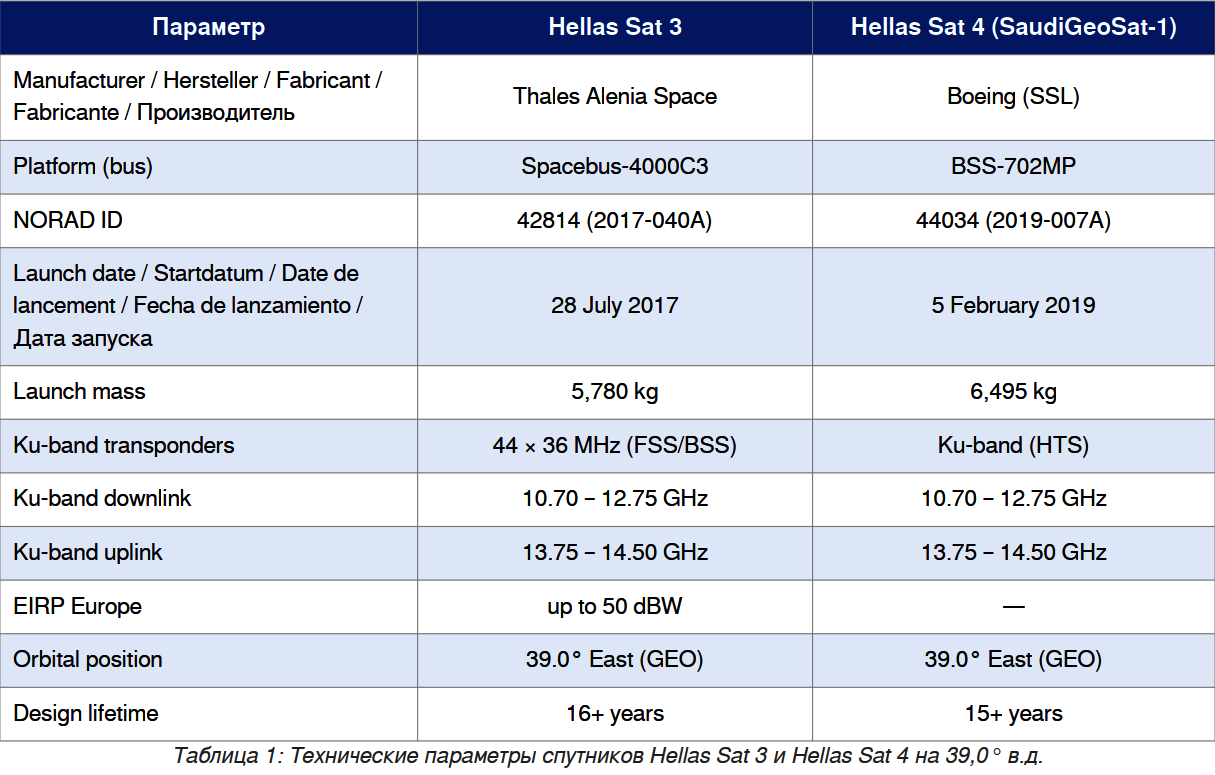
4. СТАНДАРТ DVB-T2 — АРХИТЕКТУРНЫЕ И МОДУЛЯЦИОННЫЕ ПРИНЦИПЫ
DVB-T2 определён нормой ETSI EN 302 755 и представляет второе поколение европейского стандарта цифрового эфирного телевидения. По сравнению с DVB-T он обеспечивает прирост спектральной ёмкости на 30–50 % благодаря: передовому кодированию LDPC+BCH, модуляции 256-QAM, физическим уровневым каналам (PLP), расширенным размерам БПФ (1K–32K), более длинным защитным интервалам и полной поддержке SFN-сетей.
Норма ETSI EN 302 755 определяет два профиля: T2-Base (исходный профиль для стационарных приёмников) и T2-Lite (для мобильного приёма). Кипрская DTT-сеть использует профиль T2-Base.
4.1 Ключевые технические характеристики DVB-T2
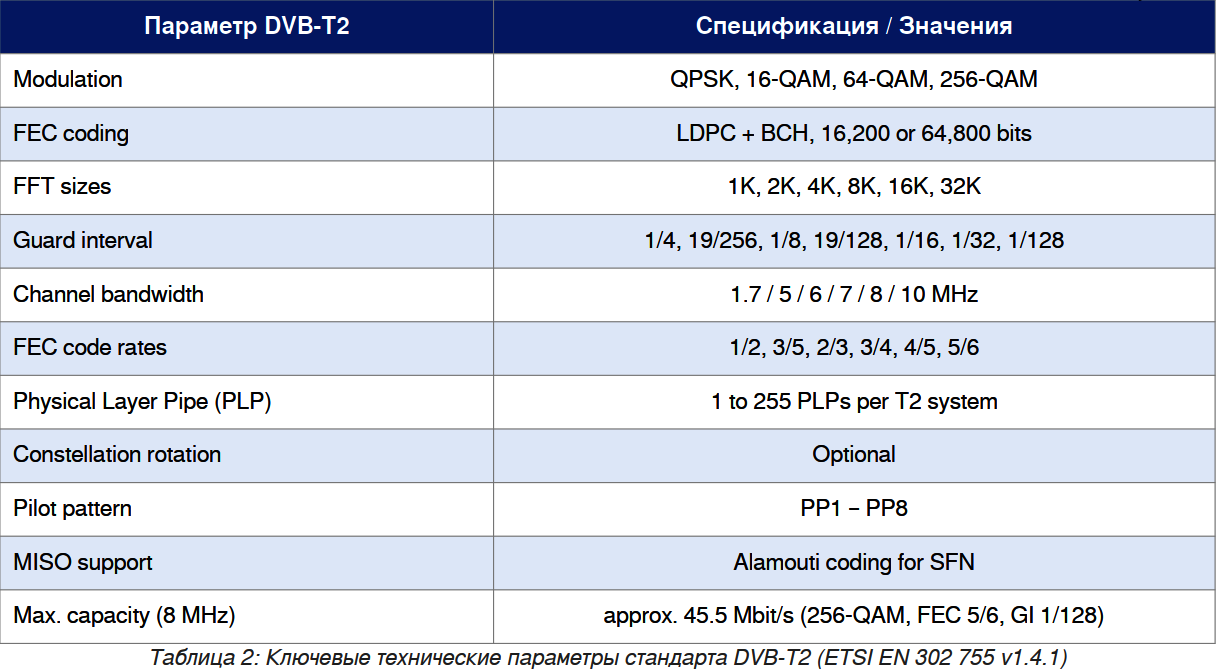
5. T2-MI (T2 MODULATOR INTERFACE) — НОРМАТИВНОЕ ОПРЕДЕЛЕНИЕ И ТЕХНИЧЕСКАЯ СУЩНОСТЬ
T2-MI (T2 Modulator Interface) — интерфейс, определённый нормой ETSI TS 102 773 (DVB Bluebook A136). Он служит для транспортировки предварительно обработанных кадров данных DVB-T2 от центрального устройства T2-Gateway к отдельным модуляторам в распределённой сети. T2-MI является фундаментальным строительным блоком, позволяющим эксплуатировать синхронизированные SFN-сети без локального мультиплексора в каждом передающем узле.
5.1 Принцип работы T2-MI
Центральное устройство обозначается как T2-Gateway. Оно принимает входные транспортные потоки (MPEG-2 TS) или данные GSE для отдельных PLP и выполняет следующие шаги:
• Форматирование входных данных в Baseband Frames (BBFRAME) для каждого PLP
• Генерация L1-сигнализации, содержащей параметры кадра T2
• Временное планирование кадров T2 и interleaving-кадров
• Вставка точных временных меток TTO (Time to Output) для SFN-синхронизации
• Инкапсуляция в пакеты T2-MI и передача к модуляторам T2-MI PID = 4096 (0x1000) — стандартное значение, определённое нормой ETSI TS 102 773 и используемое кипрским каналом T2-MI.
5.2 Преимущества T2-MI перед традиционной IP-моделью распределения
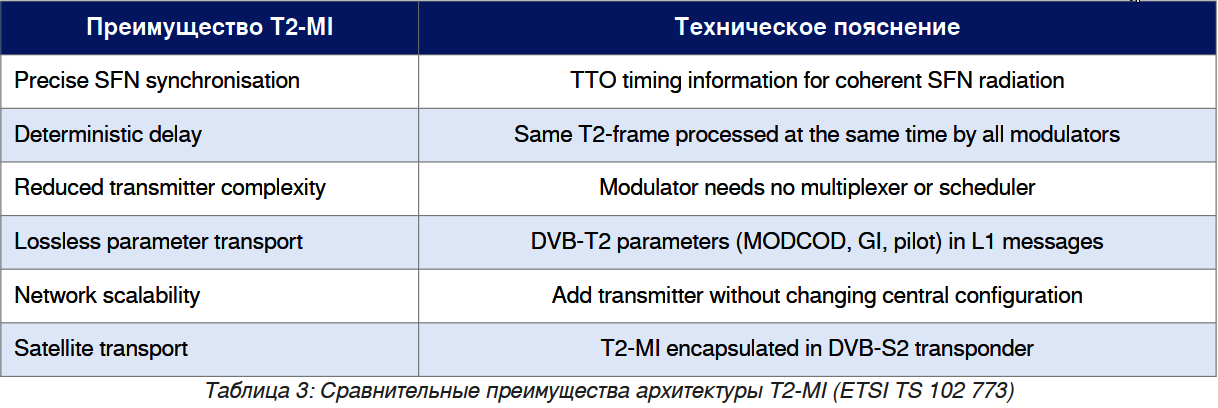
6. PHYSICAL LAYER PIPE (PLP) — ПРИНЦИП И КЛАССИФИКАЦИЯ
Physical Layer Pipe (PLP) — ключевая концепция стандарта DVB-T2 (ETSI EN 302 755). PLP представляет логический канал данных на физическом уровне системы DVB-T2. Вход T2-системы состоит из одного или нескольких логических потоков данных, каждый из которых переносится ровно одним PLP. Идентификатор PLP — 8-битное поле (PLP_ID).
6.1 Типы PLP
DVB-T2 различает два основных типа PLP:
• Data PLP: Несёт данные одного или нескольких мультимедийных сервисов (ТВ-каналов). Может статически или динамически выделяться в кадре T2.
• Common PLP: Содержит данные, общие для группы Data PLP (например, общие таблицы SI/PSI).
Передаётся один раз за кадр T2 непосредственно после L1-сигнализации. Каждый PLP проходит через модуль адаптации режима, включающий Input Stream Synchronizer (ISSY), Null Packet Deletion и кодировщик CRC-8. Результатом являются BBFRAME — вход для FEC-кодирования LDPC+BCH.
6.2 Связь PLP с T2-MI
В контексте кипрского канала T2-MI каждая передаваемая программа мультиплекса соответствует одному
PLP с PLP_ID = 0. Для обоих транспондеров f1 и f2 на Кипре объявлен T2MI-PLP ID 0.
Примечание: T2MI-PLP ID 0x00 (значение 0) является допустимым и широко используемым значением
для базового PLP данных в одноканальной конфигурации.
7. СПУТНИКОВОЕ ВЕЩАНИЕ T2-MI НА КИПРЕ: ЧАСТОТА f1 = 11 761 МГц H
Первый кипрский транспондер T2-MI работает на частоте f1 = 11 761 МГц, горизонтальная поляризация (H). В следующей таблице приведены полные технические параметры:
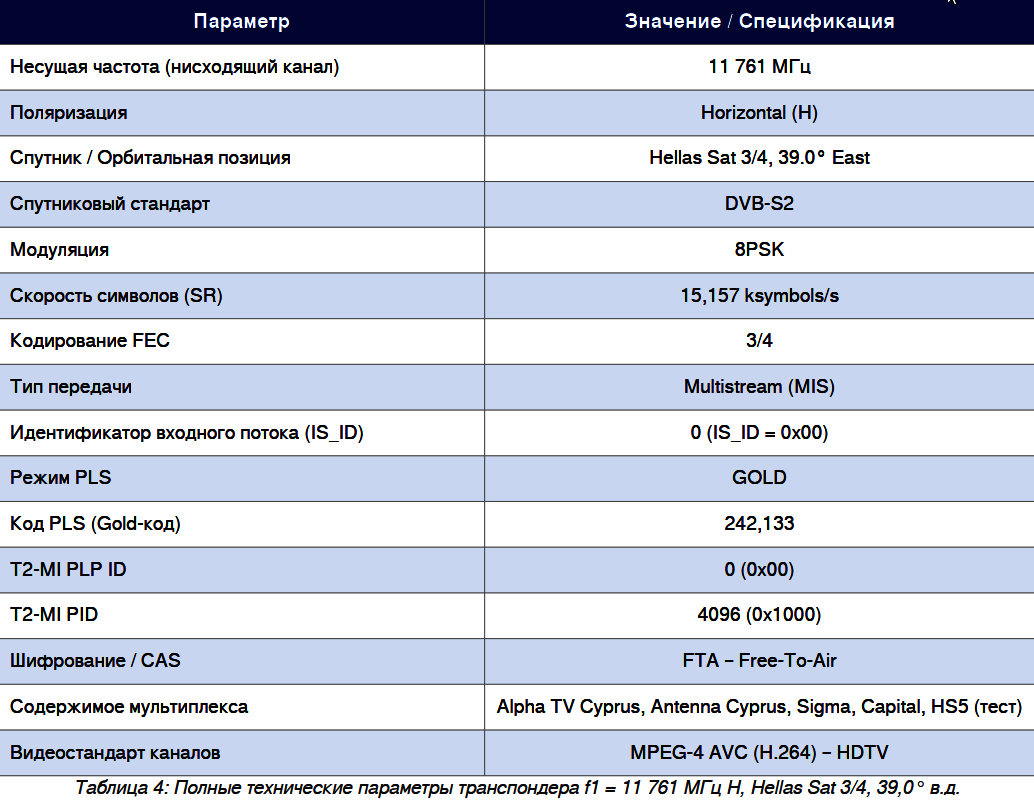
8. СПУТНИКОВОЕ ВЕЩАНИЕ T2-MI НА КИПРЕ: ЧАСТОТА f2 = 11 778 МГц H
Второй кипрский транспондер T2-MI работает на частоте f2 = 11 778 МГц, горизонтальная поляризация (H). В следующей таблице приведены полные технические параметры:
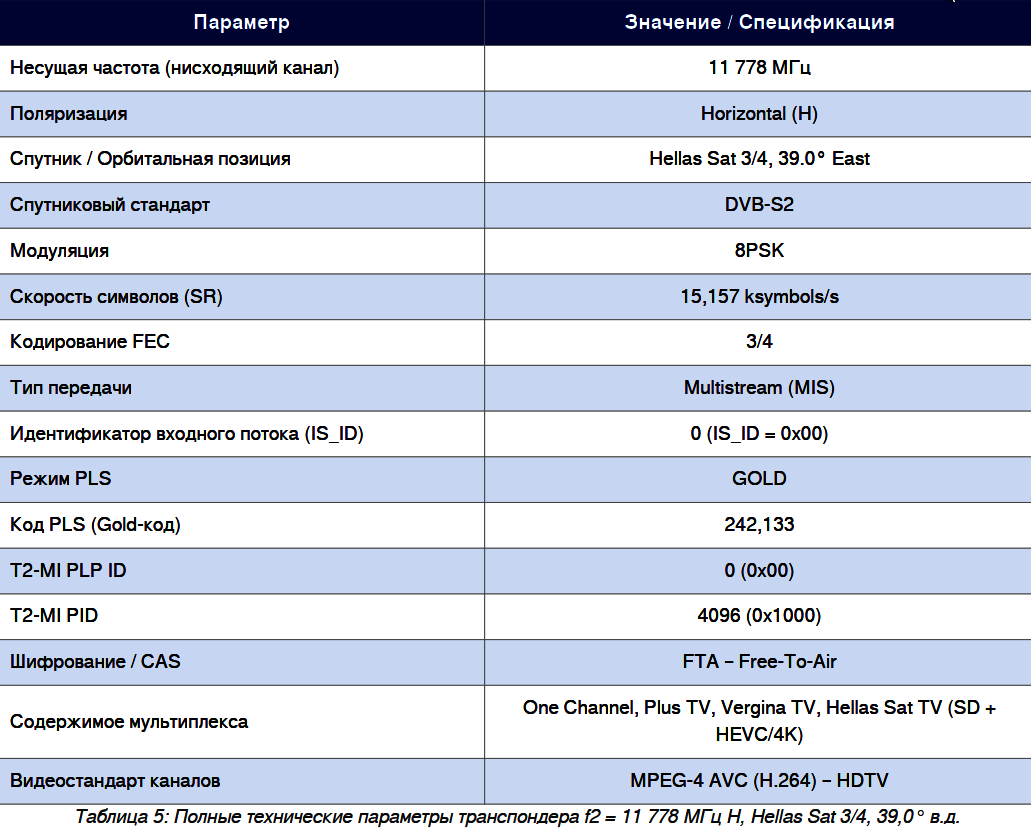
9. УРОВЕНЬ DVB-S2 — ПАРАМЕТРЫ МОДУЛЯЦИИ И КОДИРОВАНИЯ
Поток T2-MI транспортируется через спутниковую цепочку, построенную на стандарте DVB-S2 (ETSI EN 302 307). Модуляция 8PSK является компромиссом между спектральной эффективностью и помехоустойчивостью передачи. По сравнению с QPSK (2 бит/сим) 8PSK обеспечивает 3 бит/сим, увеличивая ёмкость на 50 %.
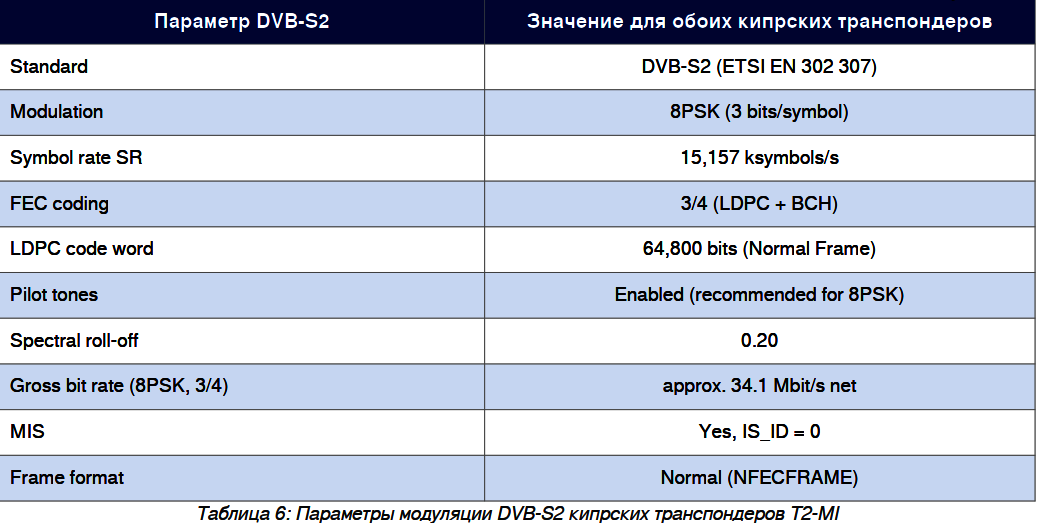
10. MULTISTREAM (MIS) И КОДЫ PLS GOLD/ROOT — ТЕХНИЧЕСКИЙ АНАЛИЗ
Стандарт DVB-S2 (ETSI EN 302 307) определяет два режима входного потока: SIS (Single Input Stream) и MIS (Multiple Input Stream). Кипрский канал T2-MI использует режим MIS. На обеих кипрских частотах IS_ID = 0.
10.1 Код PLS (Physical Layer Scrambling)
DVB-S2 определяет два типа кодов PLS:
• Root-код: Генерируется M-последовательным полиномом степени 18. Для кипрского транспондера f1 на
начальном этапе был идентифицирован Root PLS-код 211 867.
• Gold-код: Генерируется циклическим сдвигом из Root M-последовательности. Обеспечивает 262 143 уникальных кода. Оба транспондера f1 и f2 используют Gold-код 242 133.
Примечание: В спутниковом приёмнике режим PLS (ROOT или GOLD) и конкретный код PLS должны быть настроены до декодирования физического уровня DVB-S2.
11. АРХИТЕКТУРА ЦЕПОЧКИ РАСПРЕДЕЛЕНИЯ: ОТ СТУДИИ ДО ПЕРЕДАТЧИКА DVB-T2
Полная цепочка распределения кипрской системы T2-MI/DVB-T2 состоит из нескольких технологически различных, но функционально взаимосвязанных уровней:
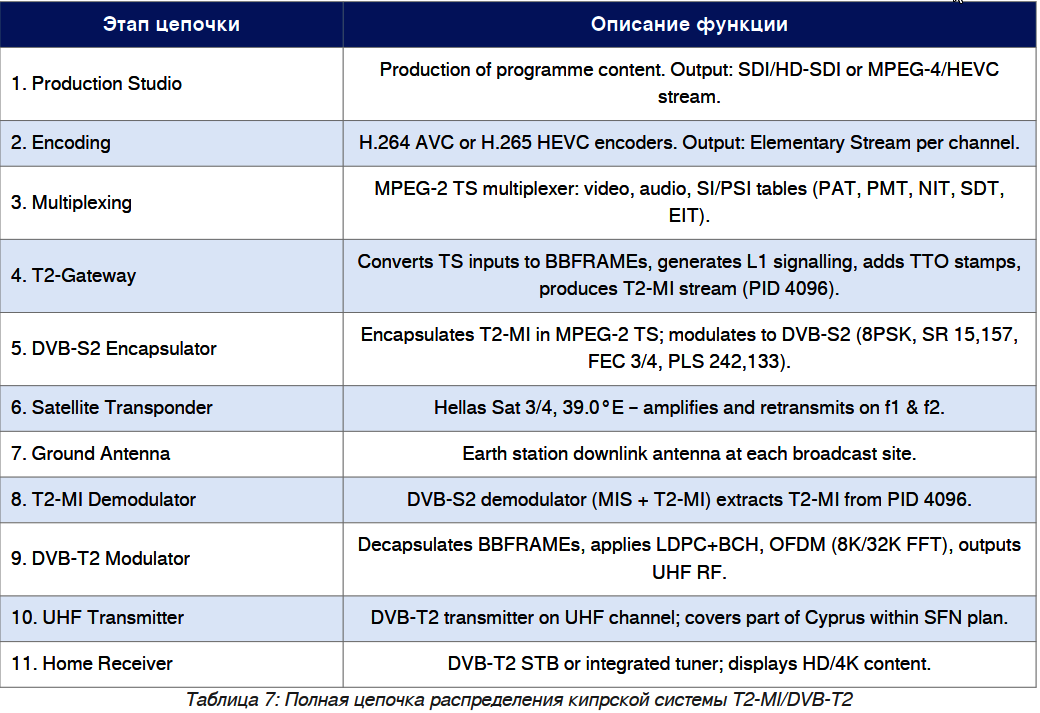
12. СЕТЬ SFN (SINGLE FREQUENCY NETWORK) НА КИПРЕ — ТОПОЛОГИЯ И ПРЕИМУЩЕСТВА
Single Frequency Network (SFN) — сеть передатчиков, ведущих одновременное вещание одной программы на одной частоте с точной взаимной фазовой синхронизацией. Кипрская DTT-система спроектирована как четыре SFN-сети с суммарно восемью передающими каналами. РаспределениеT2-MI через спутник гарантирует, что все модуляторы DVB-T2 в SFN-сети получают идентичные пакетыT2-MI с одинаковыми значениями TTO.
12.1 Преимущества SFN для Кипра
• Эффективное использование спектра: Одна и та же программа на одной частоте вместо нескольких
частот для разных зон.
• Большее покрытие: Сложение сигналов нескольких передатчиков улучшает покрытие в теневых зонах
склонов горного массива Троодос.
• Помехозащищённость: Сигналы соседних передатчиков складываются конструктивно (при попадании
в пределы защитного интервала).
• Простая система резервирования: Отказ одного передатчика не приводит к потере сигнала на всей
покрытой территории.
• Пригодность для островного рельефа: Горный рельеф Кипра (Троодос макс. 1 952 м н.у.м.) требует
нескольких передающих позиций.
13. СОДЕРЖИМОЕ МУЛЬТИПЛЕКСОВ — СТРУКТУРА КАНАЛОВ И КОДЕКИ
Сокращения: CY = Кипр, GR = Греция, HS = Hellas Sat. Наличие 4K HEVC-канала Hellas Sat TV на f2 отражает технологическую перспективу платформы в направлении UHD DTT-вещания.
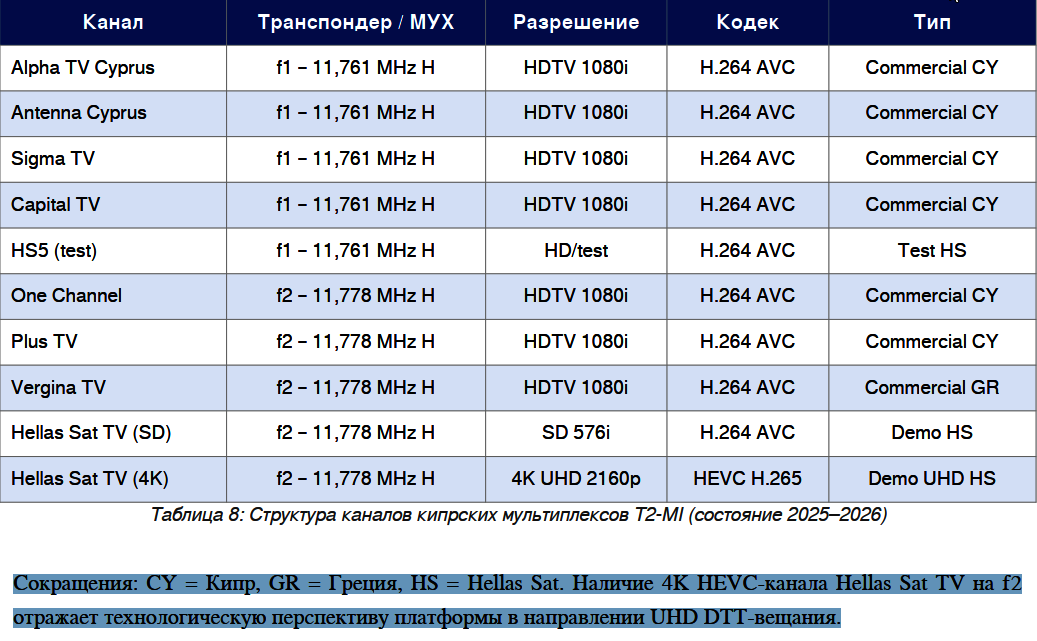
14. ПОКРЫТИЕ DTT КИПРА, ЧИСЛО ЗРИТЕЛЕЙ И СОЦИАЛЬНЫЙ КОНТЕКСТ
Республика Кипр насчитывает около 1 379 000 жителей в контролируемой части острова (оценка ООН, 2026 г.). Общее число телевизионных домохозяйств оценивается в 200 000–260 000, что соответствует пенетрации ТВ-приёмников, близкой к 100 %. Эксплуатация DTT-сети на стандарте DVB-T2 создаёт потенциал для бесплатного FTA-приёма HD- и UHD-контента для всех домохозяйств без необходимости платных спутниковых или IPTV-подписок. Расчётное число DTT-зрителей после полного запуска сети (2025–2026) составляет 150 000–200 000
активных DTT-домохозяйств.
15. ПРИЁМ СИГНАЛА T2-MI В ЕВРОПЕ — ТЕХНИЧЕСКИЕ ТРЕБОВАНИЯ
Европейский луч в диапазоне Ku достигает ЭИИМ 40–50 дБВт, что обеспечивает приём стандартными антеннами:
• Кипр, Греция, Турция, Египет: Антенна 45–60 см достаточна.
• Балканы, Румыния, Болгария, Италия: Антенна 75–90 см рекомендована.
• Центральная Европа (Словакия, Чехия, Польша, Венгрия): Антенна 90–120 см, рекомендован
малошумящий LNB с КШ ≤ 0,3 дБ.
• Северная Европа (Нидерланды, Бельгия): Антенна 100–120 см, приём возможен при благоприятных
атмосферных условиях.
15.1 Требования к приёмному оборудованию
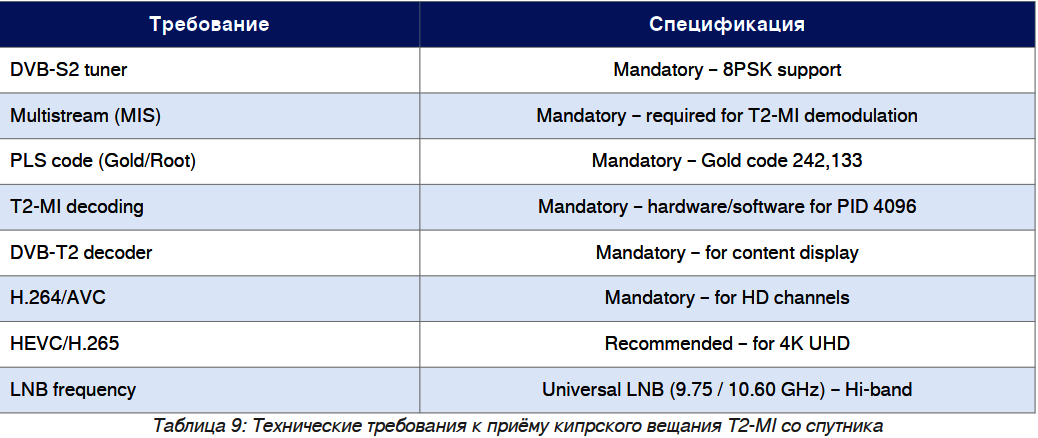
16. СРАВНЕНИЕ T2-MI/СПУТНИК И IP/ВОЛОКОННО-ОПТИЧЕСКОЕ РАСПРЕДЕЛЕНИЕ
Сравнение показывает, что для островной среды с горным рельефом и географически рассредоточенными
передающими позициями спутниковое распределение T2-MI является однозначно более выгодным
решением как с экономической, так и с технологической точки зрения.
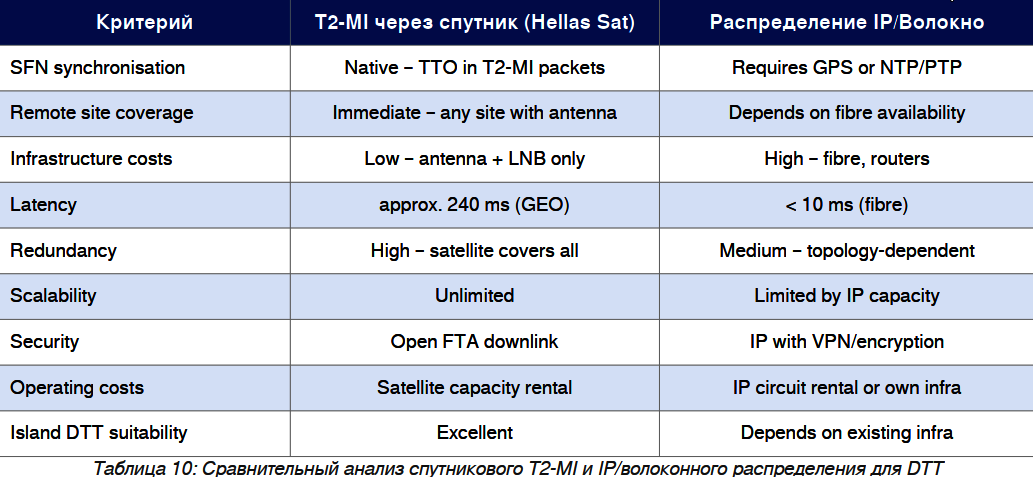
17. РЕГУЛЯТОРНАЯ И ЛИЦЕНЗИОННАЯ БАЗА — HELLAS SAT КАК ОПЕРАТОР DTT
Эксплуатация DTT-сети на Кипре регулируется Департаментом электронных коммуникаций Министерства исследований Республики Кипр. Hellas Sat получил лицензию на эксплуатацию DTT-сети сроком с 1 декабря 2025 по 9 ноября 2040 года для четырёх SFN-сетей. Hellas Sat является дочерней компанией Арабской организации спутниковой связи (Arabsat), головной офис которой расположен в Эр-Рияде (Саудовская Аравия).
18. ЗАКЛЮЧЕНИЕ И НАУЧНОЕ РЕЗЮМЕ
Кипрская система распределения T2-MI/DVB-T2 представляет собой современный и технологически высокоразвитый подход к построению наземной DTT-инфраструктуры в небольшом европейском островном государстве. Использование спутникового канала T2-MI через Hellas Sat 3/4 на 39,0° в.д. в качестве основной цепочки распределения является изящным решением. Ключевые научные выводы:
1. Кипрская DTT-система построена на стандарте DVB-T2 с распределением посредством протокола
T2-MI, инкапсулированного в сигнале DVB-S2 на Hellas Sat 3/4, 39,0° в.д.
2. Оба транспондера (f1 = 11 761 МГц H и f2 = 11 778 МГц H) используют идентичные параметры
DVB-S2: 8PSK, SR 16 515 ксим/с, FEC 5/6, MIS, Gold PLS-код 242 133, T2-MI PID 4096, PLP ID 0.
3. Архитектура T2-MI обеспечивает SFN-синхронизацию посредством временных меток TTO без внешних
GPS-систем.
4. Hellas Sat является не только спутниковым оператором, но и оператором наземной DVB-T2-сети на
Кипре с лицензией, действительной до 2040 года.
5. Структура содержимого мультиплексов включает HD-каналы (H.264) и демонстрационный контент 4K
UHD (HEVC/H.265).
6. Спутниковый канал T2-MI является оптимальным решением распределения с учётом горного рельефа и
островного расположения Кипра.
7. Исследовательская и мониторинговая ценность кипрского канала T2-MI носит общеевропейский
характер.
19. ПЕРЕЧЕНЬ НОРМ, СТАНДАРТОВ И ПРОФЕССИОНАЛЬНЫХ ССЫЛОК
[1] ETSI EN 302 755 V1.4.1 (2015): DVB; Frame structure, channel coding and modulation for DVB-T2. ETSI, Sophia
Antipolis.
[2] ETSI TS 102 773 V1.3.1 (2012): DVB; Modulator Interface (T2-MI) for DVB-T2. ETSI, Sophia Antipolis.
[3] DVB Bluebook A136 (rev. 2, 2012): DVB T2 Modulator Interface (T2-MI). DVB Project, Geneva.
[4] ETSI EN 302 307-1 V1.4.1 (2014): DVB-S2; Second generation framing structure. ETSI.
[5] DVB Bluebook A175 (2011): DVB-SIS – Single Illumination System for SFN. DVB Project.
[6] Broadband TV News (03.03.2025): Hellas Sat to run DTT network in Cyprus.
[7] Cyprus Mail (25.02.2025): Hellas Sat to launch advanced digital TV network in Cyprus.
[8] Wikipedia: Digital terrestrial television in Cyprus.
[09] Wikipedia: Cyprus Broadcasting Corporation (CyBC/RIK).
[10] Wikipedia: Hellas Sat 3.
[11] NTvsat: Hellas Sat 3 / Hellas Sat 4 technical data. https://nt-vsat.com/hellassat/
[12] UN Population Division: World Population Prospects 2024 – Cyprus.
[13] Dávid, R. (2025): T2-MI/PLP Research Centre – Scientific records. dxsatcs.com.