
SK>
EN>
DE>
FR>
ES>
RU>
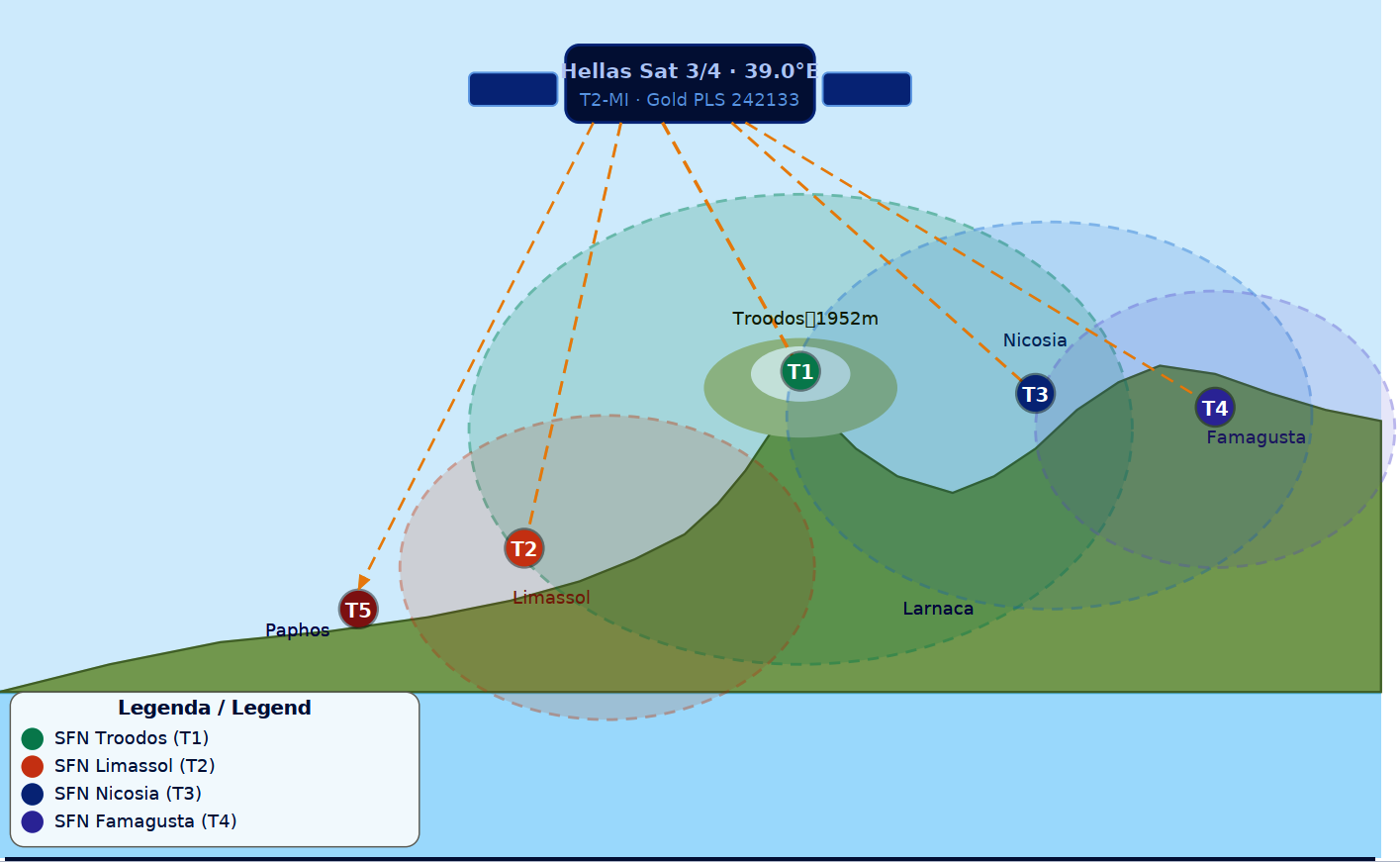
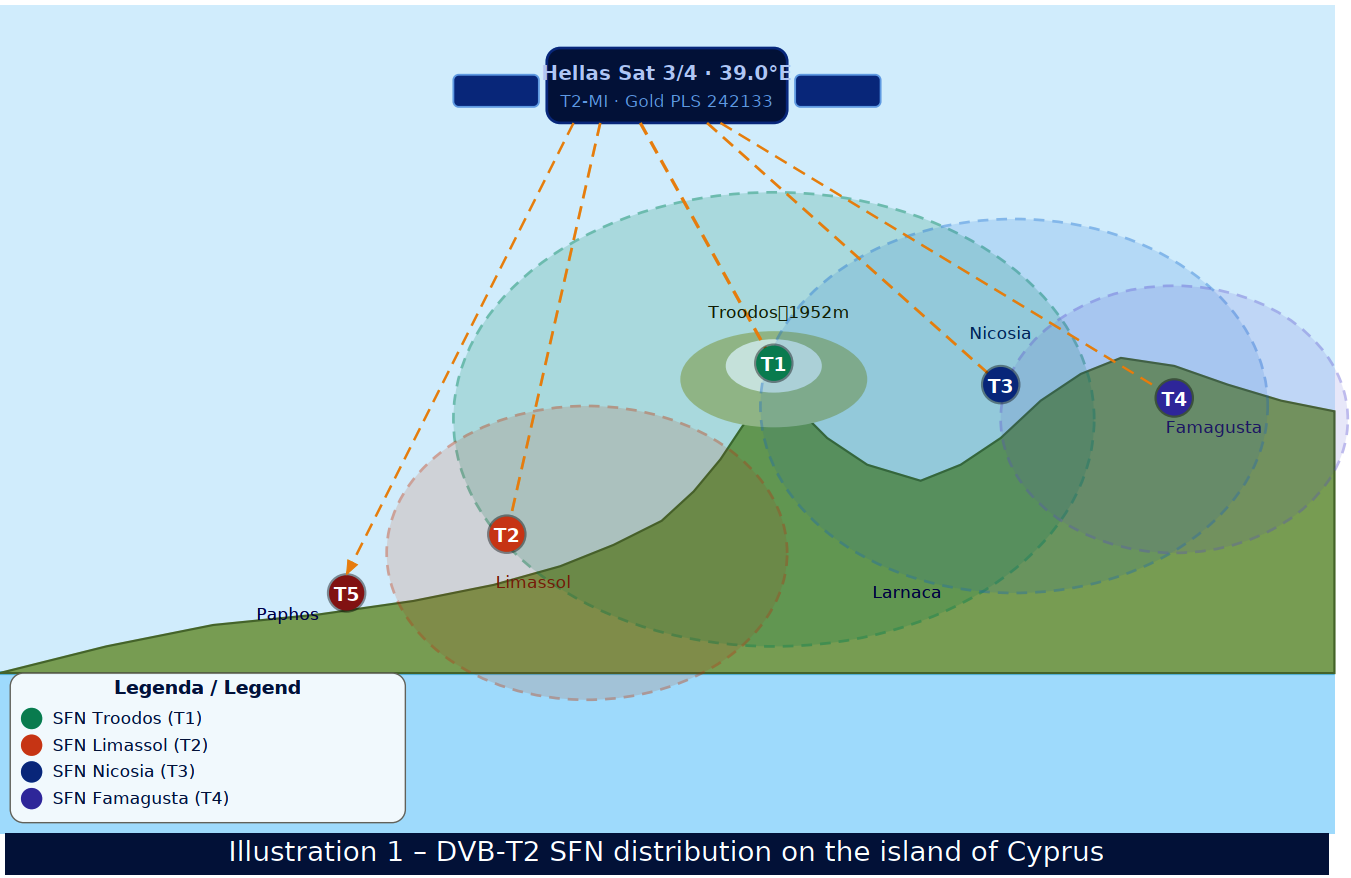
01: SK_ Opis: DVB-T2 SFN distribúcia na Cypre
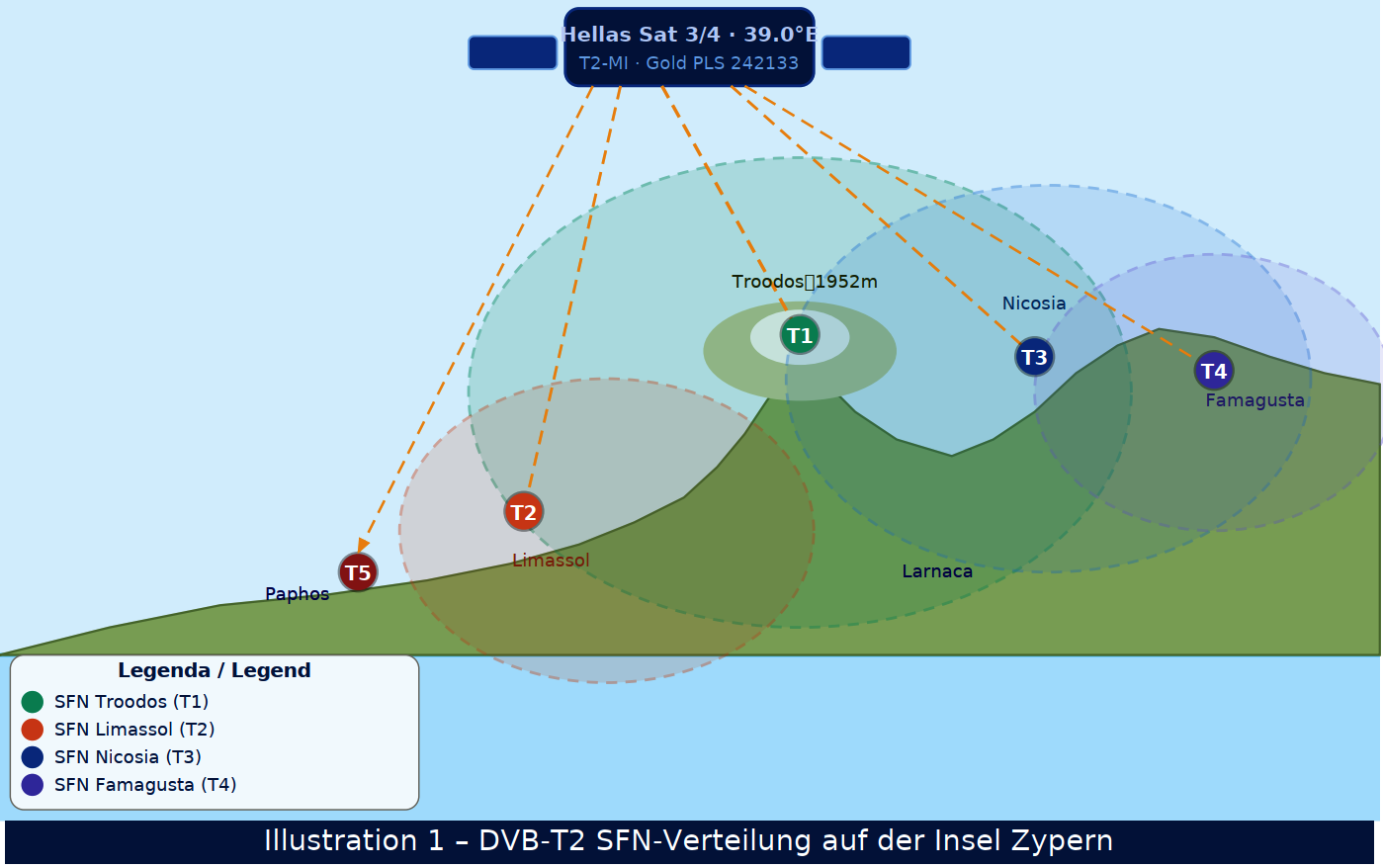
Ilustrácia zobrazuje ostrov Cyprus s jeho štyrmi synchronizovanými jednofrekvenčnými sieťami (SFN) pre digitálne terestriálne televízne vysielanie (DVB-T2 DTT). Každá SFN sieť je identifikovaná vlastnou farbou a zodpovedá konkrétnemu geografickému regiónu ostrova. V centre obrázku dominuje horský masív Troodos (max. 1952 m n.m.), ktorý tvorí najvyšší bod ostrova a zároveň najdôležitejšie miesto pre terestriálne vysielanie. Vysielač T1 na vrcholeTroodos pokrýva vďaka svojej nadmorskej výške najväčšiu plochu, vrátane južného pobrežia a dolín. Satelit Hellas Sat 3/4 na geo. orbite (39,0° v.d.) je zobrazený v hornej časti obrázku. Prerušované šikmé čiary znázorňujú T2-MI satelitné linky, ktoré dopravujú synchronizované T2-MI dátové toky (vrátane presných TTO časových značiek) ku každému pozemskému vysielaču. Tento prístup eliminuje potrebu lokálnych GPS synchronizátorov na každom stožiari. Farebné elipsy v dolinách a na pobreží predstavujú pokrytie jednotlivých SFN sietí: zelená (Troodos T1), oranžová (Limassol T2), modrá (Nicosia T3) a fialová (Famagusta T4). Vzájomné prekrytie pokrytí v dolinách vytvára SFN efekt – prijímač dostane signál z
viacerých vysielačov, pričom echá dopadajúce v rámci ochranného intervalu (Guard Interval) sa spočítajú konštruktívne.
Legenda v ľavom dolnom rohu identifikuje jednotlivé SFN siete. Celá sieť je licencovaná spoločnosti HellasSat na obdobie od 1.12.2025 do 9.11.2040.
Technické parametre: Gold PLS kód 242 133 · T2-MI PID 4096 · SR 15 157 ksps · 8PSK FEC 3/4 · FTA Free-To-Air
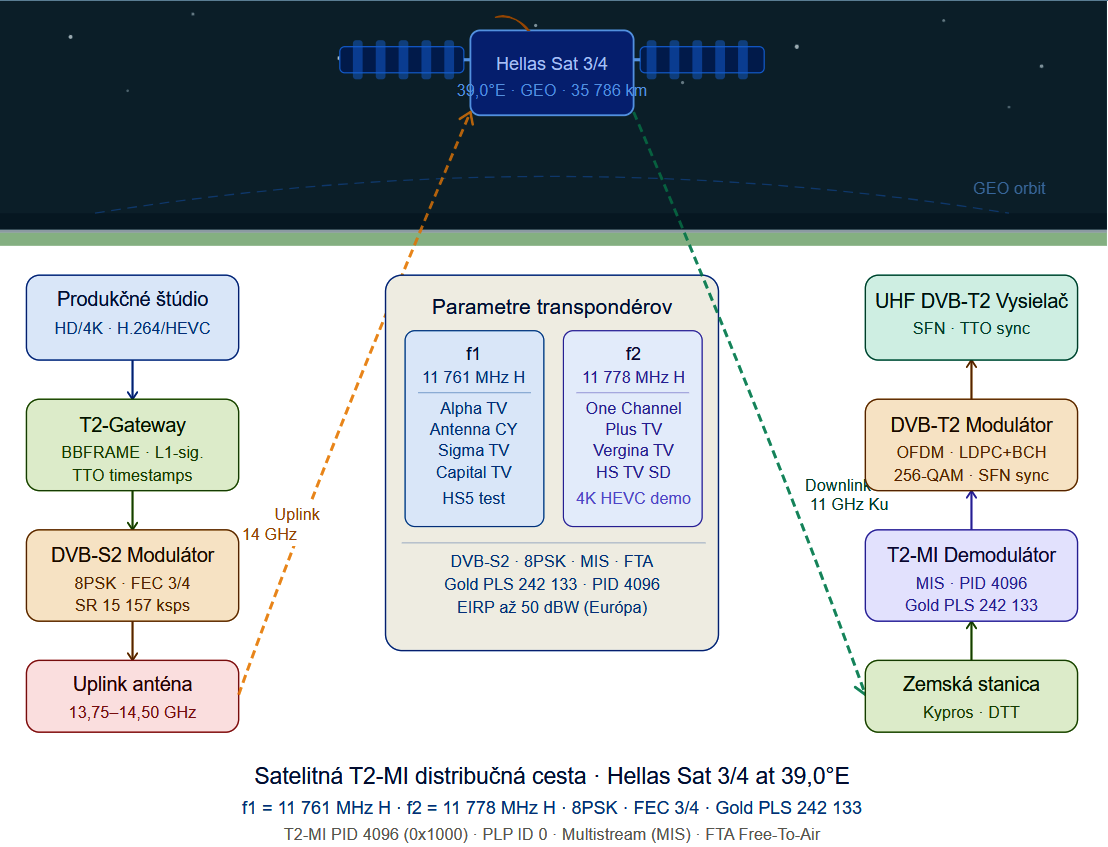
02: SK_ Opis: Satelitná T2-MI distribučná cesta
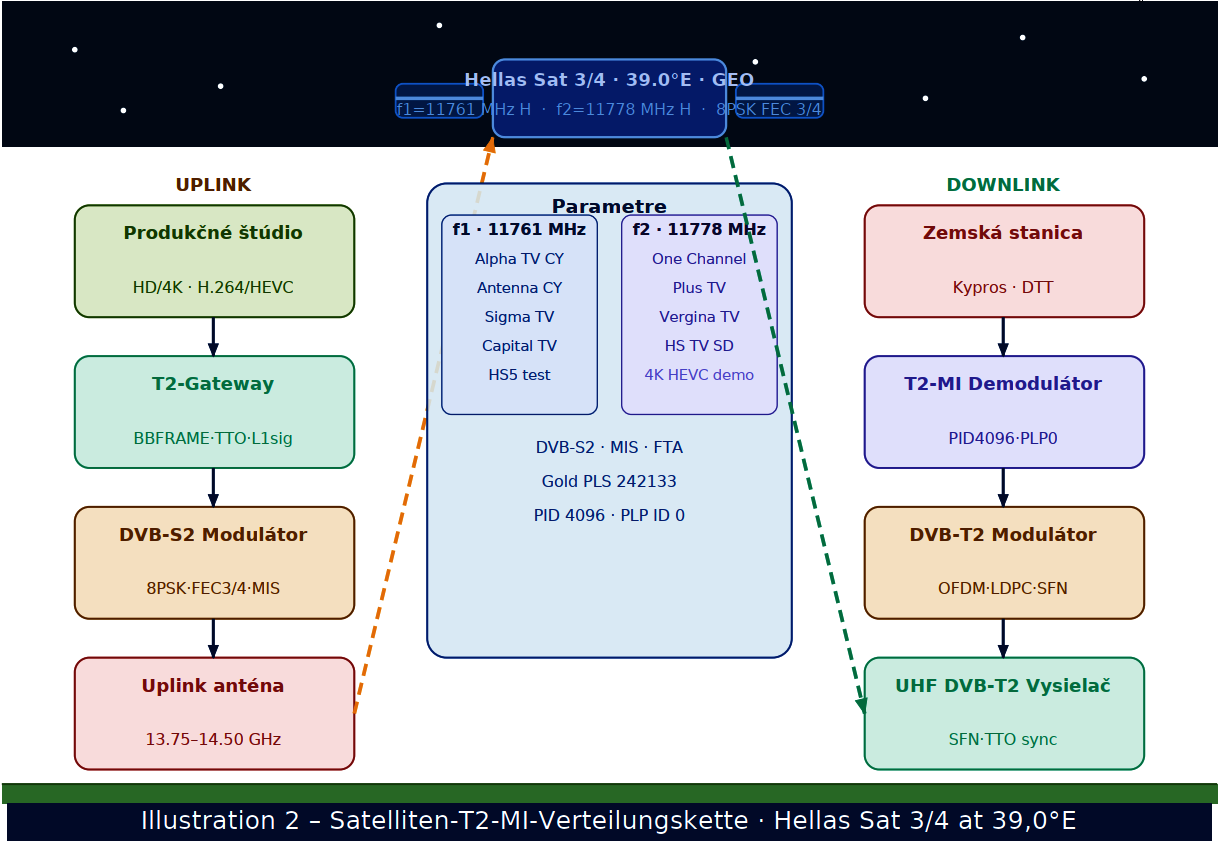
Ilustrácia komplexne zobrazuje celý distribučný reťazec cyperského DVB-T2 DTT systému od produkčného štúdia až po domáceho diváka, pričom stred cesty tvorí satelit Hellas Sat 3/4 na 39,0° v.d. Ľavá strana obrázku (UPLINK) zachytáva pozemskú časť cesty signálu smerom k satelitu. V produkčnom štúdiu sa vytvára programový obsah vo formátoch H.264 (HD) a HEVC (4K UHD). T2-Gateway konvertuje vstupné transportné toky na BBFRAME štruktúry, generuje L1-signalizáciu a vkladá TTO časové značky pre SFN synchronizáciu. DVB-S2 modulátor enkapsuluje T2-MI prúd do DVB-S2 nosnej s moduláciou 8PSK, FEC 3/4 a Multistream konfiguráciou (Gold PLS kód 242 133). Uplink anténa vysiela signál v pásme 13,75–14,50 GHz. Centrálny panel zobrazuje technické parametre oboch transpondérov. Transpondér f1 (11 761 MHz H) nesie kanály Alpha TV Cyprus, Antenna Cyprus, Sigma TV, Capital TV a HS5 (testovací kanál) v HD rozlíšení s kodekom H.264 AVC. Transpondér f2 (11 778 MHz H) nesie One Channel, Plus TV, Vergina TV, Hellas Sat TV (SD) a demonštračný 4K UHD kanál s kodekom HEVC/H.265. Pravá strana obrázku (DOWNLINK) znázorňuje príjem a spracovanie signálu na pozemskej strane Cypru. Zemská stanica prijíma downlink v pásme Ku (10,70–12,75 GHz). T2-MI demodulátor extrahuje T2-MI prúd z PID 4096 pomocou správne nakonfigurovaného Gold PLS kódu. DVB-T2 modulátor aplikuje OFDM moduláciu, LDPC+BCH FEC kódovanie a generuje UHF RF signál. UHF DVB-T2 vysielač distribuuje signál do SFN siete s TTO synchronizáciou.T2-MI/PLP Satelitné Vysielanie · Hellas Sat 3/4 · 39,0°E · dxsatcs.com Strana 4
Celý distribučný reťazec je navrhnutý tak, aby umožnil až 8 UHF vysielacích kanálov v 4 SFN sieťach pokrývajúcich celý ostrov. Obe frekvencie : DVB-S2 · 8PSK · SR 15 157 ksps · FEC 3/4 · MIS · IS_ID=0 · Gold PLS 242 133 · T2-MI PID 4096 (0x1000) · FTA
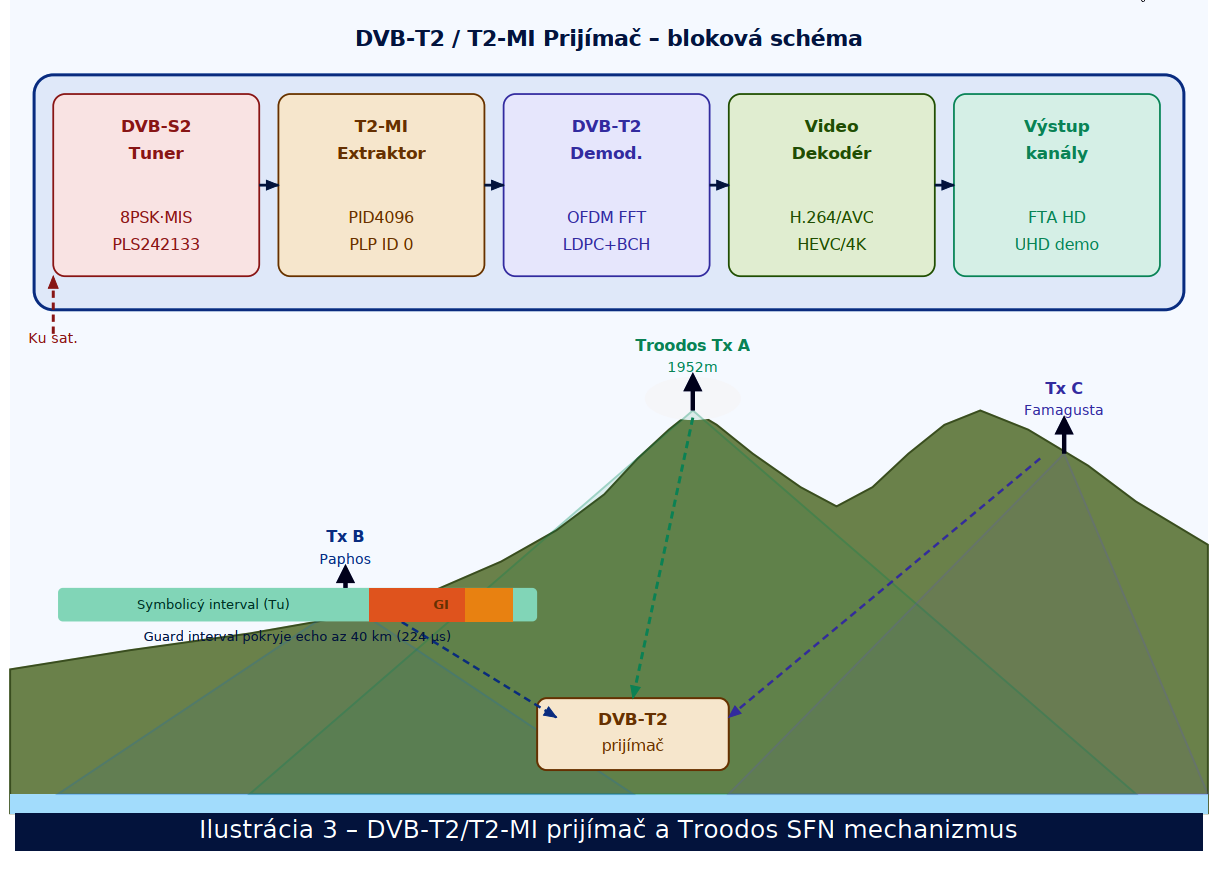
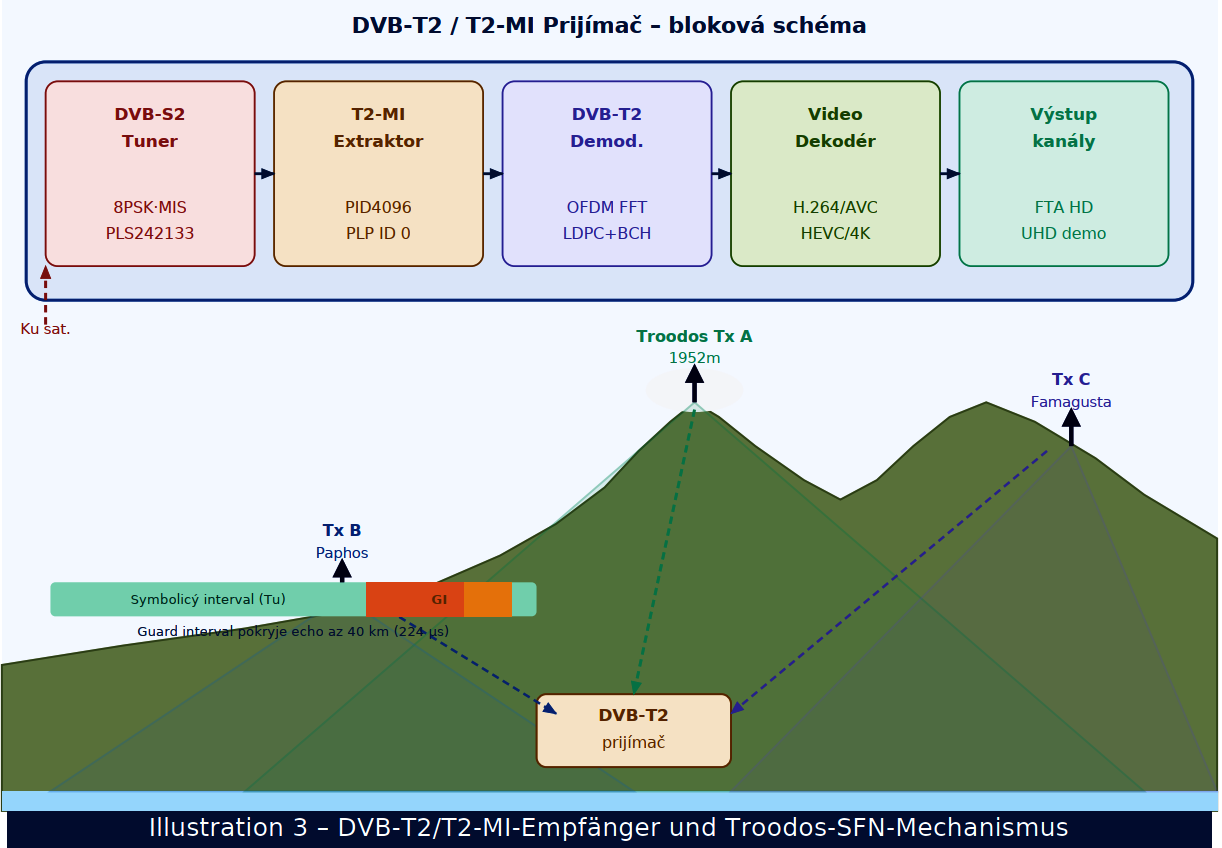
03:SK_Opis: DVB-T2/T2-MI prijímač a Troodos SFN mechanizmus
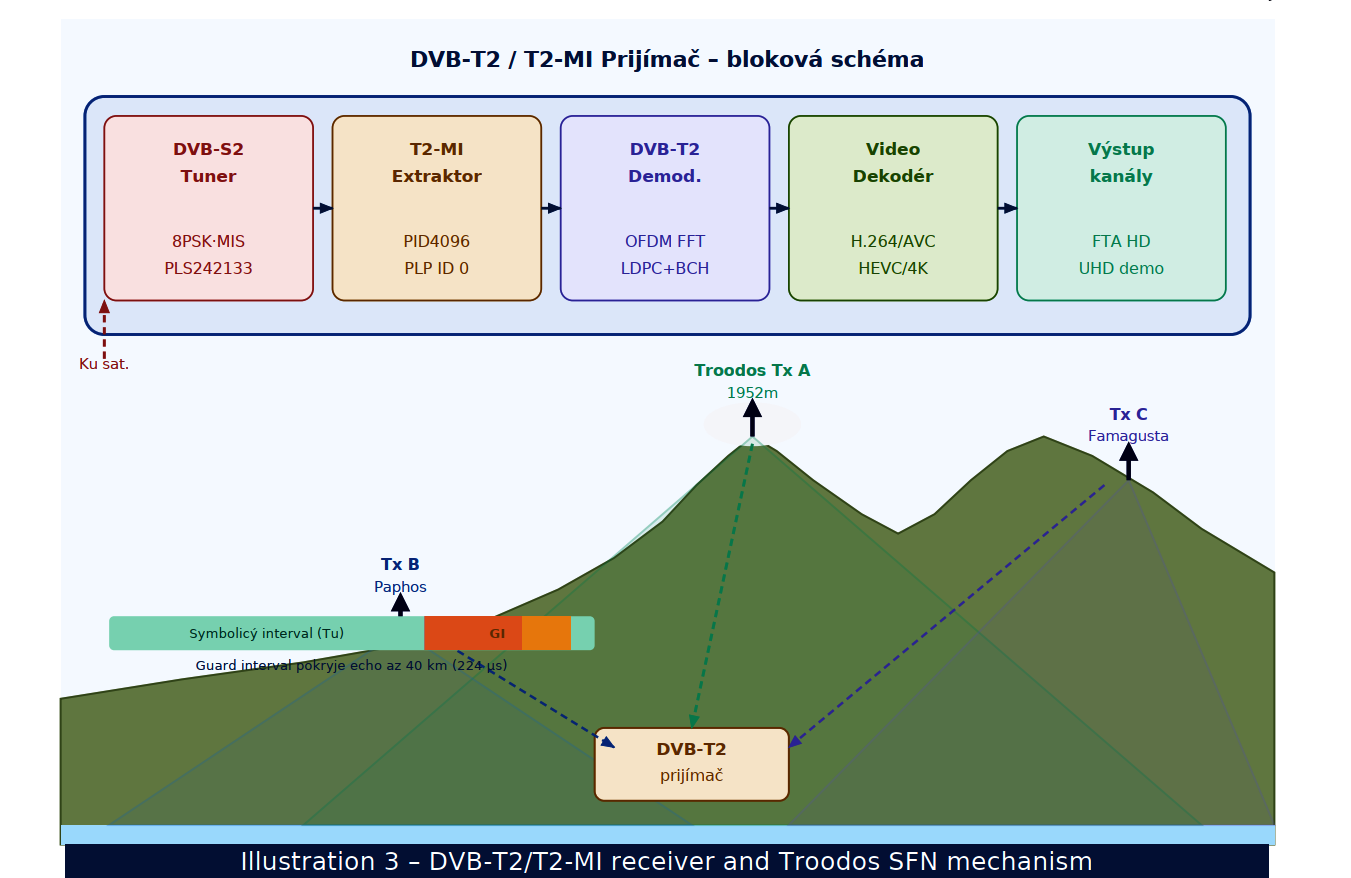
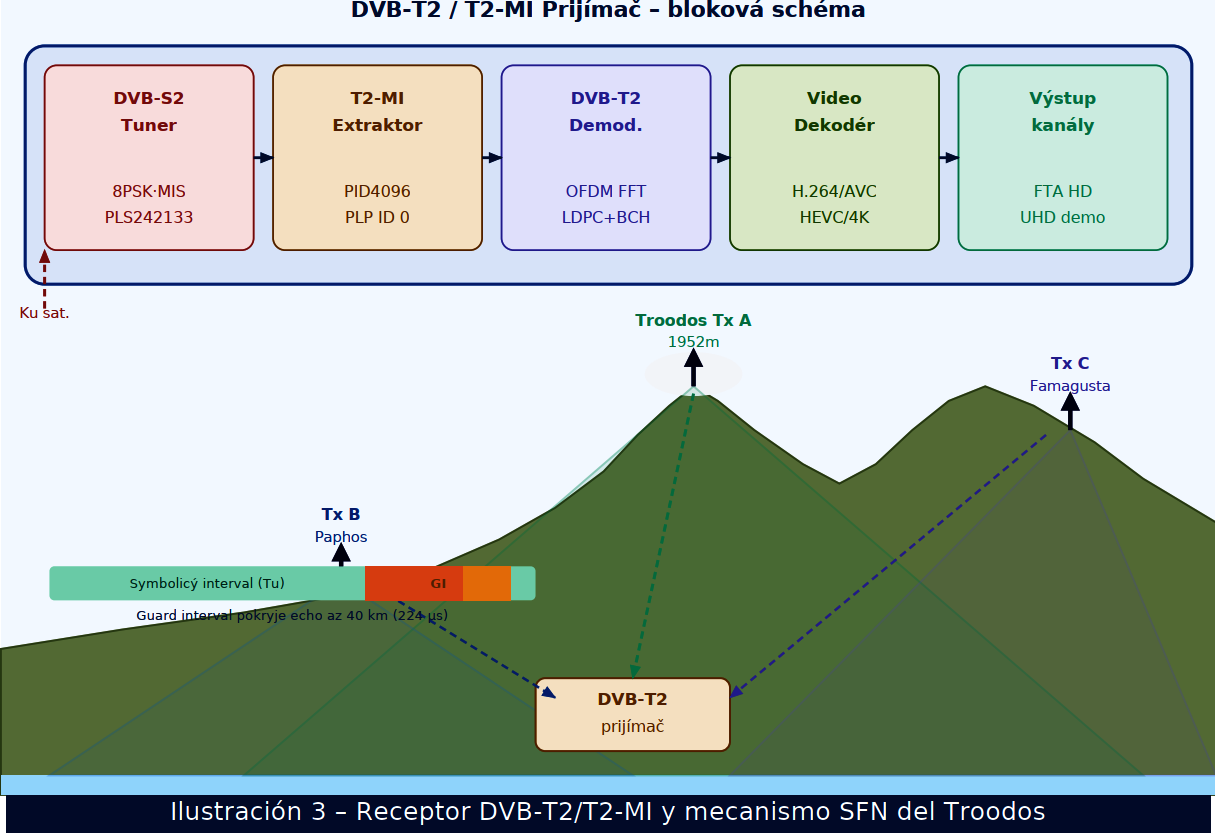
Ilustrácia je rozdelená na dve časti: hornú (bloková schéma DVB-T2/T2-MI prijímača) a dolnú (fyzikálny mechanizmus SFN na hore Troodos).
Horná časť – bloková schéma prijímača: DVB-S2 tuner prijíma satelitný signál z Hellas Sat 3/4 v pásme Ku. Pre príjem Cyperskej T2-MI služby musí tuner podporovať Multistream (MIS) a musí mať nakonfigurovaný Gold PLS kód 242 133 a IS_ID=0. T2-MI Extraktor z PID 4096 extrahuje T2-MI paketový tok a dekapsuluje BBFRAME štruktúry nesúce PLP ID 0.
DVB-T2 demodulátor aplikuje OFDM demodulation (FFT 1K–32K), LDPC+BCH FEC dekódovanie a 256-QAM demoduláciu. Video dekodér spracúva H.264 AVC (HD kanály) a HEVC/H.265 (4K UHD demonštrácia). Výstupné kanály zahŕňajú Alpha TV, Antenna Cyprus, Sigma TV, Capital TV, One Channel, Plus TV, Vergina TV a Hellas Sat TV. Dolná časť – Troodos SFN mechanizmus: Ilustrácia zobrazuje horský profil Cypru s vrcholom Troodos (1952 m n.m.) v strede. Vysielač Tx A na vrchole Troodos má najväčšiu pokrytú oblasť vďaka svojej nadmorskej výške. Vysielač Tx B(oblasť Paphos) pokrýva západné tienisté oblasti, vysielač Tx C (Famagusta) pokrýva východné časti. Kľúčovým prvkom SFN funkcionality je ochranný interval (Guard Interval, GI). Pruhový diagram v dolnej časti zobrazuje časovú štruktúru OFDM symbolu: modrá časť predstavujeužitočný symbol (Tu), oranžová časť je Guard Interval. DVB-T2 štandard s FFT 32K a GI=1/4 poskytuje ochranný interval asi 224 µs, čo zodpovedá pokrytiu vzdialenosti až 67km. Keďže vzdialenosť medzi Troodos a pobrežím je 35–40 km, všetky echá zo susedných vysielačov dopadajú v rámci tohto okna a prijímač ich integruje konštruktívne. Výsledkom je vyšší SNR v tienistých oblastiach bez akejkoľvek špeciálnej úpravy prijímača. Satelitná distribúcia T2-MI zabezpečuje, že všetky vysielače v SFN sieti vysielajú identický T2-rámec v rovnakom čase – podmienka SFN synchronizácie je splnená TTO časovými značkami v T2-MI pakete. Požiadavky na príjem: DVB-S2 tuner s MIS · Gold PLS 242 133 · T2-MI dekodér · DVB-T2 (T2-Base) · H.264/AVC · odporúčané HEVC/H.265 pre 4K
01,ENG_Description: DVB-T2 SFN distribution in Cyprus
The illustration shows the island of Cyprus with its four synchronised Single Frequency Networks (SFN) for DTT (DVB-T2 DTT). Each SFN network is identified by its own colour and corresponds to a specific geographic region of the island.
The Troodos mountain massif (max. 1,952 m a.s.l.) dominates the centre of the image and forms both the highest point of the island and the most important site for terrestrial broadcasting. Transmitter T1 on the Troodos summit covers the largest area thanks to its altitude, including the southern coastline and valleys. The satellite Hellas Sat 3/4 in geostationary orbit (39.0° East) is shown at the top of the image. Dashed diagonal lines represent the T2-MI satellite links that deliver synchronised T2-MI data streams (including precise TTO time stamps) to each terrestrial transmitter. This approach eliminates the need for local GPS synchronisers at each mast. The coloured ellipses in the valleys and on the coast represent the coverage of individual SFN networks: green (Troodos T1), orange (Limassol T2), blue (Nicosia T3) and purple
(Famagusta T4). Mutual overlap of coverage in the valleys creates the SFN effect – a receiver receives signals from multiple transmitters, and echoes arriving within the Guard Interval add constructively. The legend in the lower left corner identifies the individual SFN networks. The entire network is licensed to Hellas Sat for the period 1 December 2025 – 9 November 2040. Technical parameters: Gold PLS code 242,133 · T2-MI PID 4096 · SR 15,157 ksps · 8PSK FEC 3/4 · FTA Free-To-Air
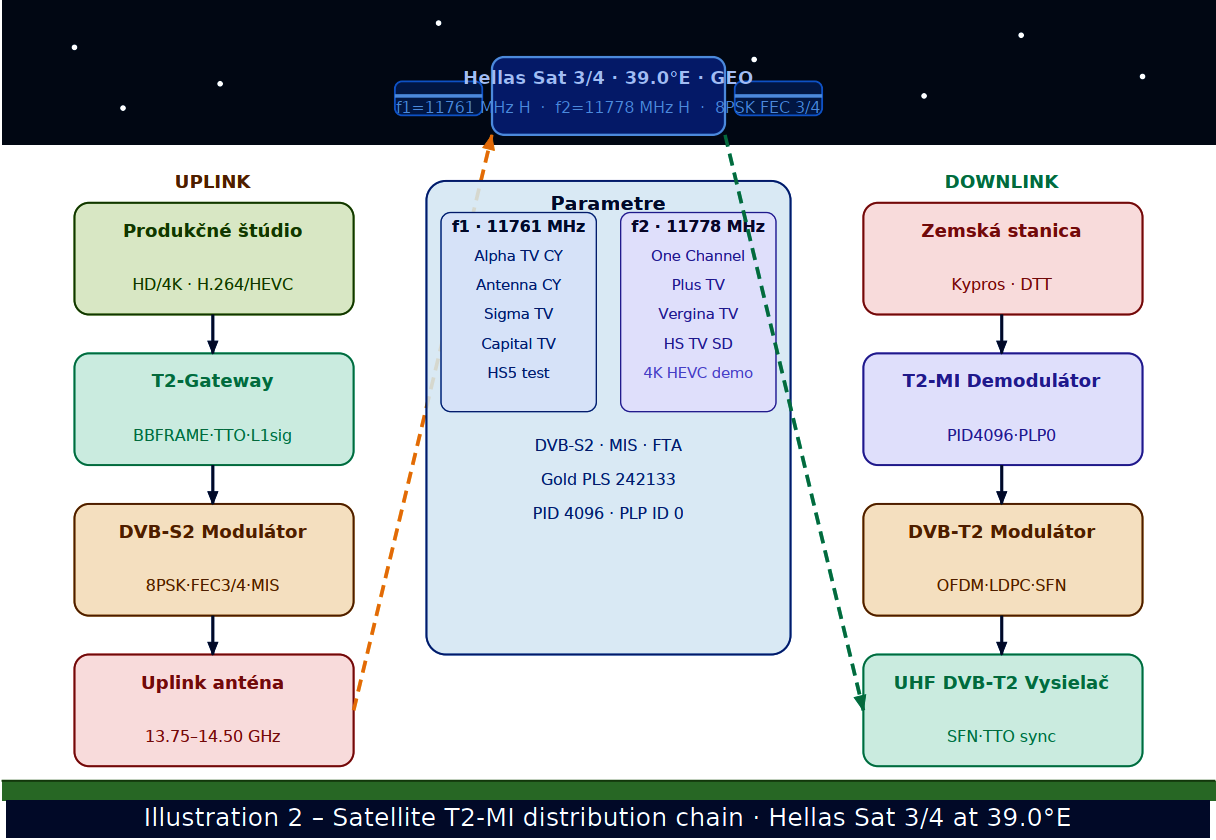
02: ENG_ Description: Satellite T2-MI distribution chain
The illustration comprehensively shows the entire distribution chain of the Cypriot DVB-T2 DTT system from the production studio to the home viewer, with the satellite Hellas Sat 3/4 at 39.0°E forming the centrepiece of the chain. The left side of the image (UPLINK) captures the terrestrial part of the signal path towards the satellite. In the production studio, programme content is created in H.264 (HD) and HEVC (4K UHD) formats. The T2-Gateway converts input transport streams into BBFRAME structures, generates L1 signalling and inserts TTO time stamps for SFN synchronisation. The DVB-S2 modulator encapsulates the T2-MI stream into a DVB-S2 carrier with 8PSK modulation, FEC 3/4 and Multistream configuration (Gold PLS code 242,133). The uplink antenna transmits in the 13.75–14.50 GHz band. The central panel shows the technical parameters of both transponders. Transponder f1 (11,761 MHz H) carries Alpha TV Cyprus, Antenna Cyprus, Sigma TV, Capital TV and HS5 (test channel) in HD resolution with H.264 AVC codec. Transponder f2 (11,778 MHz H) carries One Channel, Plus TV, Vergina TV, Hellas Sat TV (SD) and a 4K UHD
demonstration channel with HEVC/H.265 codec. The right side of the image (DOWNLINK) shows the reception and processing of the signal on the Cyprus ground side. The earth station receives the Ku-band downlink (10.70–12.75 GHz). The T2-MI demodulator extracts the T2-MI stream from PID 4096 using the correctly configured Gold PLS code. The DVB-T2 modulator applies OFDM modulation, LDPC+BCH FEC coding and generates a UHF RF signal. The UHF DVB-T2 transmitter distributes the signal into the SFN network with TTO synchronisation. The entire distribution chain is designed to support up to 8 UHF broadcast channels in 4 SFN networks covering the whole island. Both transponders: DVB-S2 · 8PSK · SR 15,157 ksps · FEC 3/4 · MIS · IS_ID=0 · Gold PLS 242,133 · T2-MI PID 4096 (0x1000) · FTA
03: ENG_Description: DVB-T2/T2-MI receiver and Troodos SFN mechanism
The illustration is divided into two parts: the upper part (block diagram of the DVB-T2/T2-MI receiver) and the lower part (physical mechanism of SFN on Mount Troodos). Upper part – receiver block diagram: The DVB-S2 tuner receives the satellite signal from Hellas Sat 3/4 in the Ku-band. To receive the Cypriot T2-MI service, the tuner must support Multistream (MIS) and must have the Gold PLS code 242,133 and IS_ID=0 configured. The2-MI Extractor extracts the T2-MI packet stream from PID 4096 and decapsulates the BBFRAME structures carrying PLP ID 0. The DVB-T2 demodulator applies OFDM demodulation (FFT 1K–32K), LDPC+BCH FEC decoding and 256-QAM demodulation. The video decoder processes H.264 AVC (HD channels) and HEVC/H.265 (4K UHD demonstration). Output channels include Alpha TV, Antenna Cyprus, Sigma TV, Capital TV, One Channel, Plus TV, Vergina TV and Hellas Sat TV. Lower part – Troodos SFN mechanism: The illustration shows the mountain profile of Cyprus with the Troodos peak (1,952 m a.s.l.) in the centre. Transmitter Tx A on the Troodos summit has the largest coverage area due to its altitude. Transmitter Tx B (Paphos area) covers the western shadow zones, Transmitter Tx C (Famagusta) covers the eastern parts. The key element of SFN functionality is the Guard Interval (GI). The bar chart in the lower part shows the time structure of the OFDM symbol: the blue part represents the useful symbol (Tu), the orange part is the Guard Interval. The DVB-T2 standard with 32K FFT and GI=1/4 provides a guard interval of approximately 224 µs, corresponding to a distance of up to 67 km. Since the distance between Troodos and the coast is 35–40 km, all echoes from neighbouring transmitters fall within this window and the receiver integrates them constructively, resulting in a higher SNR in shadowed areas without any special modification of the receiver. The T2-MI satellite distribution ensures that all transmitters in the SFN network broadcast the identical T2-frame at the same time – the SFN synchronisation condition is met by the TTO time stamps in the T2-MI packet. Reception requirements: DVB-S2 tuner with MIS · Gold PLS 242,133 · T2-MI decoder · DVB-T2 (T2-Base) · H.264/AVC · HEVC/H.265 recommended for 4K
01 : DE_Beschreibung: DVB-T2 SFN-Verteilung auf Zypern
Die Illustration zeigt die Insel Zypern mit ihren vier synchronisierten Gleichwellennetzen (SFN) für das digitale terestrische Fernsehen (DVB-T2 DTT). Jedes SFN-Netz ist durch eine eigene Farbe gekennzeichnet und entspricht einer bestimmten geografischen Region der Insel.Das Troodos-Gebirgsmassiv (max. 1.952 m ü. NN) dominiert die Bildmitte und bildet
sowohl den höchsten Punkt der Insel als auch den wichtigsten Standort für die terrestrische Ausstrahlung. Der Sender T1 auf dem Troodos-Gipfel deckt dank seiner Höhenlage die größte Fläche ab, einschließlich der Südküste und der Täler.
Der Satellit Hellas Sat 3/4 auf der geostationären Umlaufbahn (39,0° Ost) ist im oberen Bildbereich dargestellt. Gestrichelte Diagonallinien stellen die T2-MI-Satellitenstrecken dar, die synchronisierte T2-MI-Datenströme (einschließlich präziser TTO-Zeitmarken) zu jedem terrestrischen Sender liefern. Dieser Ansatz macht lokale GPS-Synchronisatoren an jedem Mast überflüssig. Die farbigen Ellipsen in den Tälern und an der Küste repräsentieren die Versorgung der einzelnen SFN-Netze: grün (Troodos T1), orange (Limassol T2), blau (Nikosia T3) und violett (Famagusta T4). Die gegenseitige Überlappung der Versorgung in den Tälern erzeugt den SFN-Effekt: Ein Empfänger empfängt Signale von mehreren Sendern, und Echos, die innerhalb des Schutzintervalls eintreffen, addieren sich konstruktiv. Die Legende links unten identifiziert die einzelnen SFN-Netze. Das gesamte Netz ist Hellas Sat für den Zeitraum 1. Dezember 2025 – 9. November 2040 lizenziert. Technische Parameter: Gold-PLS-Code 242.133 · T2-MI PID 4096 · SR 15.157 ksps · 8PSK FEC 3/4 · FTA Free-To-Air
02:DE_Beschreibung: Satelliten-T2-MI-Verteilungskette
Die Illustration zeigt umfassend die gesamte Verteilungskette des zypriotischen DVB-T2-DTT-Systems vom Produktions-studio bis zum Heimzuschauer, wobei der Satellit Hellas Sat 3/4 bei 39,0° O das Herzstück der Kette bildet. Die linke Seite (UPLINK) zeigt den terrestrischen Teil des Signalwegs zum Satelliten. Im Produktionsstudio wird Programminhalte in den Formaten H.264 (HD) und HEVC (4K UHD) erstellt. Das T2-Gateway wandelt Eingangs-Transportströme in BBFRAME-Strukturen um, erzeugt die L1-Signalisierung und fügt TTO-Zeitmarken für die SFN-Synchronisation ein. Der DVB-S2-Modulator kapselt den T2-MI-Strom in einen DVB-S2-Träger mit 8PSK-Modulation, FEC 3/4 und Multistream-Konfiguration (Gold-PLS-Code 242.133) ein. Die Uplink-Antenne sendet im Band 13,75–14,50 GHz. Das mittlere Feld zeigt die technischen Parameter beider Transponder. Transponder f1 (11.761 MHz H) trägt Alpha TV Cyprus, Antenna Cyprus, Sigma TV, Capital TV und HS5 (Testkanal) in HD-Auflösung mit dem H.264-AVC-Codec. Transponder f2 (11.778 MHz H)
trägt One Channel, Plus TV, Vergina TV, Hellas Sat TV (SD) und einen 4K-UHD-Demonstrationskanal mit HEVC/H.265-Codec. Die rechte Seite (DOWNLINK) zeigt den Empfang und die Verarbeitung des Signals auf der zypriotischen Bodenstation. Die Bodenstation empfängt den Ku-Band-Downlink (10,70–12,75 GHz). Der T2-MI-Demodulator extrahiert den T2-MI-Strom aus PID 4096 unter Verwendung des korrekt konfigurierten Gold-PLS-Codes. Der DVB-T2-Modulator
wendet OFDM-Modulation, LDPC+BCH-FEC-Codierung an und erzeugt ein UHF-HF-Signal. Der UHF-DVB-T2-Sender verteilt das Signal im SFN-Netz mit TTO-Synchronisation. Die gesamte Verteilungskette ist ausgelegt, um bis zu 8 UHF-Ausstrahlungskanäle in 4 SFN-Netzen zu unterstützen, die die gesamte Insel abdecken. Beide Transponder: DVB-S2 · 8PSK · SR 15.157 ksps · FEC 3/4 · MIS · IS_ID=0 · Gold PLS 242.133 · T2-MI PID 4096 (0x1000) · FTA
03:DE_ Beschreibung: DVB-T2/T2-MI-Empfänger und Troodos-SFN-Mechanismus
Die Illustration ist in zwei Teile gegliedert: den oberen Teil (Blockschaltbild des DVB-T2/T2-MI-Empfängers) und den unteren Teil (physikalischer SFN-Mechanismus am Troodos-Gebirge).
Oberer Teil – Empfänger-Blockschaltbild: Der DVB-S2-Tuner empfängt das Satellitensignal von Hellas Sat 3/4 im Ku-Band. Für den Empfang des zypriotischen T2-MI-Dienstes muss der Tuner Multistream (MIS) unterstützen und den Gold-PLS-Code 242.133 sowie IS_ID=0 konfiguriert haben. Der T2-MI-Extraktor extrahiert den T2-MI-Paketstrom aus PID 4096
und dekapseult die BBFRAME-Strukturen mit PLP-ID 0. Der DVB-T2-Demodulator führt OFDM-Demodulation (FFT 1K–32K), LDPC+BCH-FEC-Dekodierung und 256-QAM-Demodulation durch. Der Videodekoder verarbeitet H.264 AVC (HD-Kanäle) und HEVC/H.265 (4K-UHD-Demonstration). Zu den Ausgangskanälen gehören Alpha TV, Antenna Cyprus, Sigma TV, Capital TV, One Channel, Plus TV, Vergina TV und Hellas Sat TV. Unterer Teil – Troodos-SFN-Mechanismus: Die Illustration zeigt das Bergprofil Zyperns mit dem Troodos-Gipfel (1.952 m ü. NN) in der Mitte. Der Sender Tx A auf dem Troodos-Gipfel hat dank seiner Höhenlage das größte Versorgungsgebiet. Sender Tx B (Region Paphos) deckt die westlichen Schattenzonen ab, Sender Tx C (Famagusta) die östlichen Teile. Das Schlüsselelement der SFN-Funktionalität ist das Schutzintervall (Guard Interval, GI). Das Balkendiagramm im unteren Teil zeigt die Zeitstruktur des OFDM-Symbols: Der blaue Teil stellt das Nutzsymbol (Tu) dar, der orangefarbene Teil ist das Schutzintervall. Der DVB-T2-Standard mit 32K-FFT und GI=1/4 bietet ein Schutzintervall von ca. 224 µs, was einer Distanz von bis zu 67 km entspricht. Da die Entfernung zwischen Troodos und der Küste 35–40 km beträgt, fallen alle Echos von benachbarten Sendern in dieses Fenster, und der Empfänger integriert sie konstruktiv, was zu einem höheren SNR in Schattenbereichen führt. Die T2-MI-Satellitenverteilung stellt sicher, dass alle Sender im SFNNetz denselben T2-Rahmen zum gleichen Zeitpunkt-ausstrahlen – die SFN-Synchronisationsbedingung wird durch die TTO-Zeitmarken im T2-MI-Paket erfüllt. Empfangsanforderungen: DVB-S2-Tuner mit MIS · Gold PLS 242.133 · T2-MI-Dekoder · DVB-T2 (T2-Base) · H.264/AVC · HEVC/H.265 empfohlen für 4K
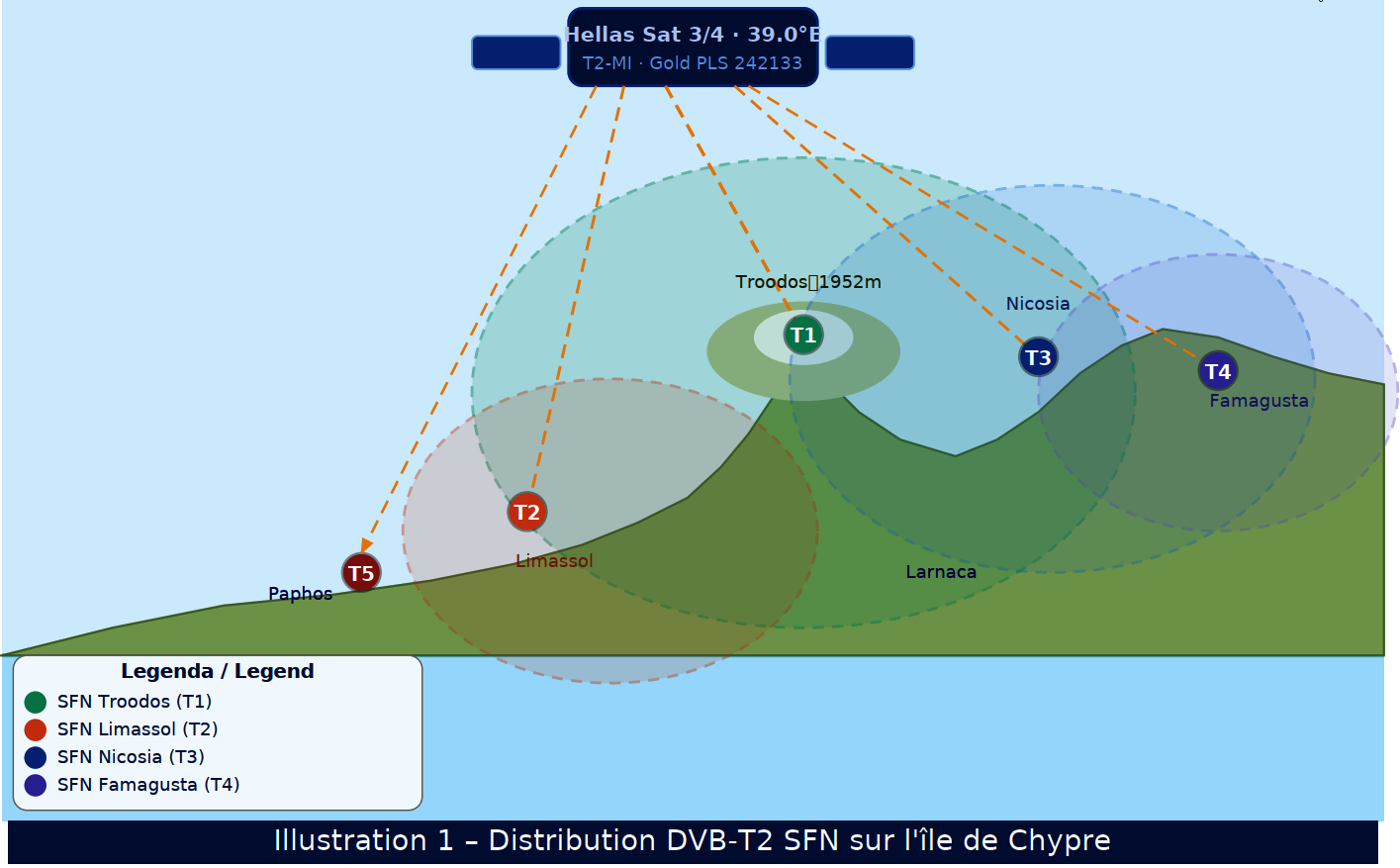
01: FR_ Description: Distribution DVB-T2 SFN à Chypre
L'illustration montre l'île de Chypre avec ses quatre réseaux monofréquence (SFN) synchronisés pour la télévision nu-mérique terrestre (TNT DVB-T2). Chaque réseau SFN est identifié par sa propre couleur et correspond à une région géographique spécifique de l'île. Le massif montagneux du Troodos (max. 1 952 m d'altitude) domine le centre de l'image et constitue à la fois le point le plus élevé de l'île et le site le plus important pour la diffusion terrestre. L'émetteur T1 au sommet du Troodos couvre la plus grande superficie grâce à son altitude, y compris la côte sud et les vallées. Le satellite Hellas Sat 3/4 sur orbite géostationnaire (39,0° Est) est représenté en haut de l'image. Des lignes diagonales en pointillés représentent les liaisons satellite T2-MI quiacheminent des flux de données T2-MI synchronisés (incluant des horodatages TTO précis) vers chaque émetteur terrestre, éliminant ainsi le besoin de synchroniseurs GPS locaux à chaque pylône. Les ellipses colorées dans les vallées et sur la côte représentent la couverture des réseaux SFN individuels: vert (Troodos T1), orange (Limassol T2), bleu (Nicosie T3) et violet (Famagouste T4). Le chevauchement mutuel des couvertures dans les vallées crée l'effet SFN: un récepteur reçoit des signaux de plusieurs émetteurs, et les échos arrivant dans
l'intervalle de garde s'additionnent de manière constructive. La légende en bas à gauche identifie les réseaux SFN individuels. L'ensemble du réseau est concédé sous licence à Hellas Sat pour la période du 1er décembre 2025 au 9 novembre 2040. Paramètres techniques: Code Gold PLS 242 133 · T2-MI PID 4096 · SR 15 157 ksps · 8PSK FEC 3/4 · FTA Free-To-Air.
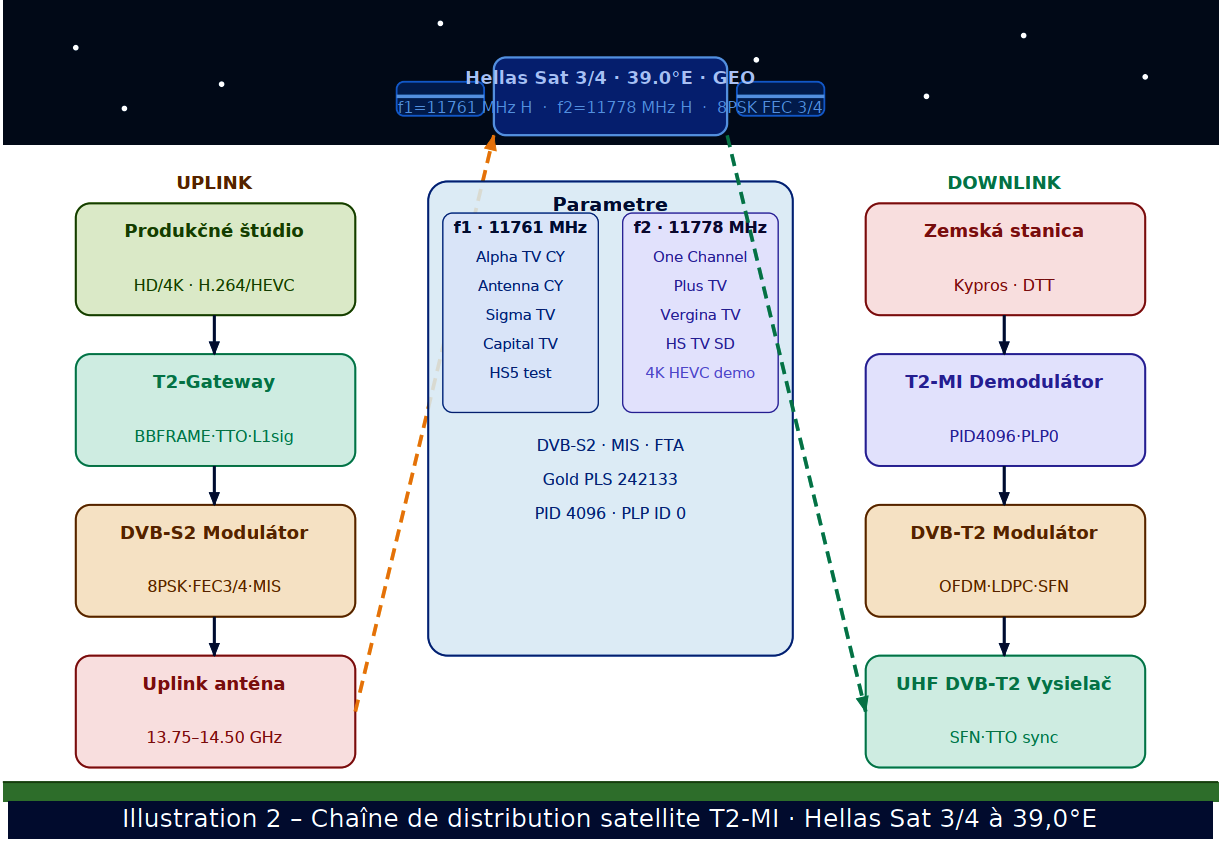
02:FR_Description: Chaîne de distribution satellite T2-MI
L'illustration montre de manière exhaustive toute la chaîne de distribution du système TNT DVB-T2 chypriote, du studio de production au téléspectateur à domicile, le satellite Hellas Sat 3/4 à 39,0°E constituant la pièce maîtresse de la chaîne.
Le côté gauche (UPLINK) représente la partie terrestre du chemin du signal vers le satellite. Dans le studio de production, le contenu des programmes est créé aux formats H.264 (HD) et HEVC (4K UHD). Le T2-Gateway convertit les flux de transport d'entrée en structures BBFRAME, génère la signalisation L1 et insère des horodatages TTO pour la synchro-nisation SFN. Le modulateur DVB-S2 encapsule le flux T2-MI dans un porteur DVB-S2 avec modulation 8PSK, FEC 3/4 et configuration Multistream (code Gold PLS 242 133). L'antenne de montée de faisceau émet dans la bande 13,75–14,50 GHz. Le panneau central montre les paramètres techniques des deux transpondeurs. Le transpondeur f1 (11 761 MHz H) porte Alpha TV Cyprus, Antenna Cyprus, Sigma TV, Capital TV et HS5 (chaîne de test) en résolution HD avec le codec H.264 AVC. Le transpondeur f2 (11 778 MHz H) porte One Channel, Plus TV, Vergina TV, Hellas Sat TV (SD) et une chaîne de démonstration 4K UHD avec le codec HEVC/H.265. Le côté droit (DOWNLINK) montre la réception et le traitement du signal du côté chypriote. La station terrestre reçoit la liaison descendante en bande Ku (10,70–12,75 GHz). Le démo-dulateur T2-MI extrait le flux T2-MI du PID 4096 en utilisant le code Gold PLS correctement configuré. Le modulateur DVB-T2 applique la modulation OFDM, le codage FEC LDPC+BCH et génère un signal RF UHF. L'émetteur UHF DVB-T2 distribue le
signal dans le réseau SFN avec synchronisation TTO. L'ensemble de la chaîne de distribution est conçu pour supporter jusqu'à 8 canaux de diffusion UHF dans 4 réseaux SFN couvrant toute l'île. Les deux transpondeurs: DVB-S2 · 8PSK · SR 15 157 ksps · FEC 3/4 · MIS · IS_ID=0 · Gold PLS 242 133 · T2-MI PID 4096 (0x1000) · FTA
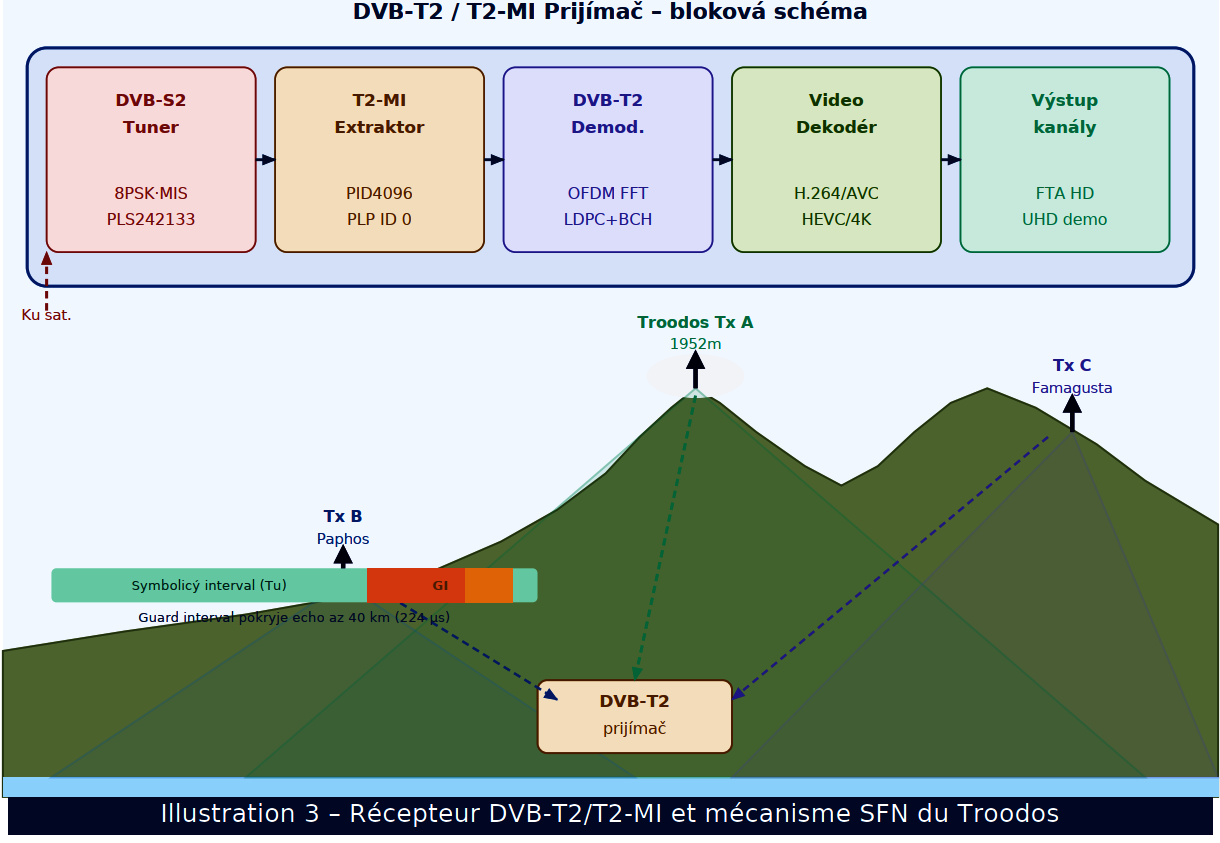
03:FR_ Description: Récepteur DVB-T2/T2-MI et mécanisme SFN du Troodos
L'illustration est divisée en deux parties: la partie supérieure (schéma fonctionnel du récepteur DVB-T2/T2-MI) et la partie inférieure (mécanisme physique du SFN sur le mont Troodos).
Partie supérieure – schéma fonctionnel du récepteur: Le tuner DVB-S2 reçoit le signal satellite de Hellas Sat 3/4 en bande Ku. Pour recevoir le service T2-MI chypriote, le tuner doit prendre en charge le Multistream (MIS) et avoir le code Gold PLS 242 133 et IS_ID=0 configurés. L'extracteur T2-MI extrait le flux de paquets T2-MI du PID 4096 et décapsule
les structures BBFRAME portant le PLP ID 0. Le démodulateur DVB-T2 applique la démodulation OFDM (FFT 1K–32K), le décodage FEC LDPC+BCH et la démodulation 256-QAM. Le décodeur vidéo traite H.264 AVC (chaînes HD) et HEVC/H.265 (démonstration 4K UHD). Les chaînes de sortie comprennent Alpha TV, Antenna Cyprus, Sigma TV, Capital TV, One Channel, Plus TV, Vergina TV et Hellas Sat TV. Partie inférieure – mécanisme SFN du Troodos: L'illustration montre le profil montagneux de Chypre avec le sommet du Troodos (1 952 m d'altitude) au centre. L'émetteur Tx A au sommet du Troodos a la plus grande zone de couverture grâce à son altitude. L'émetteur Tx B (région de Paphos) couvre leszones d'ombre occidentales, l'émetteur Tx C (Famagouste) couvre les parties orientales. L'élément clé de la fonctionnalité SFN est l'intervalle de garde (Guard Interval, GI). Le diagramme à barres dans la partie inférieure montre la structure temporelle du symbole OFDM: la partie bleue représente le symbole utile (Tu), la partie orange est l'intervalle de garde. La norme DVB-T2 avec FFT 32K et GI=1/4 fournit un intervalle de garde d'environ 224 µs, correspondant à une distance allant jusqu'à 67 km. La distance entre le Troodos et la côte étant de 35 à 40 km, tous les échos des émetteurs voisins tombent dans cette fenêtre et le récepteur les intègre de manière constructive. La distribution satellite T2-MI garantit que tous les émetteurs du réseau SFN diffusent la même trame T2 au même moment: la condition de synchronisation SFN est satisfaite par les horodatages TTO dans le paquet T2-MI. Exigences de réception: Tuner DVB-S2 avec MIS · Gold PLS 242 133 · Décodeur T2-MI · DVB-T2 (T2-Base) · H.264/AVC · HEVC/H.265 recommandé pour 4K.
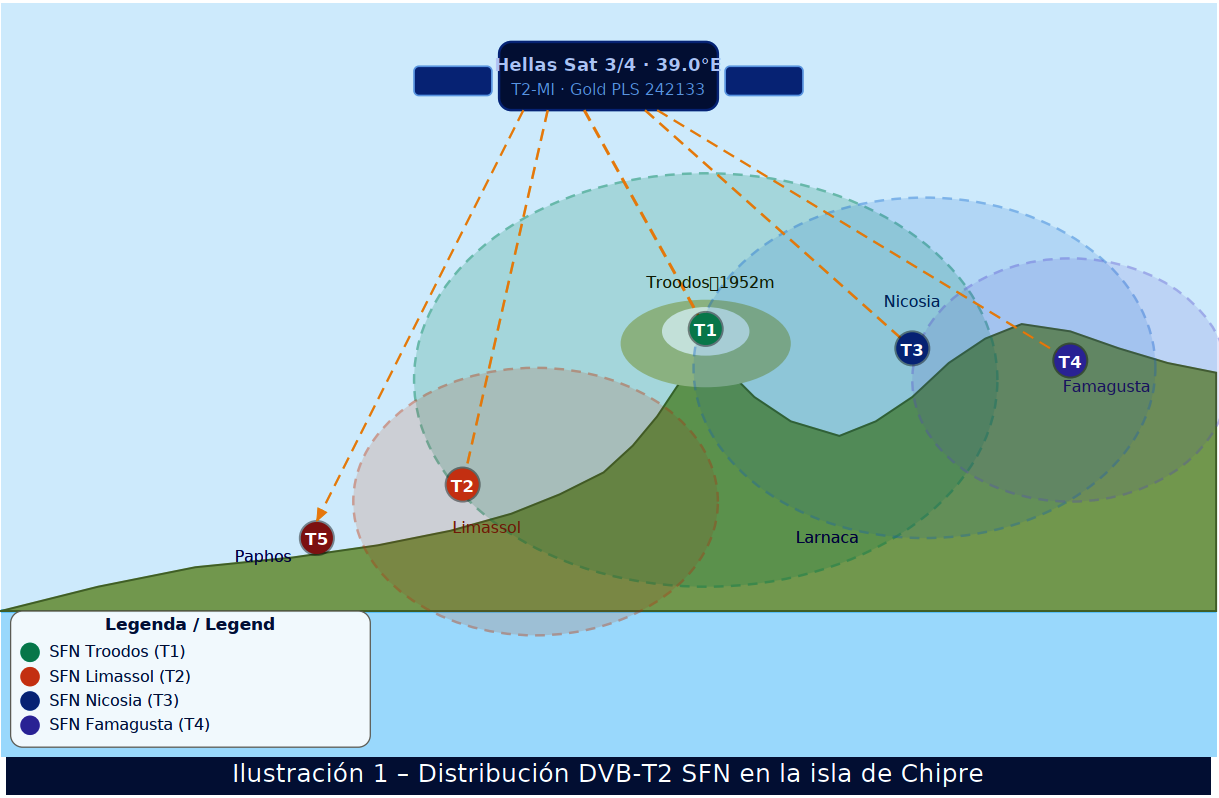
01:ES_ Descripción: Distribución DVB-T2 SFN en Chipre
La ilustración muestra la isla de Chipre con sus cuatro redes de frecuencia única (SFN) sincronizadas para la televisión digital terrestre (TDT DVB-T2). Cada red SFN se identifica con su propio color y corresponde a una región geográfica específica de la isla. El macizo montañoso del Troodos (máx. 1.952 m s.n.m.) domina el centro de la imagen y constituye tanto el punto más alto de la isla como el emplazamiento más importante para la radiodifusión terrestre. El transmisor T1 en la cumbre del Troodos cubre la mayor área gracias a su altitud, incluida la costa sur y los valles. El satélite Hellas Sat 3/4 en órbita geoestacionaria (39,0° Este) aparece en la parte superior de la imagen. Las líneas diagonales de puntos representan los enlaces satélite T2-MI que entregan flujos de datos T2-MI sincronizados (incluidas marcas de tiempo TTO precisas) a cada transmisor terrestre, eliminando la necesidad de sincronizadores GPS locales en cada mástil.
Las elipses de colores en los valles y en la costa representan la cobertura de las redes SFN individuales: verde (Troodos T1), naranja (Limassol T2), azul (Nicosia T3) y morado (Famagusta T4). La superposición mutua de coberturas en los valles crea el efecto SFN: un receptor recibe señales de varios transmisores, y los ecos que llegan dentro del intervalo
de guarda se suman de forma constructiva. La leyenda en la esquina inferior izquierda identifica las redes SFN individuales. Toda la red está licenciada a Hellas Sat para el período del 1 de diciembre de 2025 al 9 de noviembre de 2040.
Parámetros técnicos: Código Gold PLS 242 133 · T2-MI PID 4096 · SR 15 157 ksps · 8PSK FEC 3/4 · FTA Free-To-Air
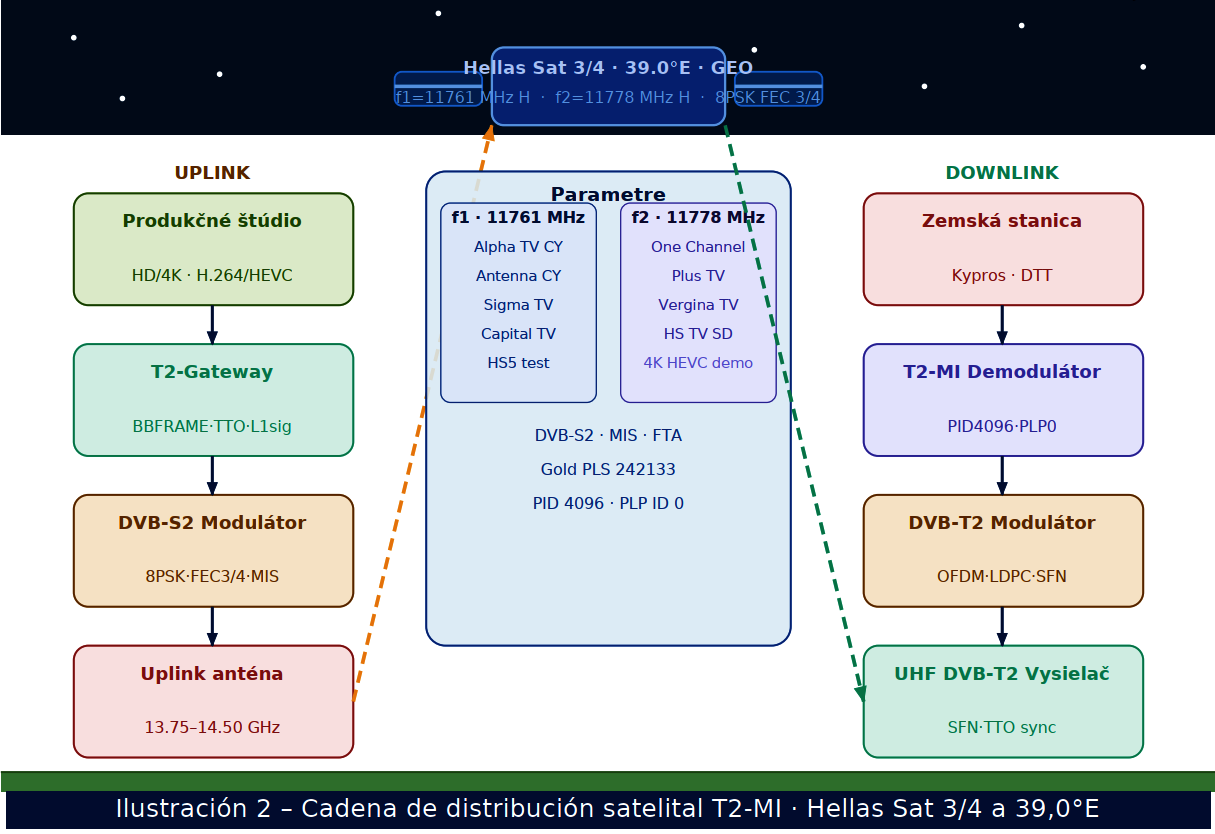
02: ES_ Descripción: Cadena de distribución satelital T2-MI
La ilustración muestra de forma exhaustiva toda la cadena de distribución del sistema TDT DVB-T2 chipriota, desde el estudio de producción hasta el telespectador en casa, siendo el satélite Hellas Sat 3/4 a 39,0°E el elemento central de la cadena. El lado izquierdo (UPLINK) captura la parte terrestre del camino de la señal hacia el satélite. En el estudio de producción se crea el contenido de los programas en los formatos H.264 (HD) y HEVC (4K UHD). El T2-Gateway convierte los flujos de transporte de entrada en estructuras BBFRAME, genera la señalización L1 e inserta marcas de tiempo TTO para la sincronización SFN. El modulador DVB-S2 encapsula el flujo T2-MI en una portadora DVB-S2 con modulación 8PSK, FEC 3/4 y configuración Multistream (código Gold PLS 242 133). La antena de subida transmite en la banda 13,75–14,50 GHz. El panel central muestra los parámetros técnicos de ambos transpondedores. El transpondedor f1 (11 761 MHz H) lleva Alpha TV Cyprus, Antenna Cyprus, Sigma TV, Capital TV y HS5 (canal de prueba) en resolución HD con el códec H.264 AVC. El transpondedor f2 (11 778 MHz H) lleva One Channel, Plus TV, Vergina TV, Hellas Sat TV (SD) y un canal de demostración 4K UHD con el códec HEVC/H.265.El lado derecho (DOWNLINK) muestra la recepción y el procesamiento de la señal en el lado chipriota. La estación terrena recibe el enlace descendente en banda Ku (10,70–12,75 GHz). El demodulador T2-MI extrae el flujo T2-MI del PID 4096 utilizando el código Gold PLS configurado correctamente. El modulador DVB-T2 aplica modulación OFDM, codificación FEC LDPC+BCH y genera una señal RF UHF. El transmisor UHF DVB-T2 distribuye la señal en la red SFN con sincronización TTO.Toda la cadena de distribución está diseñada para soportar hasta 8 canales de emisión UHF en 4 redes SFN que cubren toda la isla. Ambos transpondedores: DVB-S2 · 8PSK · SR 15 157 ksps · FEC 3/4 · MIS · IS_ID=0 · Gold PLS 242 133 · T2-MI PID 4096 (0x1000) · FTA
03: ES_Descripción: Receptor DVB-T2/T2-MI y mecanismo SFN del Troodos
La ilustración está dividida en dos partes: la parte superior (diagrama de bloques del receptor DVB-T2/T2-MI) y la parte inferior (mecanismo físico del SFN en el monte Troodos). Parte superior – diagrama de bloques del receptor: El sintonizador DVB-S2 recibe la señal satelital de Hellas Sat 3/4 en banda Ku. Para recibir el servicio T2-MI chipriota, el
sintonizador debe admitir Multistream (MIS) y tener configurados el código Gold PLS 242 133 e IS_ID=0. El extractor T2-MI extrae el flujo de paquetes T2-MI del PID 4096 y descapsula las estructuras BBFRAME que llevan el PLP ID 0. El demodulador DVB-T2 aplica demodulación OFDM (FFT 1K–32K), decodificación FEC LDPC+BCH y demodulación 256-QAM. El decodificador de vídeo procesa H.264 AVC (canales HD) y HEVC/H.265 (demostración 4K UHD). Los canales de salida incluyen Alpha TV, Antenna Cyprus, Sigma TV, Capital TV, One Channel, Plus TV, Vergina TV y Hellas Sat TV. Parte inferior – mecanismo SFN del Troodos: La ilustración muestra el perfil montañoso de Chipre con la cumbre del Troodos (1.952 m s.n.m.) en el centro. El transmisor Tx A en la cumbre del Troodos tiene la mayor área de cobertura gracias a su altitud. El transmisor Tx B (área de Pafos) cubre las zonas de sombra occidentales, el transmisor Tx C (Famagusta)
cubre las partes orientales. El elemento clave de la funcionalidad SFN es el intervalo de guarda (Guard Interval, GI). El
diagrama de barras en la parte inferior muestra la estructura temporal del símbolo OFDM: la parte azul representa el símbolo útil (Tu), la parte naranja es el intervalo de guarda. El estándar DVB-T2 con FFT 32K y GI=1/4 proporciona un intervalo de guarda de aproximadamente 224 µs, correspondiente a una distancia de hasta 67 km. Como la distancia entre el Troodos y la costa es de 35 a 40 km, todos los ecos de los transmisores vecinos caen dentro de esta ventana y el receptor los integra de forma constructiva. La distribución satelital T2-MI garantiza que todos los transmisores de la red SFN emitan la trama T2 idéntica al mismo tiempo: la condición de sincronización SFN se cumple mediante las marcas de tiempo TTO en el paquete T2-MI. Requisitos de recepción: Sintonizador DVB-S2 con MIS · Gold PLS 242 133 · Decodificador T2-MI · DVB-T2 (T2-Base) · H.264/AVC · HEVC/H.265 recomendado para 4K
01: RU_ Описание: Распределение DVB-T2 SFN на Кипре
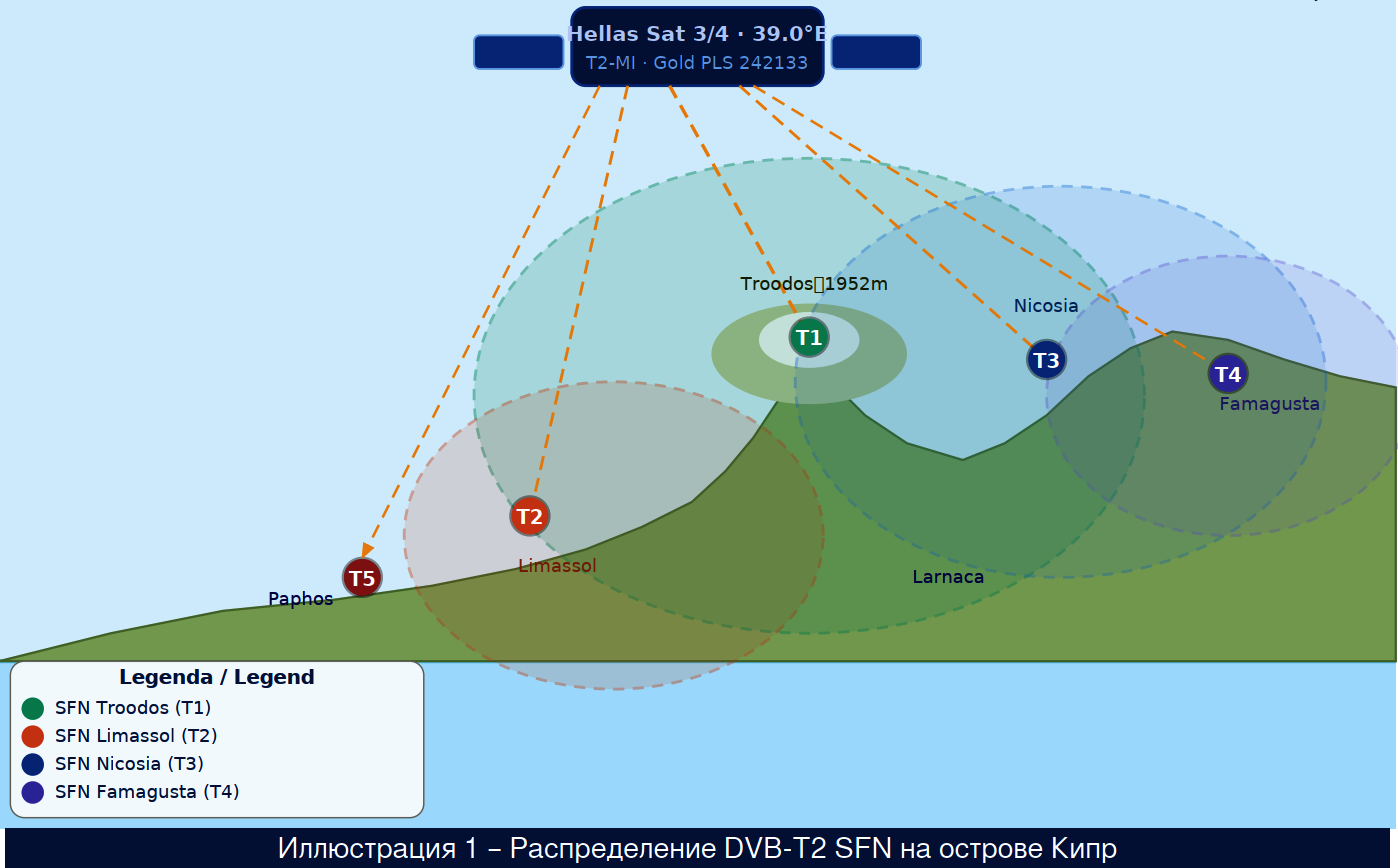
Иллюстрация показывает остров Кипр с четырьмя синхронизированными одночастотными сетями (SFN) для
цифрового эфирного телевидения (DVB-T2 DTT). Каждая сеть SFN обозначена своим цветом и соответствует
определённому географическому региону острова. Горный массив Троодос (макс. 1952 м н.у.м.) доминирует в центре изображения и является одновременно высшей точкой острова и важнейшим местом для наземного вещания. Передатчик T1 на вершине Троодоса благодаря своей высоте покрывает наибольшую площадь, включая южное побережье и долины. Спутник Hellas Sat 3/4 на геостационарной орбите (39,0° в.д.) показан в верхней части рисунка. Пунктирные диагональные линии обозначают спутниковые каналы T2-MI, по которым синхронизированные потоки данных T2-MI (включая точные временные метки TTO) доставляются к каждому наземному передатчику, что исключает необходимость в локальных GPS-синхронизаторах на каждой мачте.
Цв тные эллипсы в долинах и на побережье представляют зоны покрытия отдельных сетей SFN: зелёная
(Троодос T1), оранжевая (Лимасол T2), синяя (Никосия T3) и фиолетовая (Фамагуста T4). Взаимное
перекрытие зон покрытия в долинах создаёт эффект SFN: приёмник получает сигналы от нескольких
передатчиков, и эхо-сигналы, приходящие в пределах защитного интервала, складываются конструктивно.
Легенда в левом нижнем углу идентифицирует отдельные сети SFN. Вся сеть лицензирована компании Hellas
Sat на период с 1 декабря 2025 по 9 ноября 2040 года. Технические параметры: Gold PLS-код 242 133 · T2-MI PID 4096 · SR 15 157 ксим/с · 8PSK FEC 3/4 · FTA Free-To-Air
02:RU_ Описание: Спутниковая цепочка распределения T2-MI
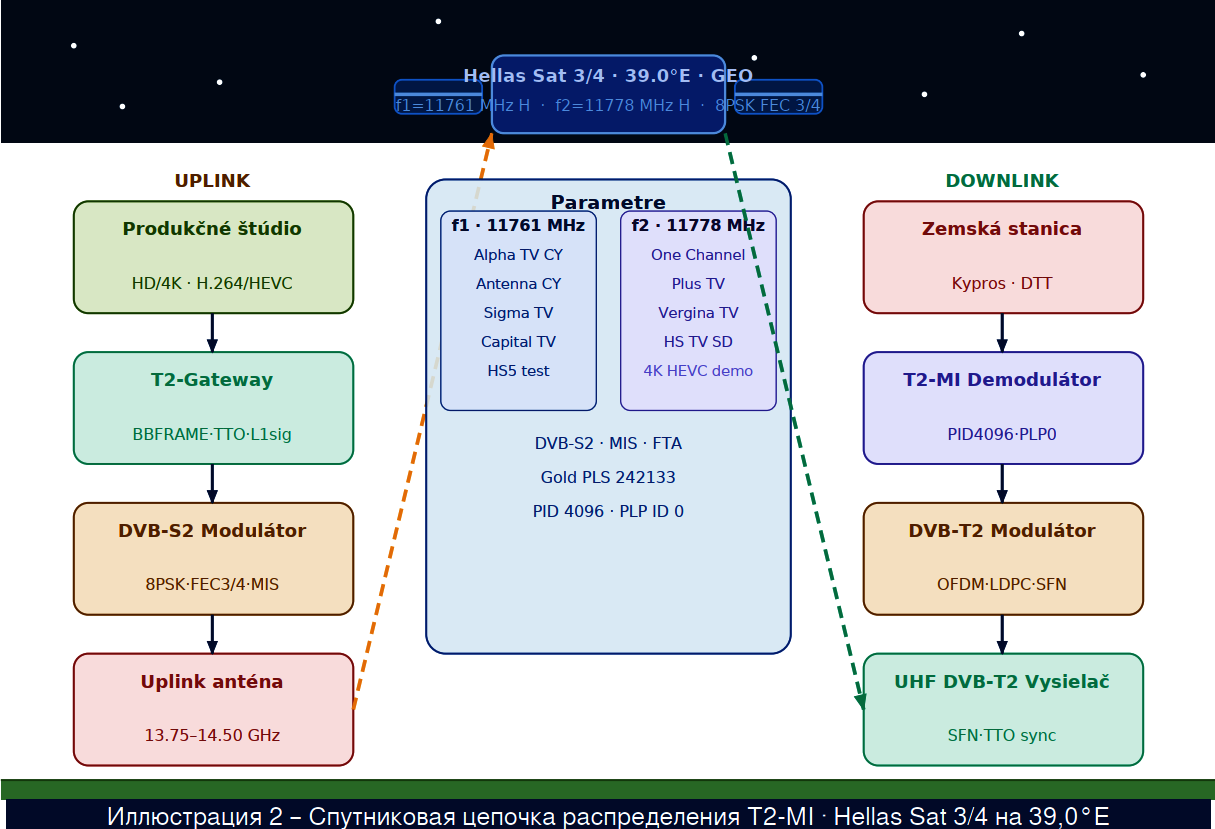
Иллюстрация исчерпывающим образом показывает всю цепочку распределения кипрской системы DVB-T2
DTT от производственной студии до домашнего зрителя, при этом спутник Hellas Sat 3/4 на 39,0° в.д.
является центральным элементом цепочки. Левая сторона (UPLINK) показывает наземную часть пути сигнала к спутнику. В производственной студии создаётся программный контент в форматах H.264 (HD) и HEVC (4K UHD). T2-Gateway преобразует входные транспортные потоки в структуры BBFRAME, генерирует L1-сигнализацию и вставляет временные метки TTO для синхронизации SFN. Модулятор DVB-S2 инкапсулирует поток T2-MI в несущую DVB-S2 с модуляцией 8PSK, FEC 3/4 и конфигурацией Multistream (Gold PLS-код 242 133). Антенна восходящего канала передаёт в диапазоне 13,75–14,50 ГГц. Центральная панель показывает технические параметры обоих транспондеров. Транспондер f1 (11 761 МГц H) несёт Alpha TV Cyprus, Antenna Cyprus, Sigma TV, Capital TV и HS5 (тестовый канал) в HD-разрешении с кодеком H.264 AVC. Транспондер f2 (11 778 МГц H) несёт One Channel, Plus TV, Vergina TV, Hellas Sat TV (SD) и демонстрационный канал 4K UHD с кодеком HEVC/H.265.
Правая сторона (DOWNLINK) показывает приём и обработку сигнала на кипрской наземной стороне. Земная
станция принимает нисходящий канал в диапазоне Ku (10,70–12,75 ГГц). Демодулятор T2-MI извлекает
поток T2-MI из PID 4096, используя правильно настроенный Gold PLS-код. Модулятор DVB-T2 применяет
OFDM-модуляцию, кодирование FEC LDPC+BCH и генерирует УВЧ-радиосигнал. Передатчик УВЧ DVB-T2
распределяет сигнал в сети SFN с синхронизацией TTO. Вся цепочка распределения рассчитана на поддержку до 8 вещательных каналов УВЧ в 4 сетях SFN, охватывающих весь остров. Оба транспондера/f1+f2: DVB-S2 · 8PSK · SR 15 157 ксим/с · FEC 3/4 · MIS · IS_ID=0 · Gold PLS 242 133 · T2-MI PID 4096 (0x1000) · FTA
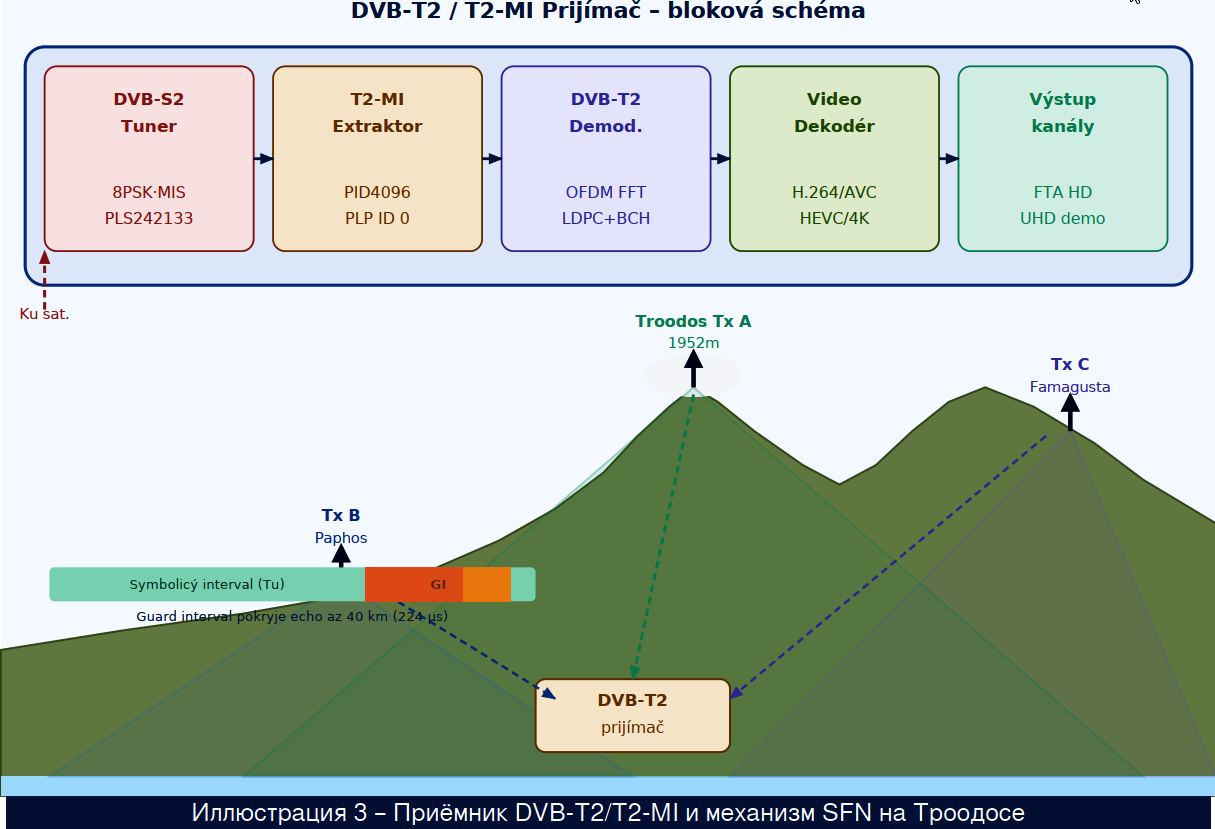
03:RU_Описание: Приёмник DVB-T2/T2-MI и механизм SFN на Троодосе
Иллюстрация разделена на две части: верхнюю (структурная схема приёмника DVB-T2/T2-MI) и нижнюю
(физический механизм SFN на горе Троодос). Верхняя часть – структурная схема приёмника: Тюнер DVB-S2 принимает спутниковый сигнал от Hellas Sat 3/4 в диапазоне Ku. Для приёма кипрской службы T2-MI тюнер должен поддерживать Multistream (MIS) ииметь настроенный Gold PLS-код 242 133 и IS_ID=0. Экстрактор T2-MI извлекает пакетный поток T2-MI изPID 4096 и декапсулирует структуры BBFRAME, несущие PLP ID 0. Демодулятор DVB-T2 выполняет OFDM-демодуляцию (БПФ 1K–32K), декодирование FEC LDPC+BCH и демодуляцию 256-QAM.
Видеодекодер обрабатывает H.264 AVC (HD-каналы) и HEVC/H.265 (демонстрация 4K UHD). Выходные каналы включают Alpha TV, Antenna Cyprus, Sigma TV, Capital TV, One Channel, Plus TV, Vergina TV и Hellas Sat TV.
Нижняя часть – механизм SFN на Троодосе: Иллюстрация показывает горный рельеф Кипра с вершиной
Троодос (1952 м н.у.м.) в центре. Передатчик Tx A на вершине Троодоса имеет наибольшую зону покрытия
благодаря своей высоте. Передатчик Tx B (район Пафоса) покрывает западные теневые зоны, передатчик Tx C
(Фамагуста) – восточные части. Ключевым элементом функциональности SFN является защитный интервал (Guard Interval, GI). Полосовая диаграмма в нижней части показывает временну структуру символа OFDM: синяя часть представляет полезный символ (Tu), оранжевая – защитный интервал. Стандарт DVB-T2 с БПФ 32K и GI=1/4 обеспечиваетзащитный интервал около 224 мкс, соответствующий расстоянию до 67 км. Поскольку расстояние между Троодосом и побережьем составляет 35–40 км, все эхо-сигналы от соседних передатчиков попадают в это
окно, и приёмник интегрирует их конструктивно, обеспечивая более высокое отношение сигнал/шум в теневых зонах. Спутниковое распределение T2-MI гарантирует, что все передатчики сети SFN вещают идентичный кадр T2 водно и то же время: условие синхронизации SFN выполняется временными метками TTO в пакете T2-MI.
Требования к приёму: Тюнер DVB-S2 с MIS · Gold PLS 242 133 · Декодер T2-MI · DVB-T2 (T2-Base) · H.264/AVC · HEVC/H.265 рекомендуется для 4K.